




When the dollar’s share of Central Banks’ FX reserves hit a two-decade low in 2025, talks about de-dollarisation intensified in many circles.
This was coupled with the fact that foreign ownership in the U.S. Treasury market had fallen over the previous 15 years, as noted by J.P. Morgan. They also noted that a larger share of energy is priced in currencies other than the USD.
Interestingly, just as these conversations were going on, the Iran war started. The panic that followed led investors to rush into USD-denominated safe-haven assets, underscoring the currency's importance in global markets.
By March 13, 2026, the dollar index (DXY) had crossed the $100 mark for the first time since November 2024. Yet concerns remain about the possible effects of war-induced stagflation on the US dollar.
In this article, we examine the US dollar outlook in the short, medium, and long term, and how institutional investors should navigate discussions on de-dollarisation and the future of the USD.
We’ll cover:
- Is de-dollarisation happening? Where the concerns lie
- Is de-dollarisation possible? Where the concerns don’t lie
- US dollar outlook: The short, medium, and long-term prospects of the USD
- Navigating the US dollar outlook: What institutional investors should do
Do you want more insights on how to diversify your portfolio between USD- and non-US-denominated assets? Subscribe now to the cio investment club’s newsletter for regular updates on sound portfolio management.
1. Is de-dollarisation happening? Where the concerns lie
J.P Morgan brought some clarity into the de-dollarisation discussion by highlighting the three areas where the dollar’s dominance is being challenged: central bank reserves, foreign ownership in Treasury securities, and the commodity markets.
Let’s focus on these three aspects for a moment.
Diversification of central bank reserves
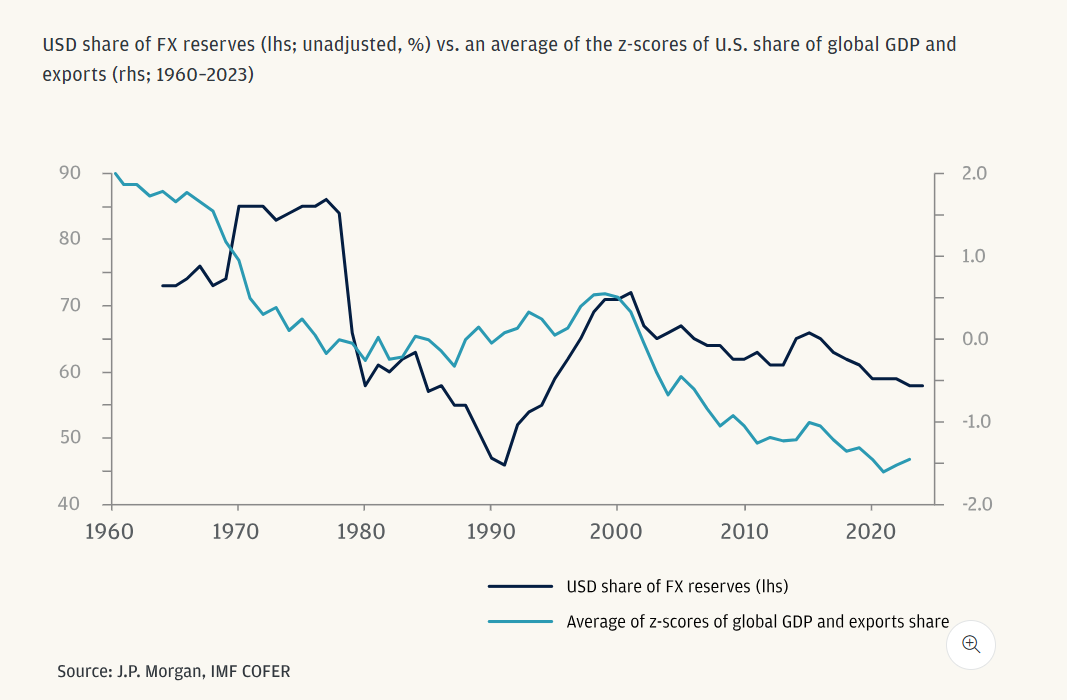
The USD’s share of central bank reserves hit a two-decade low when it fell below 60% in 2023, as seen in the chart below:
USD Share of FX Reserves, 1960-2023
Source: J.P. Morgan
At the end of 2024, it was 58.52% of total FX reserves, according to data from the International Monetary Fund. The latest (quarterly) data shows that it was down to 56.92% at the end of Q3, 2025.
But what is responsible for this shift?
Though there has been a diversification to other currencies, it is the demand for gold that has been the major factor.
“One of the factors that has been responsible for the rebundling away from USD concentration at the margins is the increasing role of gold as a reserve diversifier,” according to Brandon Stanley, the president of Stanley Insurance Group.
This ‘gold rush’ has especially been evident in emerging markets, with China, Russia and Turkey being the largest buyers in the previous 10 years, according to J.P. Morgan.
Decline in foreign ownership of US Treasuries
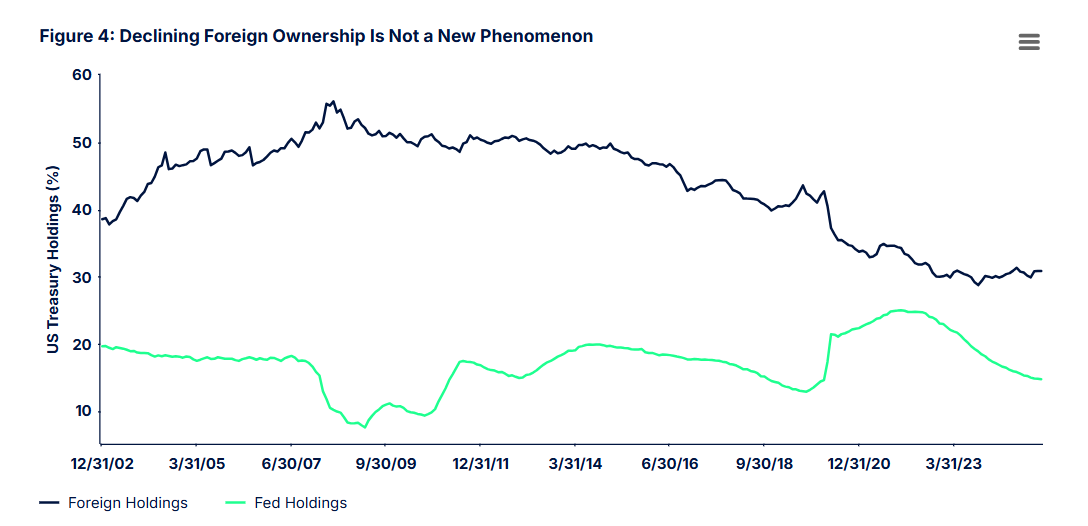
The sell-offs in the US Treasuries market after Liberation Day led to concerns about the state of US Exceptionalism. Foreign ownership of US Treasuries fell to 30.8% as foreign investors worried about the fiscal and monetary direction of the US.
However, the reality is that foreign ownership of US Treasuries has been on a decline since 2008, as seen below:
Foreign Ownership of US Treasuries
Source: State Street Global Advisors
As we have seen, foreign institutions are diversifying their reserve portfolios into gold and other currencies. Similarly, foreign private investors are prioritising developed markets' bond markets, where yields are higher, according to J.P. Morgan.
Nevertheless, both phenomena are not unconnected to concerns about the fiscal stability of the US.
“The factor I think gets underweighted in the discussions about de-dollarisation is confidence in U.S. fiscal discipline,” said Josh Katz, the founder of Universa Tax Professionals, a tax accounting firm. “Foreign investors don't just hold dollars because of inertia. They hold them because they trust the underlying system. When deficit spending is running at these levels, and the political appetite for addressing it is basically zero, that's a slow-moving credibility problem. It doesn't show up in a crisis; it shows up over a generation.”
Growing use of other currencies in commodity markets
J.P. Morgan also noted that the influence of the USD on pricing in commodity markets is diminishing.
They pointed to Russian oil products being priced in the local currencies of buyers or countries with which they have friendly terms. Saudi Arabia is exploring yuan-denominated contracts for its oil. Outside of the energy market, India and Bangladesh have decided to pay Russia for non-oil imports in yuan.
“The de-dollarisation trend in the commodity trade is a boon for countries like India, China, Brazil, Thailand and Indonesia, which can now not only buy oil at a discount, but also pay for it with their own local currencies,” according to Natasha Kaneva, head of Global Commodities Strategy at J.P. Morgan. “This reduces the need for precautionary reserves of U.S. dollars, U.S. Treasuries and oil, which might in turn free up capital to be deployed in growth-boosting domestic projects.”
2. Is de-dollarisation possible? Where the concerns don’t lie
What does de-dollarisation mean?
One of the causes of confusion about this subject is the lack of clarity in defining the term.
“The term refers to the gradual decline in reliance on the U.S. dollar in international trade and finance,” according to Luca Nacucchio, Senior Research Analyst at Payments CMI, a global payments advisory firm.
Investopedia also defines it as “a process of moving away from the world’s reliance on the U.S. dollar (USD) as the chief reserve currency.”
So, is the reliance on the USD in international trade and finance declining?
It’s to that question that we turn.
USD still leads in international currency usage
Though buyers of Russian oil and non-oil products are exploring other currencies, this has not delivered any significant blow to the dominance of the USD in international trade.
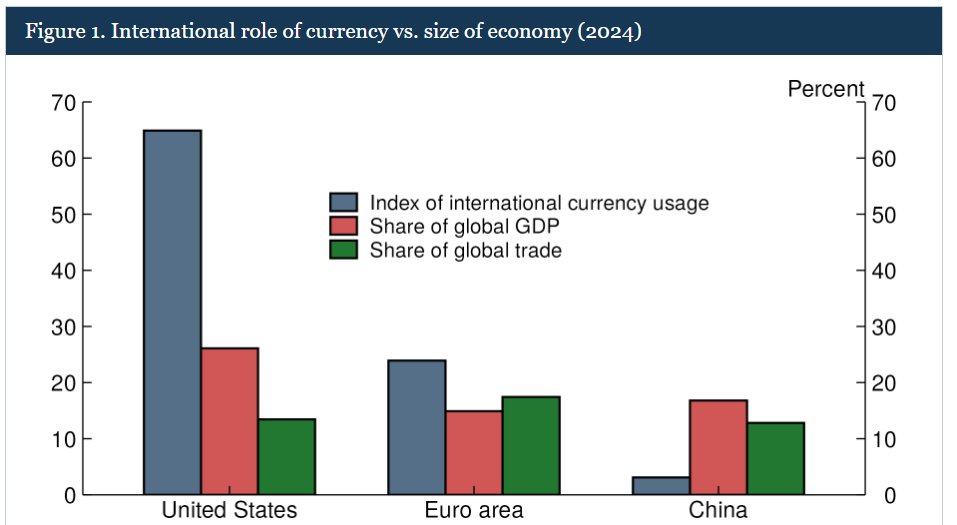
As the chart below shows, more than 60% of international trade still takes place in the USD. Despite China’s growing importance in the global economy, less than 5% of global trade takes place in yuan.
International Role of Currency vs Size of the Economy
Source: Federal Reserve
“According to our index combining various factors, the dollar's international usage is little changed over the past 5 years and far exceeds the U.S. share of global GDP and trade,” noted the Federal Reserve. “It also plays an outsized role in areas of financial innovation, such as being the dominant anchor for stablecoins.”
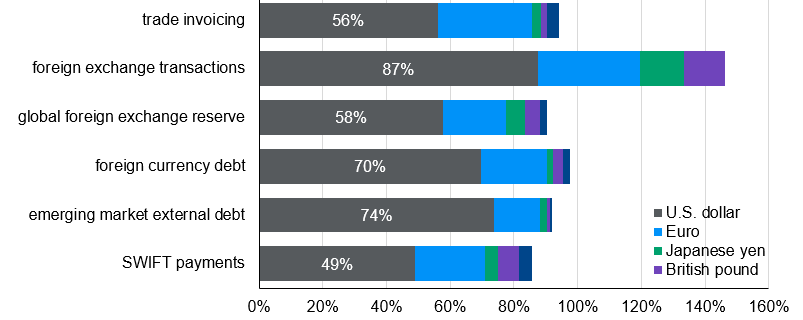
J.P. Morgan also noted that the transactional dominance of the USD remains evident in FX volumes, trade invoicing, cross-border liabilities denomination and foreign currency debt issuance, as seen below:
Share of Currency Use in International Finance
Source: J.P. Morgan
This is why short-term moves in the FX markets are not as important as the fundamentals that drive demand. Stanley explains this using the dynamics that operate in the insurance industry:
“What’s overlooked is insurance-style balance sheet mechanics: FX moves matter less than who must post collateral in USD, roll USD funding, or meet margin calls,” he noted. “In my world, a small premium change triggers huge behaviour; similarly, a 50–100 bps shift in hedging costs or cross-currency basis can force ‘non-discretionary' USD buying that overwhelms narratives about the Yen or gold for long stretches.”
In other words, the dominance of the USD in international trade and capital markets can cause demand to shift to it anytime the cost of hedging (by diversifying into other currencies) increases.
Furthermore, the transactional dominance of the dollar continues irrespective of the three trends we noticed above.
“Central banks are diversifying reserves, yes,” noted Katz, who helps Americans living abroad file US taxes. “But when my expat clients in Europe, Southeast Asia, or Latin America need to move serious money, they're still thinking in dollars first.”
The safe-haven status of the USD
We noted above that institutions and private investors are diversifying their reserves and bond holdings away from the USD and USD-denominated bonds.
However, 56.92% of global reserves are still in the USD (as of Q2, 2025), with the second-placed Euro accounting for only about 20%.
Similarly, the recent US-Iran-Israel war was another reminder that many global investors still consider USD and USD-denominated assets as safe havens.
“Dollar gains as investors flee risk on escalating Middle East war,” reported Reuters as the US dollar index rose by 0.22% on March 23, 2026, while the euro and yen continue to struggle.
One consequence of the war has been a positive correlation between crude oil and the US dollar that has fostered a rise in the price of the latter as supply shocks spur the former.
“Oil is priced in dollars, global trade is financed in dollars, and a vast stock of offshore liabilities is denominated in the greenback,” noted Brendan Fagan, a strategist at Bloomberg. “When crude spikes, it is effectively a direct demand shock for the currency at the core of the petrodollar complex.”
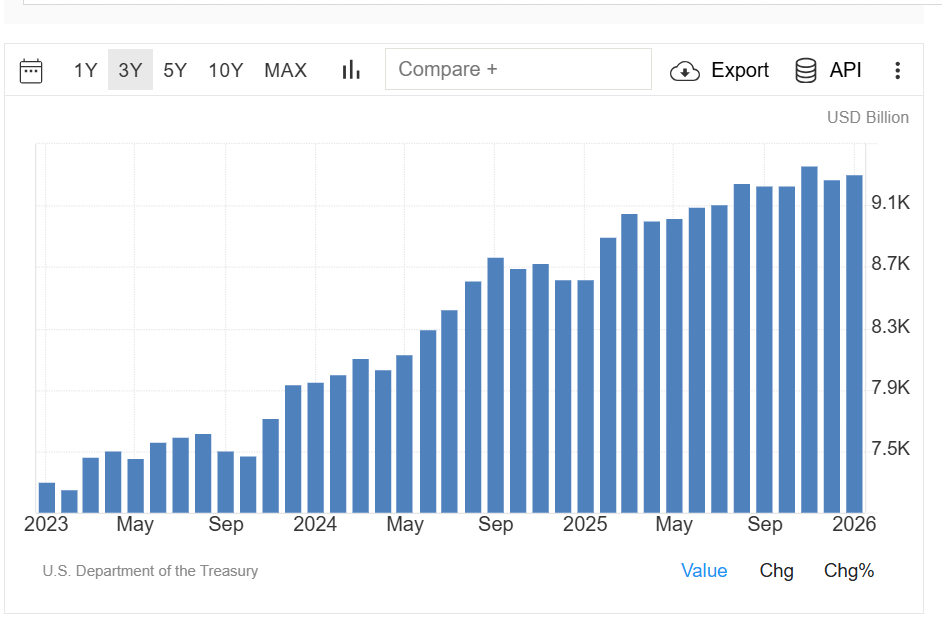
Also, as seen below, foreign ownership of US Treasury securities has been on an upward trend since 2023.
United States Foreign Treasury Holdings
Source: Trading Economics
In January 2026, foreign treasury holdings increased by 0.37% month-on-month and 8% year-on-year (led by Japan, the UK, and China) due to elevated yields and changing perspectives on Federal Reserve policy, as Reuters reported.
All of these reinforce that foreign institutions and private investors still consider the USD as a key safe-haven asset amidst global uncertainty.
“When stress hits (war headlines, liquidity crunch), the world still bundles back into USD/Treasuries because that market clears size without slippage,” said Stanley.
US investment opportunities abound
Geopolitical conflicts and uncertainty in financial markets often lead investors to prioritise hard or real assets over purely financial assets. Thus, institutional investors who prefer the safety of the US real estate sector will increase investments in the US.
“I view the dollar's strength through the lens of institutional capital flight into U.S. 'hard assets,’” said Jack Donahue, the founder of Donahue Advisors, a real estate advisory firm. “During geopolitical conflicts, I see a surge in ‘flight to quality’ where global investors move out of volatile currencies and into stabilised Class A office portfolios.”
Relatedly, Donahue notes that the focus on onshoring of manufacturing in the US will foster dollar-denominated investments that will counter any reduction in foreign ownership of US Treasuries.
“While many focus on gold, people overlook that de-dollarisation is being countered by the massive onshoring of manufacturing, which reinforces the dollar's necessity for domestic industrial leasing,” he said. “My experience with REITs like Highwoods Properties shows that as long as the U.S. controls the world’s most transparent real estate titles, the dollar remains the ultimate collateral for global debt.”
A similar trend occurs in the private equity market, according to Oliver Bogner, founder of The Advisory Investment Bank, an investment bank focusing on essential services industries.
“I see the dollar’s resilience anchored by the $7 trillion in private equity 'dry powder' currently targeting US essential services,” he noted. “While headlines focus on de-dollarisation, the aggressive competition for recession-resistant businesses in HVAC and plumbing shows that institutional capital is still betting heavily on the US domestic engine.”
So, is de-dollarisation taking place?
If we define it as the loss of US dominance, then there is no de-dollarisation. The US continues to hold its status as the reserve currency for international trade and finance.
However, if we define it as a decline in the strength of that dominance, then there is de-dollarisation, even though it's very slow and minimal at this point.
3. US dollar outlook: The short, medium, and long-term prospects of the USD
So far, we have seen that while there are trends that don’t bode well for the US dollar, the greenback continues to maintain its dominance in global trade and finance.
A good way to combine these two realities is to consider the US dollar outlook in the short, medium, and long term. This helps to separate the relevant factors affecting any US dollar forecast.
Most importantly, it will give institutional investors the clarity they need to take relevant actions.
So, what’s the outlook for the US dollar? Here is what the experts think:
Short-term outlook for the US dollar
Many experts expect that the uncertainty introduced by the war in Iran should lift the dollar in the short term as oil prices increase.
“Short term, I’m bullish due to risk-off flows into safe havens like US Treasuries,” said Deepak Shukla, the CEO of Pearl Lemon Invest, an investment advisory firm.
Stanley agrees: “In the short-term, USD is resilient on 'flight-to-cash' and collateral demand.” As uncertainty and lower risk appetite lead to capital flows into the US, the dollar will rise.
For other analysts, the most important macroeconomic determinant for any USD forecast is the interest rate. “Short-term, the dollar will oscillate with interest rates,” according to Donahue.
If inflationary fears from the war in Iran lead to higher US interest rates, foreign purchase of US Treasuries may increase (especially if rate differentials favour the US), which will bode well for the USD.
On the other hand, if things stabilise in Iran and the long-anticipated Fed rate cuts finally happen, the dollar may weaken or normalise after a brief appreciation.
Another factor is the state of trade policy. “Short-term volatility is likely due to trade-policy shifts,” according to Bogner. We saw how Trump’s tariffs spurred outflows from the US Treasuries market, leading to a US dollar depreciation. Any move in that same direction may cause another depreciation in the USD.
Medium-term outlook for the US dollar
For Stanley, real yields will be the most significant determinant in the medium term.
In this, he is similar to Donahue, except that he expects concerns about interest rates and term premiums to dominate in the medium term rather than the short term (when he expects safe-haven demand to overshadow other factors).
“The medium-term outlook for the dollar depends on whether US real yields stay structurally high and whether fiscal noise raises the term premium (that can lift USD even if it’s not “good news”).”
As said above, higher yields attract global investors, which favours the US dollar.
Though USD will continue to dominate in the medium term, investors will keep hedging their USD exposure with other currencies, according to Shukla.
In other words, we might never go back to a period where portfolios are concentrated in the USD. The USD might dominate, but diversification will remain a thing in the short term.
Concerns about the US economy will also play a part in the medium term. For example, a protracted war in Iran could have negative effects on US growth and cause the inflation rate (both CPI and PCE) to rise.
Such stagflation can exacerbate monetary policy uncertainty since higher rates will slow inflation but hurt economic growth, while lower rates will foster economic growth but worsen inflation. The interest path the Federal Reserve takes will then determine what happens to the exchange rate.
Long-term outlook for the US dollar
Some analysts are bullish on the USD in the long term.
For Bogner, this is because investment into essential services in the US will continue to dominate in a world where uncertainty remains a reality.
However, many analysts have a more bearish outlook on the dominance of the USD over the long term.
“Long-term, I expect a slow erosion in share, not a cliff,” said Stanley. He explains this using his experience in the insurance industry: “It will be more like how renters insurance is cheap until the tail risk (fire/theft) reminds you why you carry it; the USD’s tail-risk utility keeps it relevant even as people diversify.”
In other words, diversification into other currencies and precious metals will erode USD dominance, but headwinds like geopolitical conflicts, recessions, market downturns, and economic uncertainty will always lead investors to run towards the shelter that USD-denominated assets provide.
Shukla also agrees with Stanley. He believes that a gradual erosion of USD dominance is possible in the long term.
Nacucchio says it best:
“While the dollar hegemony is not under significant threat in the short and medium terms, the collective efforts of several countries to explore alternatives and digitise their currencies seem to indicate that a major transformation process is brewing in the world’s financial landscape.”
4. Navigating the US dollar outlook: What institutional investors should do
How should institutional investors respond to this outlook for the US dollar?
The first thing to understand is that de-dollarisation is not necessarily a moral issue. Is de-dollarisation good or bad? It’s neither good nor bad.
It’s all about understanding global restructuring and positioning oneself to benefit from it.
In view of all we have said, institutional investors should consider the following:
- A core position in USD is still very much valid: Many investors are overreacting to talks about de-dollarisation by divesting away from the US at an alarming rate.
From what we have seen, the USD maintains its dominance as a global reserve currency. The flight to US Treasuries in recent weeks was a reminder of this fact.
Therefore, a core allocation to USD-denominated assets is still a sound strategy. This is the practice of Shukla at Pearl Lemon Invest:
“Worries about de-dollarisation don’t make us jumpy,” he said. “They just nudge us to tweak things here and there. We’ve nudged our allocations a bit toward non-dollar assets and commodities as a hedge, but we’re not abandoning dollars altogether. That core position still matters.”
He gave an example of how his team insisted on keeping a strong US core portfolio last year despite the clamour of some clients to concentrate on the positive economic data from emerging markets.
“We talked them down from that ledge,” he said. “Instead, we kept a solid dollar base and layered in hedges like gold, a few carefully picked foreign bonds and some diversified currency ETFs. It’s nothing dramatic, just small moves that, over time, make a portfolio more resilient. That’s the approach we try to live by. Notice the trends, but don’t get swept up chasing the latest headline.”
- Hedge your core US portfolios: Though Shukla insists on a core US portfolio, he also intelligently hedges this core portfolio with a satellite portfolio that includes allocation to gold, foreign bonds, and diversified currency ETFs.
Some institutions with significant exposure to a currency pair (AUD/USD, EUR/USD, GBP/USD, USD/JPY, among others) can also hedge through direct participation (going long or short) in the foreign exchange (forex) market.
Yes, it is best to trust the ingenuity of American capitalism. However, sound portfolio management requires smart diversification.
“For practical purposes, anyone with significant cross-border exposure should not be sitting in a single currency,” said Katz. “I've been saying this to expat clients for years. Whether the dollar strengthens or weakens in the short term, currency diversification is just good hygiene at this point.”
Interestingly, though Katz has a positive short-term US dollar forecast, due to the safe-haven demand spurred by the war in Iran, he still insists on a diversified portfolio since geopolitical conflicts come and go.
“The geopolitical uncertainty that's currently supporting the dollar as a safe haven is real, but it's also temporary by nature,” he noted. “Build your financial life assuming the dollar stays dominant, but hedge like it might not.”
- Choose a diversified approach to dollar alternatives: Even when investing in non-dollar-denominated assets, there is a need to pursue diversification as a risk-reducing strategy.
For example, putting all your money into yen or euros might not be the smart approach. Instead, a diversified approach that combines precious metals (like gold and silver) with a good number of quality currencies like JPY, AUD, EUR, and GBP is better.
Similarly, when investing in non-dollar-denominated assets, it is crucial to combine equities and bonds investment depending on the strengths of each market.
- Quality risk management is always essential: Diversifying outside the US does not mean you should purchase any non-dollar-denominated assets that come your way.
Diversification just for the sake of it will only lead to wealth destruction.
Before adding a country’s assets to your portfolio, conduct due diligence. This involves identifying potential currency, interest rate, liquidity, political, and economic risks and designing strategies to manage them (assuming the risk is worth it).
One way to navigate the global restructuring and its effects on the US dollar is to engage with other asset managers who are also making portfolio decisions to reflect these new realities.
On the one hand, such engagement will put you onto investment ideas that you can explore. On the other hand, you can bounce off your ideas against other experts who can highlight any important points you are missing.
As interest in international diversification intensifies, such a community will help you conduct proper due diligence.
At cio investment club, we provide you with such a community of asset managers and other investment professionals. We also organise exclusive roundtables and investment breakfasts where you can network with them.
Do you want to be a part of an investment community that will help you make well-informed portfolio decisions? Register today to become a part of the cio investment club.
Takeaways
- The USD is losing marginal share in reserves, Treasuries, and commodities, but remains dominant in global finance and trade.
- Central banks and investors are hedging with gold and other currencies, not replacing the dollar entirely.
- Geopolitical shocks (like the US–Israel–Iran war) continue to trigger strong capital inflows into US assets.
- Investors need a balanced strategy: maintaining a core USD allocation while diversifying into alternative assets and currencies for resilience.
This document is produced by Instaconnect Limited, trading as cio investment club, a company registered in England & Wales with registration number 15262951.
Instaconnect Limited is neither authorised nor regulated by the Financial Conduct Authority in the United Kingdom nor the Securities and Exchange Commission in the United States of America.
This document is a marketing documentation and is not intended to constitute an invitation or an inducement to engage in any investment activity. It is not intended to constitute investment advice and should not be relied upon as such. It is not intended and none of Instaconnect Limited, its holding companies or any of its or their associates, or any of the participants in the documentation, shall have any liability whatsoever for (a) investment advice; (b) a recommendation to enter into any transaction or strategy; (c) advice that a transaction or strategy is suitable or appropriate; (d) the primary basis for any investment decision; (e) a representation, warranty, guarantee with respect to the legal, accounting, tax or other implications of any transaction or strategy; or (f) to cause Instaconnect Limited to be an advisor or fiduciary of any recipient of this report or other third party.
The content and graphical illustrations contained in this document are provided for information purposes and should not be relied upon to form any investment decisions or to predict future performance. Instaconnect Limited recommends that recipients seek appropriate professional advice before making any investment decision. Although the information expressed is provided in good faith, Instaconnect Limited does not represent, warrant or guarantee that such information is accurate, complete or appropriate for your purposes and none of them shall be responsible for or have any liability to you for losses or damages (whether consequential, incidental or otherwise) arising in any way for errors or omissions in, or the use of or reliance upon the information contained in this document.
To the greatest extent permitted by law, we exclude all conditions and warranties that might otherwise be implied by law with respect to the document, whether by operation of law, statute or otherwise, including as to their accuracy, completeness, or fitness for purpose.
Instaconnect Limited and its logo are proprietary trademarks of Instaconnect Limited and are registered in the United Kingdom. Unauthorised copying of this document is prohibited.
© Copyright Instaconnect Limited 2026