



Since the launch of ChatGPT 3.5 in 2022, artificial intelligence has been on everyone’s lips.
Big technology companies (Alphabet, Apple, Meta, Amazon, Microsoft, etc.) are fighting for AI dominance, new startups are applying AI to various domains of society, and every industry is asking questions about how they can apply AI to their operations.
Investors have also joined the AI wave (or AI hype, in some people’s opinion).
As of Q3, 2025, AI startups had captured 51% of global venture capital funding, according to CB Insights, a business analytics and market intelligence platform. Similarly, the deal value for AI private companies increased dramatically from $23 billion in 2024 to $150 billion in 2025, according to Bloomberg Intelligence.
Furthermore, AI-related stocks have accounted for 75% of the S&P 500 Index returns since ChatGPT 3.5. launched, according to Michael Cembalest, Chairman of Market and Investment Strategy at J.P. Morgan Asset Management.
This AI ‘craze’ has led to fears, in Silicon Valley and beyond, that a bubble may be developing that would soon burst. Perhaps this is another iteration of the Dot-com bubble, some query. Hasn’t the 2008/2009 financial crisis taught us a definite lesson about asset bubbles?
Should we expect an AI bubble burst? In what follows, we consider whether we are in an AI bubble and if there is any valid reason to be afraid of a bubble burst in the coming months or years. We’ll cover:
- Are we in an AI bubble?
- Will the AI bubble burst? Reasons to be optimistic about AI
- Will the AI bubble burst? Reasons to be cautious about AI
- How should institutional investors approach AI investment?
Do you want to learn more about global investment trends and how they should impact your portfolio? Subscribe now to the cio investment club’s newsletter for regular updates that will improve your investment choices.
1. Are we in an AI bubble?
Many analysts have been pointing to the misallocation of funds to AI and the overvaluation of many AI companies that has resulted from it.
But perhaps none has been as vocal as Julien Garran, a partner at MacroStrategy Partnership, an independent research firm in the UK.
Garran believes that AI is the biggest and most dangerous bubble the world has ever seen. He recently estimated that the AI frenzy is 17x and 4x worse than the dot-com bubble and the real estate bubble, respectively.
Profitability and overvaluation
For him, the seemingly permanent funding tour we see in AI is because while chipmakers like NVIDIA are making a profit, data centres, large language models (LLMs) developers, and software developers that use LLMs continue to make losses.
At the moment, these investors continue to put money into AI in the hope that things will turn around. Garran is pessimistic about such a turnaround, and he expects that AI firms will soon run out of investors.
While acknowledging the potential benefits of AI to humanity that AI enthusiasts emphasise, Bloomberg notes, in agreement with Garran, that the inability of many AI companies to turn a profit remains a concern.
“Yet never before has so much money been spent so rapidly on a technology that remains somewhat unproven as a profit-making business model,” they noted.
AI companies will need $2 trillion in revenue to fund their computing demand by 2030, according to Bain and Co., a global consulting company. However, they expect these companies to fall short by about $800 billion.
Relatedly, there have been concerns about the extremely high valuations of these AI companies.
“Sharp falls in global technology stocks in early November underscored investors’ growing unease over the sector’s sky-high valuations, with Wall Street chief executives warning of an overdue market correction,” Bloomberg noted.
The Financial Times has raised a similar concern. They noted that 10 AI startups with zero dollars in profit gained $1 trillion in market value between October 2024 and October 2025.
Even Sam Altman, the CEO of OpenAI, acknowledged that investors may be too excited about AI. “Are we in a phase where investors as a whole are overexcited about AI? In my opinion, yes,” he was quoted as saying by Bloomberg.
However, while everyone can agree that there has been overexcitement in the AI investment space (in other words, a bubble), there are differences of opinion on what we can expect to happen next.
2. Will the AI bubble burst? Reasons to be optimistic about AI
For some analysts, there is no reason to worry about the AI bubble bursting.
The role of profitable and stable Big Tech companies
For one, the AI revolution is being driven by stable and profitable companies that have proven their mettle over the years.
“Unlike the dot-com boom of the late 1990s, today’s AI expansion is being led by profitable global companies deploying existing cash flow,” according to VanEck, a global investment management firm.
This is in keeping with Bloomberg’s point about the scope of Big Tech investment in the AI revolution.
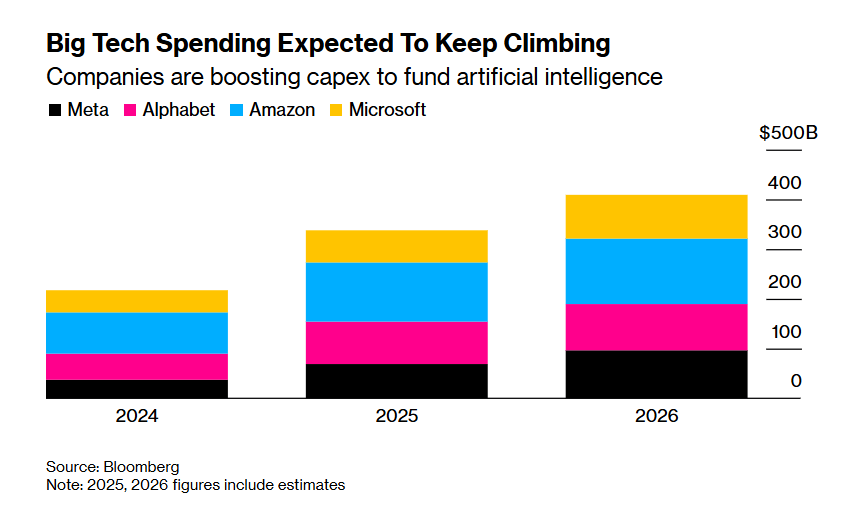
As the chart below shows, the CAPEX spending of tech giants will keep rising year-on-year.
CAPEX Spending of Big Tech Companies
Source: Bloomberg
In fact, in the first half of 2025, CAPEX spending by these tech giants contributed 1.1% to US GDP growth, more than the portion contributed by US consumer expenditure, according to J.P. Morgan.
Relatedly, they noted that the CAPEX spending of semiconductor firms is driven by profit and innovation rather than speculative financing.
“Industry data show that semiconductor firms reinvest roughly 60% of their distributable capital in R&D and capacity expansion, a level that has doubled over the past eight years, with an annualised growth rate of nearly 10%,” they noted. “That suggests today’s capex is being fueled mostly by profits and innovation, not by speculative financing.”
These companies have the highest free cash flow and the strongest balance sheets in the stock market, according to Janus Henderson Investors (JHI), a global asset management firm. In contrast, the dot-com bubble was driven by ‘IPO-fuelled internet demand.’
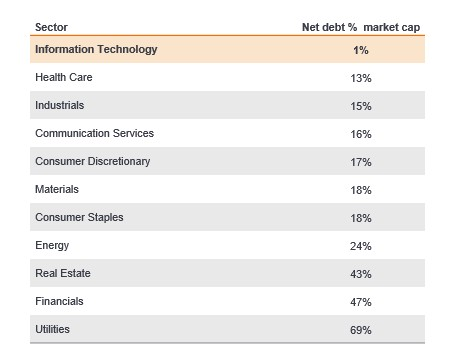
As seen below, the technology sector has the lowest net debt to market cap in the equity market:
Net Debt as a Percentage of Market Cap in Equity Sectors
Source: Janus Henderson Investors
Technology sector’s lower valuation premium
Similarly, the entire technology sector is currently trading at a lower premium to the entire market compared to the dot-com era.
“In 2000, the technology sector traded at more than double that of the broader equity market,” according to JHI. “Currently, it trades lower, at around 1.34x the broader equity market.”
Focus on physical infrastructure
Also, VanEck notes how the current wave of spending has focused on AI infrastructure (like data centres) that will propel future commercial applications.
“Additionally, OpenAI’s partnerships with NVIDIA, AMD, Intel, and Oracle highlight how critical computing power has become as AI moves from experimentation to commercial applications,” they said. “The world’s largest technology companies are reinvesting substantial free cash flow into physical infrastructure because they view AI as essential to their long-term competitiveness.”
One advantage of this is that AI companies can rent infrastructure being built by hyperscalers instead of trying to raise funds to build out their own.
Different funding situation
JHI has also pointed to some differences between the funding situation today and in the dot-com bubble.
First, the availability of funds in the private capital market today has made it unnecessary for AI startups to do an IPO early, unlike in the dot-com era. Secondly, as shown in the chart below, the percentage of unprofitable listed tech companies is a bit lower now:
The Percentage of Unprofitable Tech Stocks in the Dot-com Era vs Now

Source: Janus Henderson Investors
Different macroeconomic situation
Furthermore, both VanEck and JHI acknowledge that the macroeconomic situation is different today than it was in the early 2000s.
Back then, the Federal Reserve was implementing contractionary monetary policy to bring down inflation. Now, the Fed is currently embracing an expansionary monetary policy as inflation nears the 2% target.
Real-world application and impact
Finally, AI enthusiasts point to the structural transformation that the technology is capable of producing.
The other side of Sam Altman’s quote goes thus: “Is AI the most important thing to happen in a very long time? My opinion is also yes.”
VanEck has also emphasised that today’s CAPEX spending on AI will be the launchpad for future productivity gains and technological progress.
Bloomberg has also chronicled statements and reports by OpenAI, Meta, and Anthropic to the effect that AI is making a meaningful impact on people’s work and that these models are already approaching the quality of work done by experts in various industries.
“The hope among developers is that, as AI models improve and field more complex tasks on users’ behalf, they will be able to convince businesses and individuals to spend far more to access the technology.”
Even Bill Gates, who acknowledged similarities between the dot-com bubble and the current AI wave, told CNBC that AI is the biggest technical thing in his lifetime.
3. Will the AI bubble burst? Reasons to be cautious about AI
So, are we in an AI bubble?
We have considered seven reasons why the current situation with AI is different from what happened during the dot-com bubble.
Yet, there are still similarities that justify the caution about an AI bubble burst.
These include “sky-high valuations of AI startups with minimal revenues, extraordinary per-employee funding, and the enormous share of capital funnelled into AI at the expense of other ventures,” according to Adrien Laurent, the CEO of Intuition Labs, an AI software development company. “Those echo bubble-like irrationality,” he continued.
This is in line with the concerns that were raised by Garran, Bloomberg, and Bain and Co.
Yet, there is another concern regarding the utility of AI.
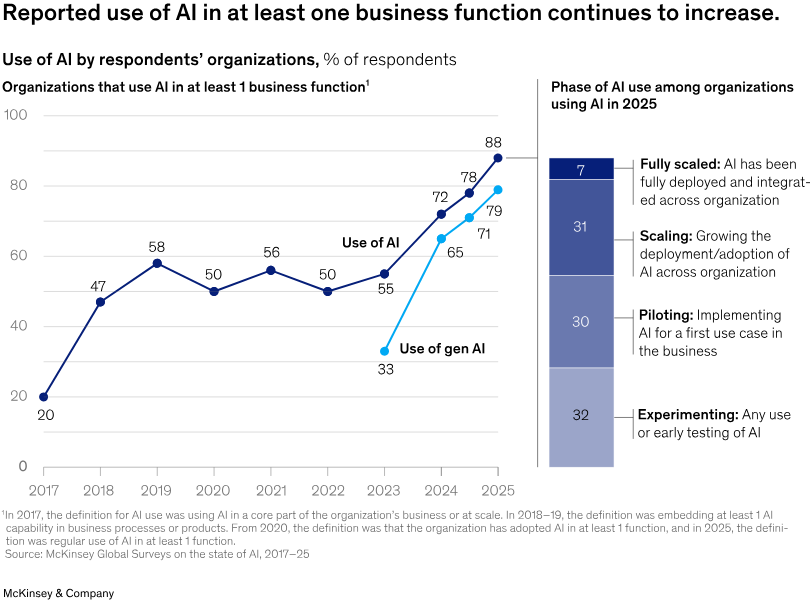
While 88% of companies use AI for at least one business function, 62% are either experimenting or piloting, according to a survey by McKinsey and Co.
The Use of AI in Business Functions
Source: McKinsey and Co
“We are seeing that while companies may have rolled out AI tools, most have not yet productized use cases, redesigned workflows around AI and agentic capabilities, or built the platforms/guardrails needed to run them at scale,” according to Alex Singla, a senior partner at McKinsey and Co.
Furthermore, though companies report that AI helps with innovation, employee and customer satisfaction, and product differentiation, there has not been any significant impact on enterprise-wide EBIT.
“Thirty-nine per cent of respondents attribute any level of EBIT impact to AI, and most of those respondents say that less than 5 per cent of their organisation’s EBIT is attributable to AI use,” according to the McKinsey report.
Also, the drop in workforce that many anticipated has not materialised. “In most functions, fewer than 20 per cent of respondents report decreases of 3 per cent or more, and smaller shares say their organisation’s AI use led them to add headcount within functions.”
What can we then conclude?
“While the use of AI is now common, our new survey suggests that its full promise still remains ahead. Most organisations are still navigating the transition from experimentation to scaled deployment, and while they may be capturing value in some parts of the organisation, they’re not yet realising enterprise-wide financial impact.”
For some, like Garran, all of these confirm that AI has not yet demonstrated much long-term value.
“You can’t create an app with commercial value as it is either generic (games, etc), which won’t sell, or it is regurgitated public domain (homework), or it is subject to copyright,” he said in an interview with Market Watch. “It’s hard to advertise effectively, LLMs cost an exponentially larger amount to train each generation, with a rapidly diminishing gain in accuracy. There’s no moat on a model, so there’s little pricing power. And the people who use LLMs the most are using them to access compute that costs the developer more to provide than their monthly subscriptions.”
4. How should institutional investors approach AI?
Laurent has provided us with the best way to approach the AI bubble.
First, we need to disaggregate the data to see where the concerns are. “Some AI-related numbers (funding, valuations, market sentiment) look like 1999, while others (profit margins, growth, adoption) do not.”
Second, we have seen that many of the reasons to hope centre on stable and profitable hyperscalers (Big Tech companies) that are driving big investment in physical infrastructure. On the other hand, the relevant concerns are primarily about AI startups with overbloated valuations not driven by profitability.
Third, while there may be hype in the AI space, some profitable businesses with true long-term value may also be developing. “Much like the Internet in the 2000s, AI may be a generational shift, even if the hype moment is overdone,” said Laurent. In other words, neither complete optimism nor pessimism is justified.
Given these points, institutional investors should take note of the following:
- Focus on fundamentals: When the AI bubble bursts, companies with inflated valuations will drop off, while those with strong fundamentals (real revenue, scalable business model, product-market fit, profitability) will likely survive.
Institutional investors should look beyond the hype and fixate on the numbers that matter. Similarly, you can focus primarily on hyperscalers rather than venture-backed companies with inflated valuations.
- Diversify your holdings: Though early-stage startups may have the greatest return potential, they are also the riskiest. Hyperscalers (and chipmakers), with strong free cash flow and balance sheets, are the safest. In between those two are mature AI companies building solutions in industries like healthcare, finance, and industrials.
- Long-term focus: The AI market is still young, and the most pragmatic investors will approach it as a multi-decade technological progress capable of structural transformation.
Thus, institutional investors should take a long-term approach to their AI exposure and focus on companies that can drive long-term value.
So, is AI a bubble? In some sense. There is a bubble in the world of AI startups that does not necessarily apply across board to established Big Tech companies driving the AI investment.
Is the AI bubble bursting inevitable, then? It seems so, since every bubble pops eventually. “It is both true that AI will transform the economy, and I think it will, like the internet, create huge amounts of economic value in the future,” according to Bret Taylor, the chairman of OpenAI, quoted by Bloomberg. “I think we’re also in a bubble, and a lot of people will lose a lot of money.”
When will the AI bubble burst? No one knows. Garran already sees a decline in the willingness of venture capital firms to fund some of these startups, especially those focused on software development. But even he does not know when the bubble will burst.
So, instead of speculating on whether and when the bubble will burst, institutional investors should keep focusing on fundamentally sound companies that can provide long-term value across various industries and to the general economy.
At the cio investment club, we provide you with a network of asset managers and owners you can discuss your investment ideas with. Through these discussions, you can identify viable and fundamentally sound AI companies that will improve your portfolio’s performance.
We also organise exclusive roundtables and investment breakfasts where you can have face-to-face interactions and one-on-one networking sessions with other investment experts.
Are you ready to become a part of an investment club where you can exchange investment ideas and make better portfolio decisions? Register today to join the cio investment club.
Takeaways
- The AI boom may contain pockets of overvaluation, especially among startups with little revenue (and zero profit).
- However, Big Tech’s strong balance sheets, profitability, and stability differentiate today from the dot-com era.
- Though the adoption of AI has not had major impacts on EBIT margins, many analysts are confident that the future is bright.
- Institutional investors should focus on fundamentals — profitability, scalability, and long-term value — instead of chasing speculative hype.
This document is produced by Instaconnect Limited, trading as cio investment club, a company registered in England & Wales with registration number 15262951.
Instaconnect Limited is neither authorised nor regulated by the Financial Conduct Authority in the United Kingdom nor the Securities and Exchange Commission in the United States of America.
This document is a marketing documentation and is not intended to constitute an invitation or an inducement to engage in any investment activity. It is not intended to constitute investment advice and should not be relied upon as such. It is not intended and none of Instaconnect Limited, its holding companies or any of its or their associates, or any of the participants in the documentation, shall have any liability whatsoever for (a) investment advice; (b) a recommendation to enter into any transaction or strategy; (c) advice that a transaction or strategy is suitable or appropriate; (d) the primary basis for any investment decision; (e) a representation, warranty, guarantee with respect to the legal, accounting, tax or other implications of any transaction or strategy; or (f) to cause Instaconnect Limited to be an advisor or fiduciary of any recipient of this report or other third party.
The content and graphical illustrations contained in this document are provided for information purposes and should not be relied upon to form any investment decisions or to predict future performance. Instaconnect Limited recommends that recipients seek appropriate professional advice before making any investment decision. Although the information expressed is provided in good faith, Instaconnect Limited does not represent, warrant or guarantee that such information is accurate, complete or appropriate for your purposes and none of them shall be responsible for or have any liability to you for losses or damages (whether consequential, incidental or otherwise) arising in any way for errors or omissions in, or the use of or reliance upon the information contained in this document.
To the greatest extent permitted by law, we exclude all conditions and warranties that might otherwise be implied by law with respect to the document, whether by operation of law, statute or otherwise, including as to their accuracy, completeness, or fitness for purpose.
Instaconnect Limited and its logo are proprietary trademarks of Instaconnect Limited and are registered in the United Kingdom. Unauthorised copying of this document is prohibited.
© Copyright Instaconnect Limited 2025