




For decades, Norway, Singapore, and the Gulf states have used sovereign wealth funds to turn national wealth into powerful investment portfolios. The UK, despite its deep financial markets, has historically lacked a true sovereign wealth fund of its own.
To many people, the launch of the National Wealth Fund (NWF) in 2024 was meant to bridge this gap by propelling infrastructure investment and empowering national development.
But is the NWF truly the UK’s sovereign wealth fund?
For institutional investors familiar with established sovereign wealth vehicles, understanding the NWF's mandate, funding structure, and differences from classic sovereign funds offers valuable insight into the UK's evolving investment landscape and the opportunities it may create for asset owners.
We’ll bring clarity to this conversation by considering the following:
- Does the UK have a sovereign wealth fund?
- What is the National Wealth Fund, and how does it work?
- How does the NWF compare to Norway, Singapore, and Gulf Sovereign Funds?
- What does the NWF mean for institutional investors?
Do you want insights into the latest developments in global financial markets? Sign up now for the cio investment club’s newsletter for regular expert insights.
1. Does the UK have a sovereign wealth fund?
Perhaps a more fundamental question is, “What is a sovereign wealth fund?”
Sovereign Wealth Funds (SWFs) have three characteristics, according to Appendix 1 of the Santiago Principles, a document outlining the generally accepted principles and practices of SWFs:
- They are owned by the general government, which includes the central (federal) government and sub-national governments.
- They include investment in foreign financial assets. “The investment strategies include investments in foreign financial assets, so it excludes those funds that solely invest in domestic assets.”
- They are created for macroeconomic purposes to achieve financial objectives using medium-to-long-term investment strategies.
Also, SWFs typically pursue one or more of the following three objectives, according to the International Forum of Sovereign Wealth Funds (IFSWF):
- Savings funds: These are SWFs that focus on saving a portion of resource wealth for the future. This is common among countries rich in finite resources like oil, gas, and precious metals.
- Stabilisation funds: These SWFs serve as pools of capital that governments can draw on to smooth the budget when revenue falls below expenditure. Like savings funds, stabilisation funds are common among resource-rich countries that must manage commodity price volatility.
- Strategic funds: Also known as development funds, they are designed to contribute to national development and often form a part of domestic economic policy.
Most SWFs today operate under a dual mandate of generating long-term financial returns and supporting national economic, strategic, or developmental objectives, according to the CFI Institute.
The pursuit of these objectives has led to some changes in the allocation decisions of SWFs over the years.
“Traditionally, these funds have invested in external assets, especially securities traded in major markets,” according to the World Bank Group. “But the persistent infrastructure financing gap in developing countries has motivated some governments to encourage their sovereign wealth funds to invest domestically.”
Consequently, many SWFs now “invest domestically, in particular to finance long-term infrastructure investments.”
The CFA Institute has documented how SWFs have increased their allocations to private markets (private equity, private credit, infrastructure, and real estate) over the years. As seen in the chart above, there was a steady rise in private markets allocation between 2005 and 2025.
Sovereign Wealth Fund Allocation to Private Markets, 2005-2025
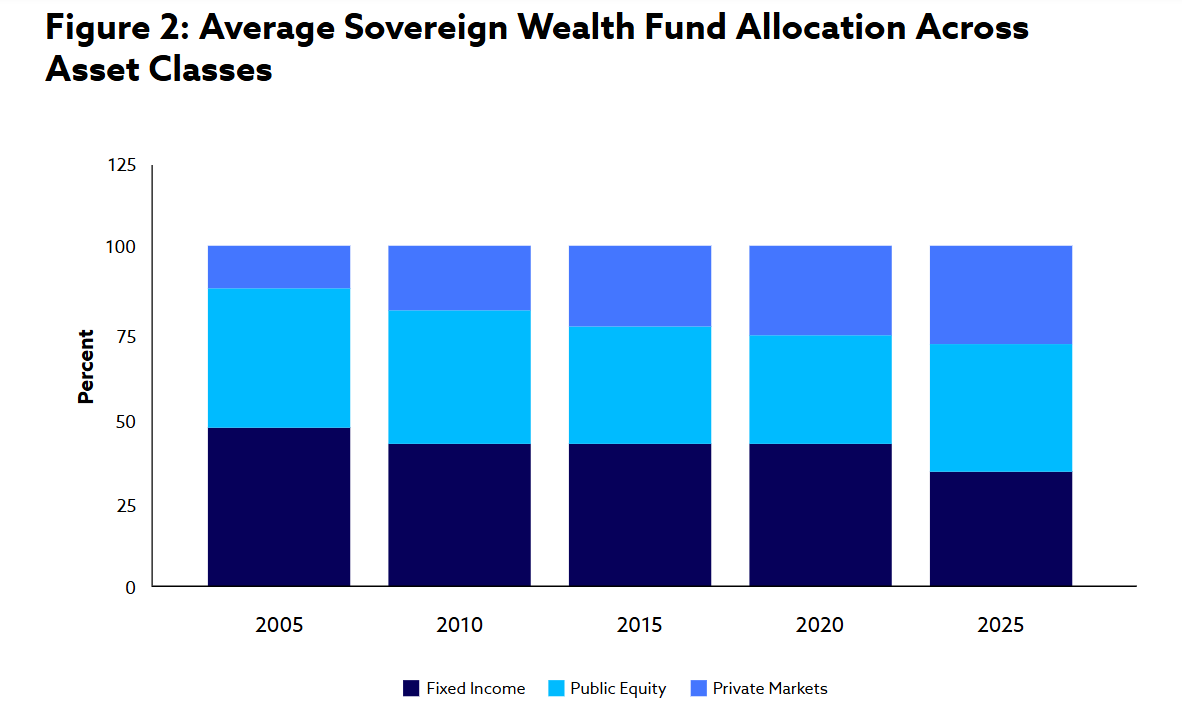
Source: CFA Institute
So, does the UK have a sovereign wealth fund?
If we go strictly by the definition provided by the Santiago Principles, then the UK does not have a SWF.
For one, as we will see, the NWF invests entirely in domestic assets (especially infrastructure investment) and does not allocate to foreign financial assets, as the second characteristic demands.
Secondly, the NWF functions primarily as a domestic policy instrument rather than a pure macroeconomic management fund. It aims to de-risk investments and attract private capital to infrastructure projects rather than maximise financial returns for the state treasury.
But let’s take a look at what the NWF is all about before going deeper into how it differs from classic SWFs.
2. What is the National Wealth Fund, and how does it work?
The National Wealth Fund UK is a strategic investment fund seeded with £27.8 billion of public capital with the mandate to crowd in private investment for projects that advance the UK’s industrial and clean energy goals.
It was launched in October 2024 as the rebranded and expanded version of the UK Infrastructure Bank (UKIB), which was created in 2021 to tackle climate change and support economic growth with priority in clean energy, digital, transport, water, waste, and natural capital. This expansion was also supported with “additional financial capacity and an enhanced risk budget.”
The fund complements the British Business Bank, which supports small businesses, and the Great British Energy, which supports power-sector projects.
The NWF is owned and sponsored by HM Treasury, and it describes itself as “a mission-driven investor with the capital, expertise and ambition to unlock the UK’s future.”
It does this in two ways:
- Private sector finance: They provide corporate and project finance across the capital structure (loans, guarantees, equity investments), focusing on “capital-intensive infrastructure, supply chains and businesses across the UK.”
They aim to crowd in private investment across 25 sectors, with priorities in the following ten sectors: ports; carbon capture, usage and storage; green hydrogen; gigafactories, battery manufacturing and electric vehicle supply chain; green steel; power grid; energy storage; nuclear; transport infrastructure; and place-based regeneration.
- Local government support: They also support local and regional governments with lending, project advisory, and long-term partnerships to “accelerate projects that create long-term economic benefits.”
They prioritise projects in the following sectors: building retrofit and energy system decarbonisation; clean energy and heat networks; transport and place-based regeneration and investment.
The fund has three key objectives, according to its 5-year Strategic Plan to 30/31:
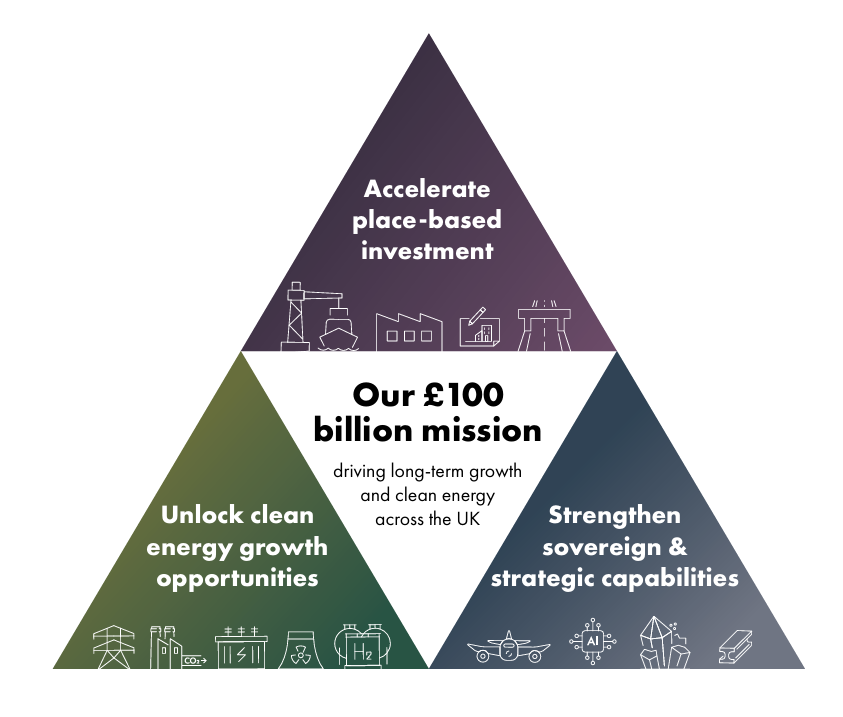
- Unlocking growth opportunities on the pathway to clean energy: The NWF seeks to accelerate the UK’s transition to net zero by investing in clean energy infrastructure, technology, and supply chains that generate sustainable economic growth.
- Accelerating place-based investment across all four nations of the UK: It prioritises regional regeneration by directing capital to projects that boost productivity and create jobs in every part of the country. Its goal is to ensure that economic transformation benefits communities across England, Scotland, Wales, and Northern Ireland equally.
- Strengthening sovereign and strategic capabilities: It seeks to build national resilience in critical sectors such as energy, manufacturing, and technology.
“On top of this, we are quantifying our ambitions by driving more than £100 billion in finance by the end of this strategic plan, creating and supporting more than 200,000 jobs, and saving 500 million tonnes of carbon dioxide emissions by 2050,” said Oliver Holbourn, the CEO of the NWF.
It has also set up an Impact Framework that outlines how it will measure and evaluate results based on its core mandates. The framework evaluates results across key metrics like private capital mobilised, jobs created, carbon emissions reduced or avoided, regional economic growth, and innovation and supply-chain resilience.
3. How does the NWF compare to Norway, Singapore, and Gulf Sovereign Funds?
We pointed to two reasons why the NWF, though styled like a SWF, is not a true SWF.
First, SWFs typically have a global focus, investing mostly (though not exclusively) in foreign assets. As the World Bank Group article shows, it is only in recent years that SWFs even began to invest in domestic assets, a practice that remains controversial due to fears of political interference. Even then, domestic assets don't take up the entire portfolio of SWFs.
On the other hand, the NWF invests exclusively in domestic projects in 25 sectors (with ten of them having priority over others) and supports projects by local and regional governments in the UK.
Second, the NWF works more like a development or policy bank committed to the UK’s development rather than an investment portfolio tasked with maximising long-term financial returns to achieve macroeconomic stability.
There are two other reasons why the NWF is not a classic SWF.
While many classic SWFs are funded from commodity revenues (usually oil and gas windfalls) and fiscal reserves, the NWF was seeded with an allocation from the Treasury.
Also, while classic SWFs aim to maximise financial returns or save money to protect future generations from economic shocks, the NWF functions as an economic development vehicle designed to crowd in private investment by co-investing in otherwise high-risk projects.
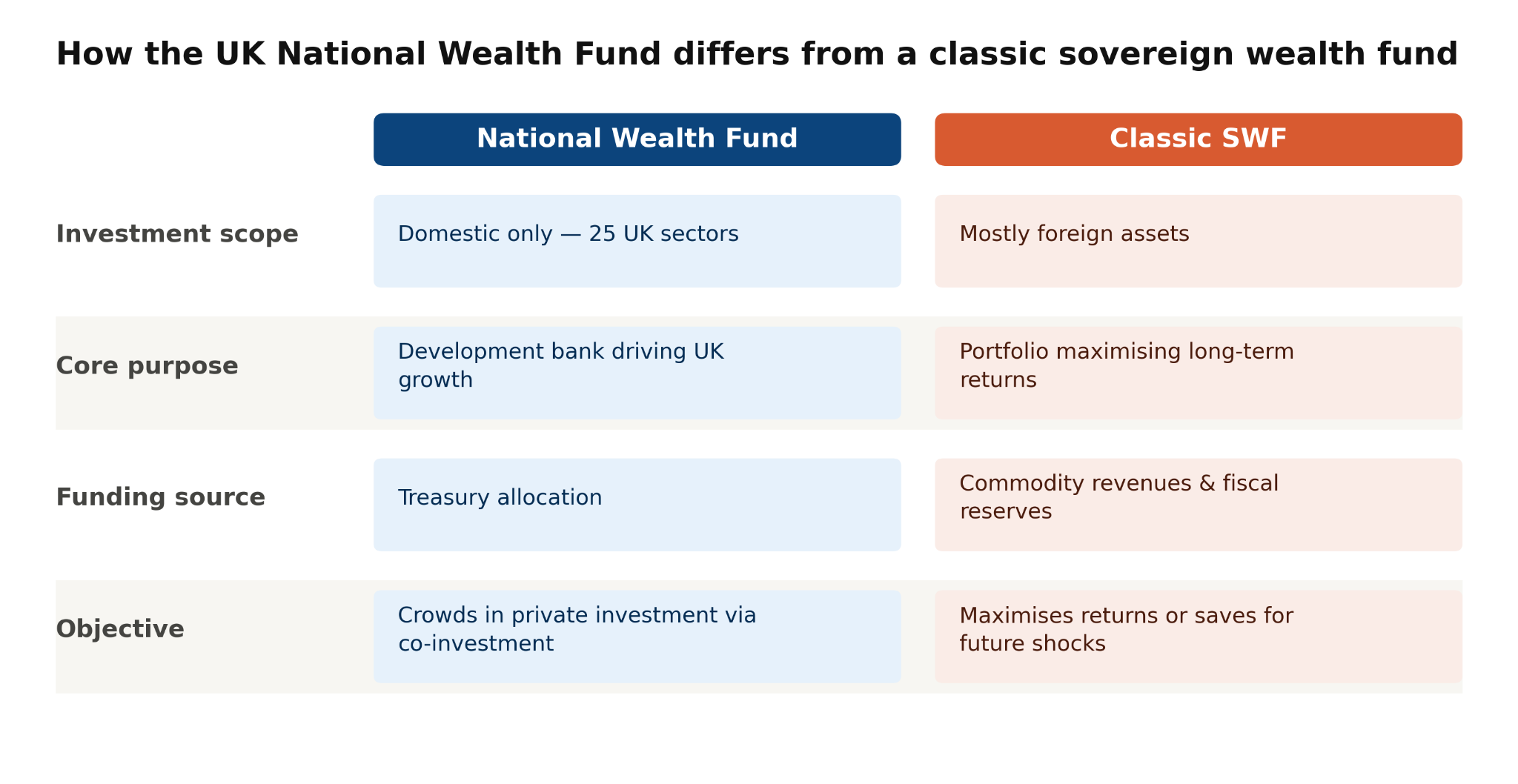
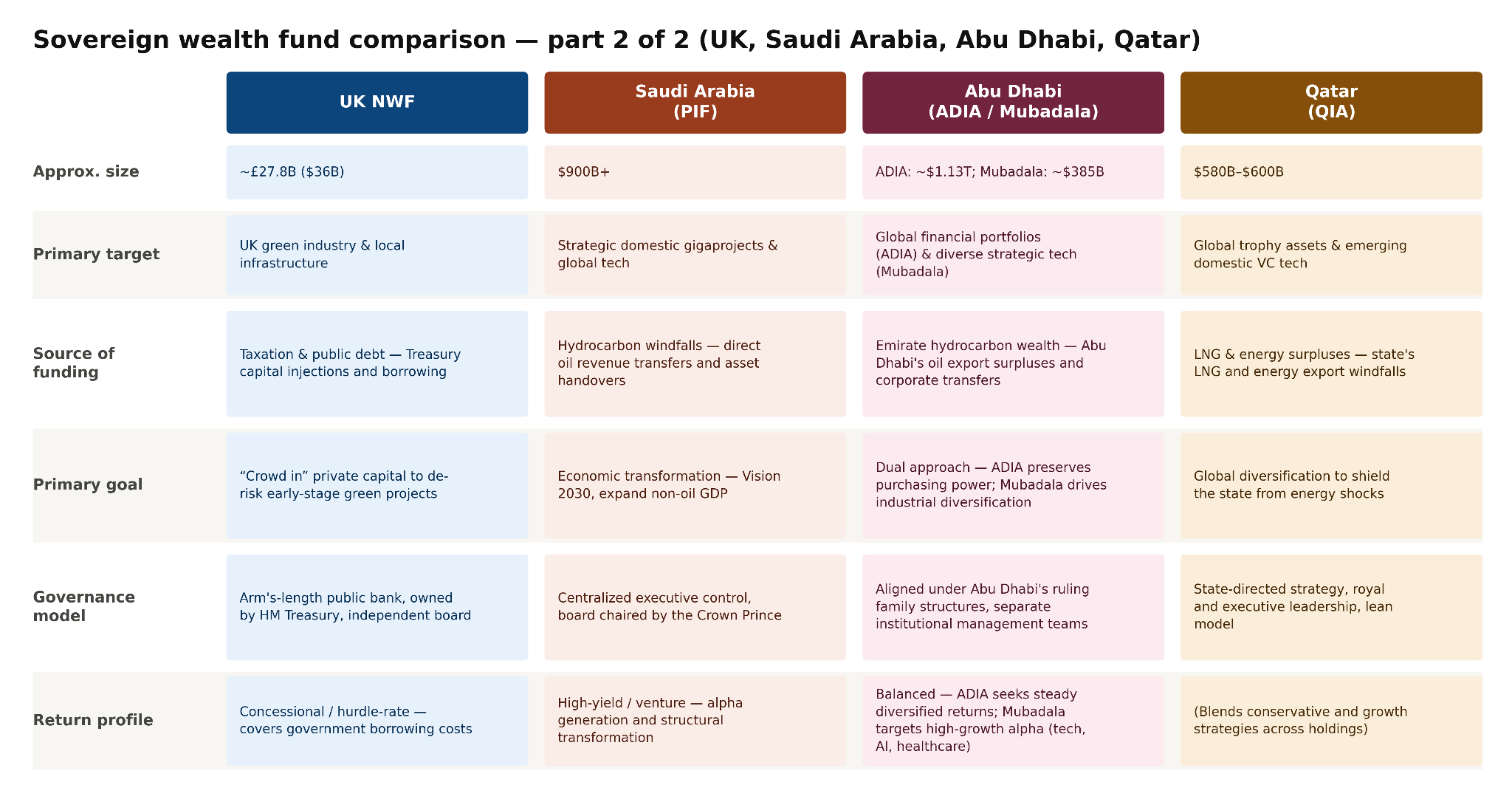
Another way to consider how the NWF differs from classic SWFs is to highlight differences between some popular SWFs.
For this purpose, we will focus on Norway’s Government Pension Fund Global, Singapore’s Temasek and GIC, and Gulf Sovereign Funds like the UAE’s Abu Dhabi Investment Authority (ADIA) and Mubadala Investment Company, the Qatar Investment Authority (QIA), and Saudi Arabia’s Public Investment Fund (PIF).
First, let’s consider the differences between the NWF and Norway’s and Singapore’s SWFs.
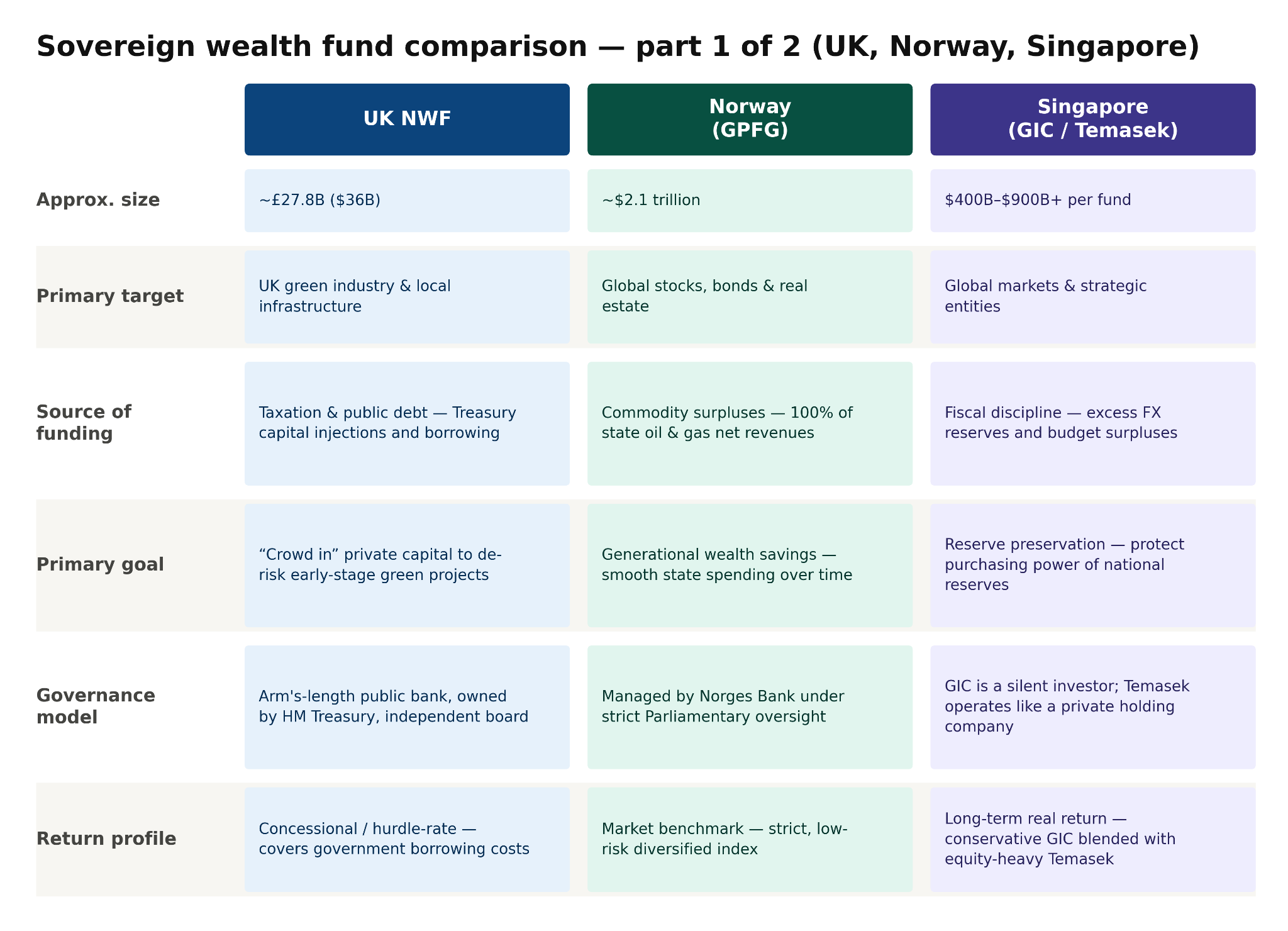
Next are the differences between the NWF and the Gulf States’ SWFs:
4. What does the NWF mean for institutional investors?
The UK's National Wealth Fund (NWF) creates a different route into UK infrastructure and strategic investment for institutional investors.
Rather than simply managing public wealth, it is designed to use government-backed capital to help finance projects and attract private investment.
For asset owners, this has several practical implications:
- Potential opportunities in UK infrastructure: The NWF's focus on infrastructure, clean energy, and economic growth could create opportunities for pension funds, insurers, and other institutional investors seeking exposure to long-term assets in the UK economy.
This can be seen in the growing popularity of UK infrastructure investment funds among institutional investors. In addition, co-investment opportunities are opening up since the NWF is structured to crowd in private capital. With this, asset owners can partner with government-backed financing in priority sectors.
- More opportunities for private capital: By participating in projects alongside private investors, the NWF can help support investment in areas where financing may otherwise be difficult to secure. This may be relevant to institutions looking for infrastructure debt, equity, or other private-market opportunities.
By using public capital to absorb early-stage risk, the fund makes projects more attractive to long-term investors seeking stable returns in priority sectors. It does this by taking lower-tier equity or junior debt positions in complex projects or issuing Sovereign Infrastructure Guarantees (SIGs) to boost the project’s credit rating.
This is why the NWF evaluates its impact through additionality measures. In other words, by how much the fund’s investments add value beyond what the private market would deliver on its own.
- Pipeline visibility: With NWF, institutional investors can gain access to a clearer, government-endorsed pipeline of investable projects with defined strategic priorities through the UK Infrastructure Bank.
Thus, they can quickly identify projects that align with their goals and explore opportunities for participation.
- Large-scale projects: The NWF targets a long-term leverage ratio of £3 of private capital for every £1 of public money deployed. This combination of public seed money with private capital allows it to take on mega-scale projects, resulting in the kind of institutional-grade assets asset owners are willing to back.
“For institutional investors, the interesting part is that the NWF can help make large projects easier to finance,” according to Deepak Shukla, the CEO of Pearl Lemon Capital, a business and property financing company. “It can use debt, equity and guarantees, with the government aiming to bring in more than £100 billion of additional private investment over five years.”
- The commercial “halo effect”: When the NWF backs a project, it signals to the market that the venture has passed rigorous commercial and financial due diligence. It also signals to global investors that the project aligns with the UK’s long-term industrial strategy and is unlikely to be derailed by regulatory or policy shifts.
However, this interest from global investors will not be automatic.
“The NWF only makes the UK attractive if it improves execution,” according to Dale Gremillion, a manager at Capital Home Mortgage, a mortgage financing company. “Investors do not just want a fund to exist; they want clear rules, credible underwriting, predictable approvals, and confidence that projects can move from application to funding without surprises.”
Global asset owners interested in infrastructure investing in the UK can benefit from conversations with UK-based asset owners already exploring the opportunities provided by the NWF.
UK-based asset owners new to infrastructure investing can also benefit from the same conversations.
At the cio investment club, we provide an avenue where such conversations can be had. We bring together asset owners and managers from across the globe to explore investment opportunities in both developed and emerging markets.
We also hold exclusive roundtables and investment breakfasts where finance experts can discuss and collaborate on interesting projects.
Do you want to become a member of an investing community that will help you spot opportunities in global financial markets? Register today to join the cio investment club.
Takeaways
- The UK has no traditional sovereign wealth fund equivalent to the one in Norway, Singapore, and the Gulf States.
- Though the National Wealth Fund is similar to traditional SWFs, it differs from them in its domestic focus and development focus.
- The NWF is designed to mobilise private capital. It uses government-backed funding to support UK infrastructure, clean energy, and strategic industries.
- With the NWF, institutional investors may find new opportunities as the fund supports co-investment, infrastructure financing, and access to government-backed projects across priority sectors.
This document is produced by Instaconnect Limited, trading as cio investment club, a company registered in England & Wales with registration number 15262951.
Instaconnect Limited is neither authorised nor regulated by the Financial Conduct Authority in the United Kingdom nor the Securities and Exchange Commission in the United States of America.
This document is a marketing documentation and is not intended to constitute an invitation or an inducement to engage in any investment activity. It is not intended to constitute investment advice and should not be relied upon as such. It is not intended and none of Instaconnect Limited, its holding companies or any of its or their associates, or any of the participants in the documentation, shall have any liability whatsoever for (a) investment advice; (b) a recommendation to enter into any transaction or strategy; (c) advice that a transaction or strategy is suitable or appropriate; (d) the primary basis for any investment decision; (e) a representation, warranty, guarantee with respect to the legal, accounting, tax or other implications of any transaction or strategy; or (f) to cause Instaconnect Limited to be an advisor or fiduciary of any recipient of this report or other third party.
The content and graphical illustrations contained in this document are provided for information purposes and should not be relied upon to form any investment decisions or to predict future performance. Instaconnect Limited recommends that recipients seek appropriate professional advice before making any investment decision. Although the information expressed is provided in good faith, Instaconnect Limited does not represent, warrant or guarantee that such information is accurate, complete or appropriate for your purposes and none of them shall be responsible for or have any liability to you for losses or damages (whether consequential, incidental or otherwise) arising in any way for errors or omissions in, or the use of or reliance upon the information contained in this document.
To the greatest extent permitted by law, we exclude all conditions and warranties that might otherwise be implied by law with respect to the document, whether by operation of law, statute or otherwise, including as to their accuracy, completeness, or fitness for purpose.
Instaconnect Limited and its logo are proprietary trademarks of Instaconnect Limited and are registered in the United Kingdom. Unauthorised copying of this document is prohibited.
© Copyright Instaconnect Limited 2026