




If you ever needed a confirmation of how volatile the oil and gas industry is, the US capture of Nicolas Maduro, the Venezuelan President, was another reminder.
In the aftermath of the capture, the share prices of US energy companies went up in response to Trump’s promise to tap into Venezuela's oil reserves, as reported by the BBC. The oil price also increased, as investors expressed concerns about a possible impact on crude oil supply.
Many analysts expect that the US control of Venezuelan oil reserves would increase oil supply and thus lower energy prices. However, such expectation may not materialise in the short term, according to Forbes, since Venezuela’s oil production infrastructure is currently poor.
The main point here is that oil and gas remain very volatile as they usually respond to geopolitical tensions, macroeconomic developments, political uncertainties, and natural disasters, among others.
Why then should you invest in such a volatile market? Simply put, the benefits of investing in oil and gas cannot be simply undone by its volatility. Thus, rather than shun these commodities, institutional investors should learn how to navigate them to their advantage.
In what follows, we examine the benefits of investing in oil and gas and discuss how to manage such investments effectively. We’ll cover:
- 8 benefits of investing in oil and gas
- How to manage the volatility of the oil and gas market
Do you want to learn more about trends in the global energy market and how to benefit from them? Sign up today for the cio investment club’s newsletter.
1. 8 benefits of investing in oil and gas
Below are some of the most powerful advantages of oil and gas investing:
1. Strong global demand
Despite the growing interest in and adoption of renewable energy, the global demand for oil and gas remains strong.
In December 2025, the International Energy Agency projected that global oil demand was on course for an 830 kb/d (thousand barrels per day) year-on-year (YoY) increase from its 2024 levels.
Looking ahead to 2026, they forecasted an even bigger increase: 860 kb/d YoY. They expect petrochemical feedstocks to dominate this growth, with their share of demand rising from 40% in 2025 to more than 60% in 2026.
Even if we take a long-term view of things, we can expect the same trend to persist, according to the IEA.
They predict that if current policies persist, oil demand will increase to 113 million barrels per day by 2050, driven by emerging and developing markets. Similarly, they expect natural gas demand to rise to 5,600 billion cubic metres by 2050, buoyed by strong demand in the Middle East and developing economies in Asia.
Oil and Gas Demand Through 2050
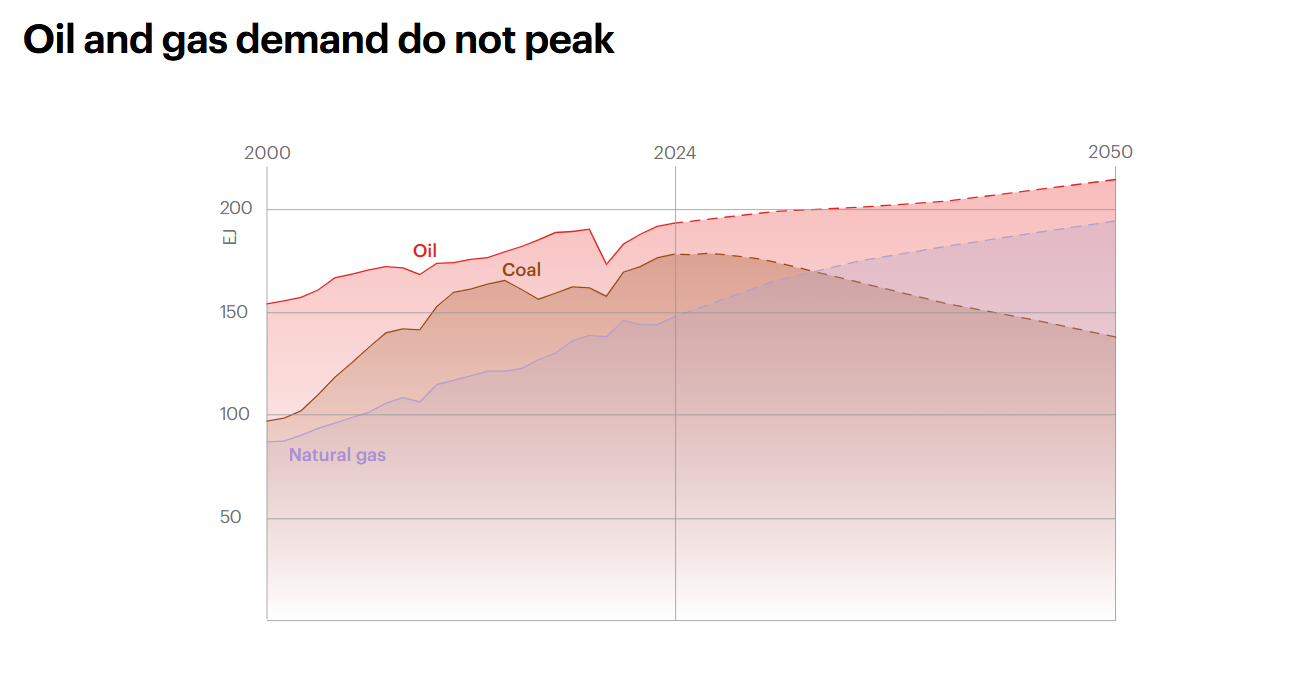
Source: International Energy Agency
“Oil underpins the global economy and is central to our daily lives,” according to the Organisation of Petroleum Exporting Countries (OPEC). “Out to 2050, we see oil demand continuing to expand and reaching 123 million barrels a day (mb/d). There is no peak oil demand on the horizon.”
On the production side, the IEA expect that constraints on oil production and trade sanctions should ease as we get closer to 2025, resulting in increased production, subject to the underlying economies of the affected countries. However, if geopolitical constraints remain, increased production will depend on greater infrastructure investment, which also bodes well for oil prices.
In other words, they expect the demand and supply dynamics to favour rising oil and gas prices till 2050.
Even in a Stated Policies Scenario (based on policies that have been adopted and put forward but not yet codified into law), IEA expect oil demand to keep rising till 2030 and gas demand till 2035.
In summary, the demand-supply dynamics of the oil and gas industry should remain beneficial to investors in the short (under stated policies) or long term (under current policies).
2. Portfolio diversification
When an asset has low correlation to other assets in a portfolio, its addition helps to lower the portfolio’s risk.
Commodities, in general, have served the role of portfolio diversifiers in traditional stock-bond portfolios.
For example, between January 1991 and June 2025, the correlation coefficients between commodities (measured by the Bloomberg Commodity Total Return Index) and US stocks (measured by the S&P 500 Total Return Index) and global bonds (measured by the Bloomberg Global-Aggregate Total Return Index) were 0.28 and 0.07, respectively, according to Pacific Investment Management Company (PIMCO), an investment management firm.
Correlation of Commodities with US Stocks and Global Bonds
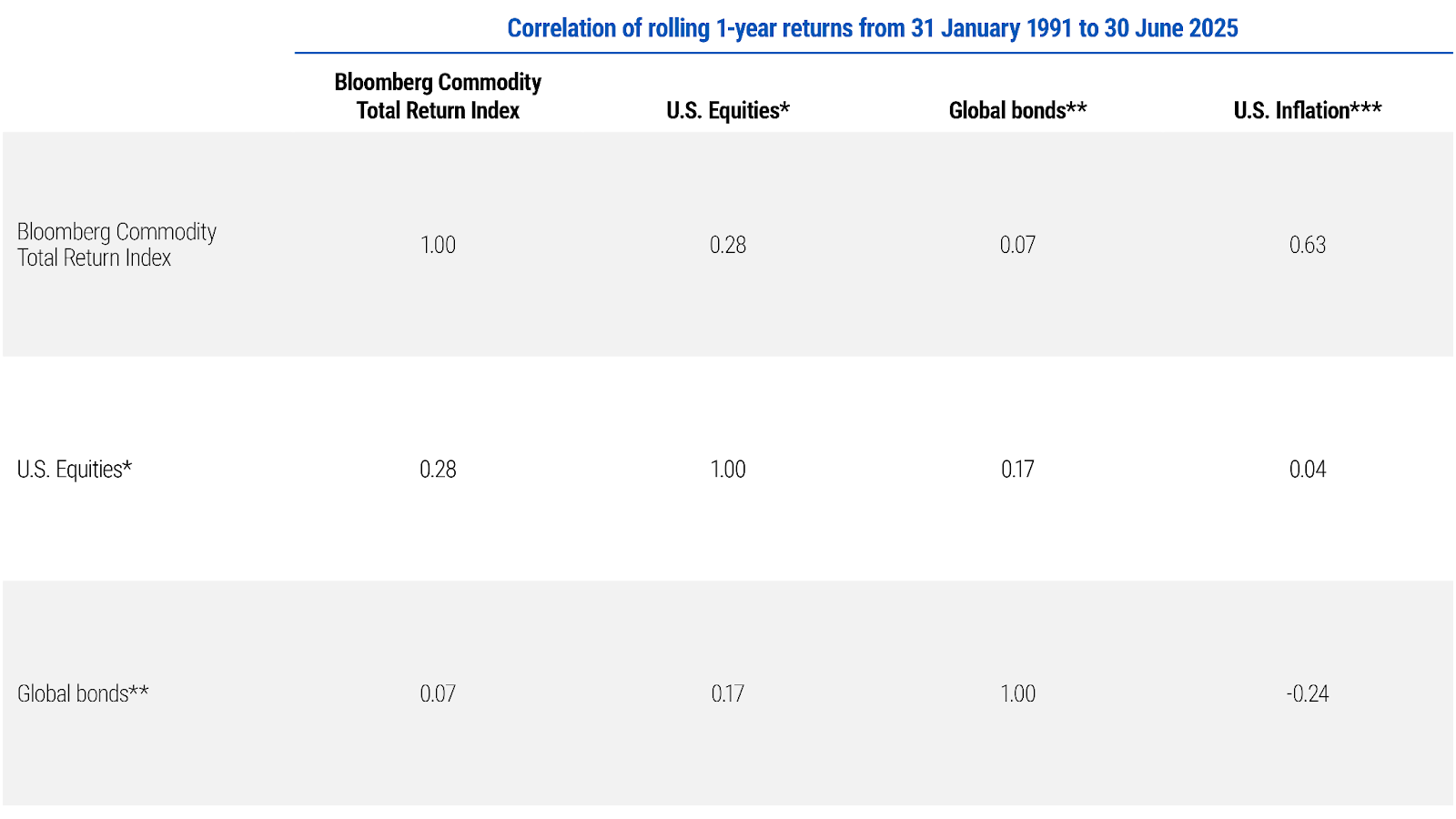
Source: PIMCO
The same weak correlation exists in the relationship between crude oil and the stock market, according to the Federal Reserve Bank of Cleveland. As far back as 2008, they noted that the correlation between the weekly averages of the S&P 500 Index and the spot oil price is weak and statistically insignificant over the previous 10 years.
More recent research reveals a similar pattern. As the chart below shows, the correlation coefficient between crude oil prices and the S&P 500 is mostly between -0.25 and 0.40, which is a weak correlation.
Correlation Between Crude Oil Prices and Other Asset Classes, Q1 2015 - Q1 2025
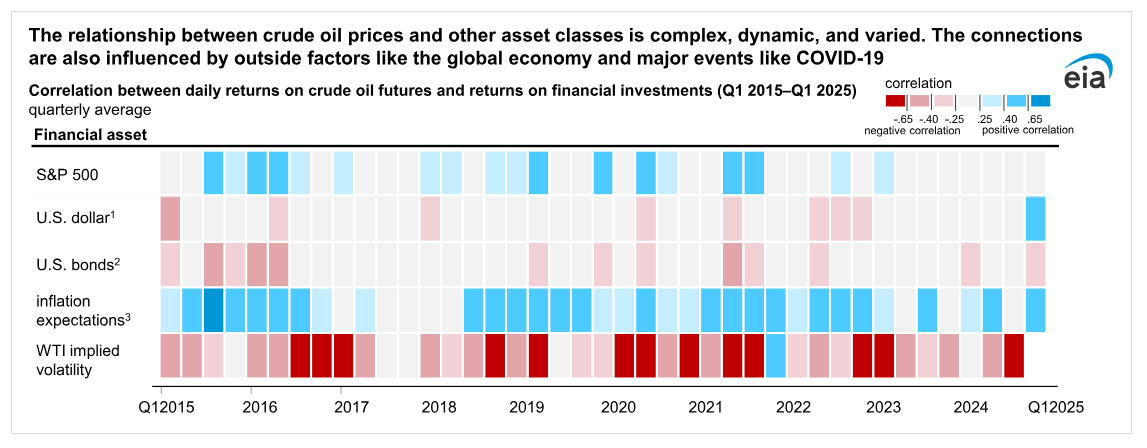
Source: US Energy Information Administration
The same pattern occurs with US bonds, where the correlation coefficient is mostly between -0.40 and 0.25.
This shows that crude oil can benefit investors as a diversifier of a traditional stock and bond portfolio.
3. High return potential
When an asset is volatile, it can create incredible returns for investors as a result of favourable market conditions.
For example, we have had at least seven years since 1946 (1974, 1979, 1999, 2002, 2007, 2009, and 2021) where the annual return of WTI crude oil was more than 50%, according to data from Macro Trends.
Annual Returns of WTI Crude Oil, 1946 - 2026
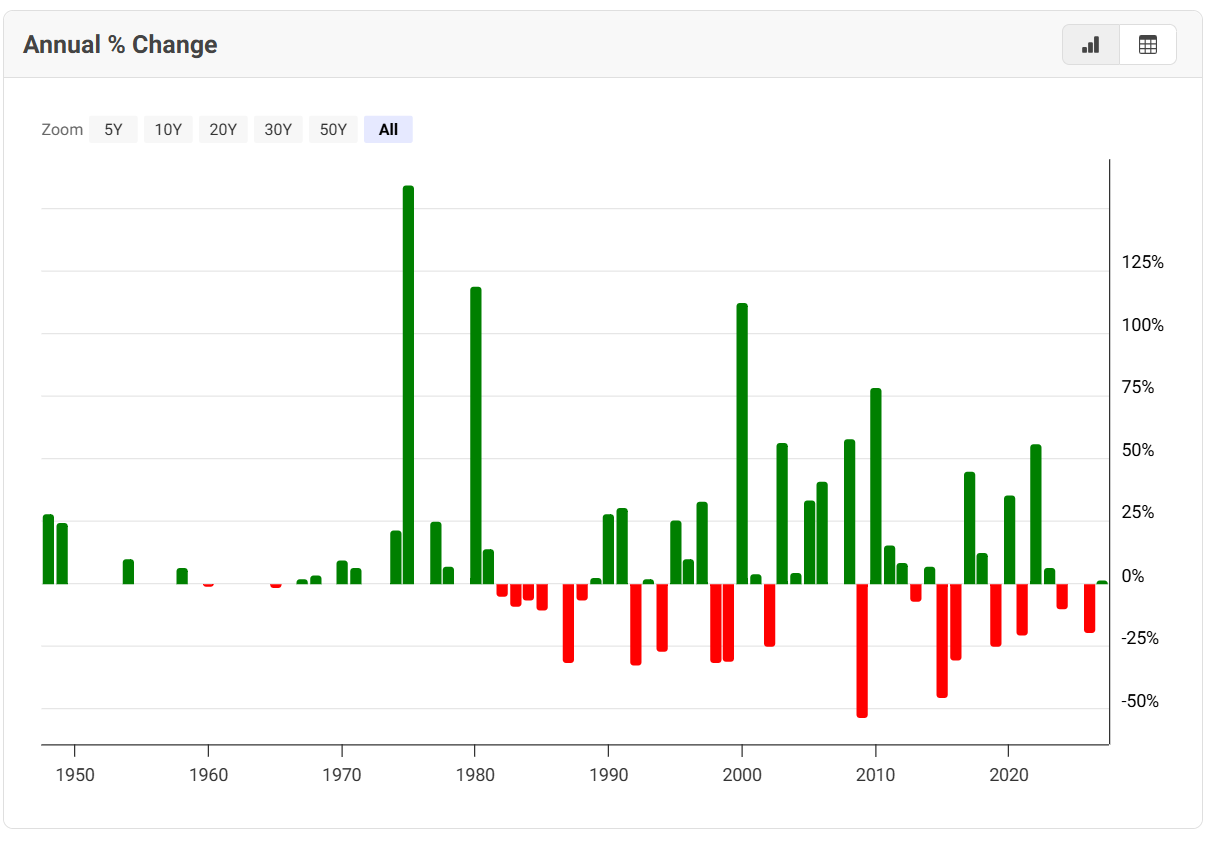
Source: Macro Trends
In contrast, the S&P 500 Index has only done this once: in 1954.
The chart above also shows that crude oil’s positive years exceed its negative years, and the returns during the former are usually larger than the latter.
Also, the energy component of systematic commodity investments usually contributes disproportionately towards returns, while the non-energy components tend to contribute towards the reduction of volatility, according to an academic article by Ilia Bouchouev, a managing partner at Pentathlon Investments and Lingchao Zuo, a senior quantitative analyst at National Grid, an electricity and gas utility company.
4. High risk-adjusted returns
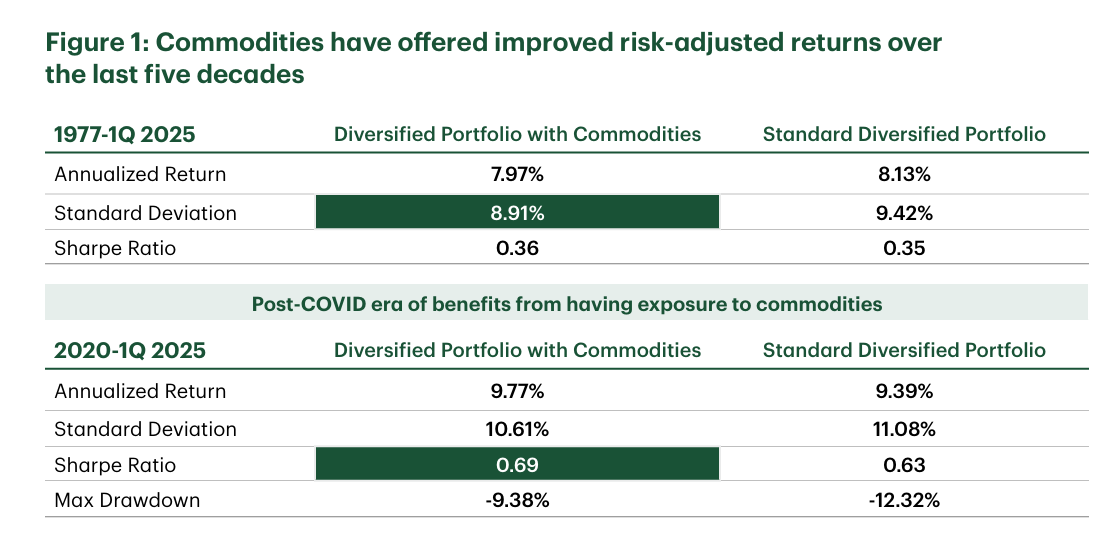
Adding commodities to a portfolio can also increase the risk-adjusted returns of such a portfolio.
As seen below, a diversified portfolio with commodities has a higher Sharpe ratio than a standard diversified portfolio (0.36 to 0.35).
How Commodities Reduce Risk and Improve Risk-Adjusted Returns
Source: TD Asset Management
But does this same relationship hold with oil and gas?
“Holders of portfolios of bonds and stocks can improve their risk-return trade-off by enlarging their portfolio with an investment in oil,” according to an academic paper available on Research Gate.
This is especially so in inflationary periods, where crude oil benefits from rising prices.
5. Inflation hedge
When Trump’s tariffs threatened to raise the inflation rate, many investors increased their allocations to crude oil futures. This reinforces the belief that oil and gas provide safe havens in inflationary periods.
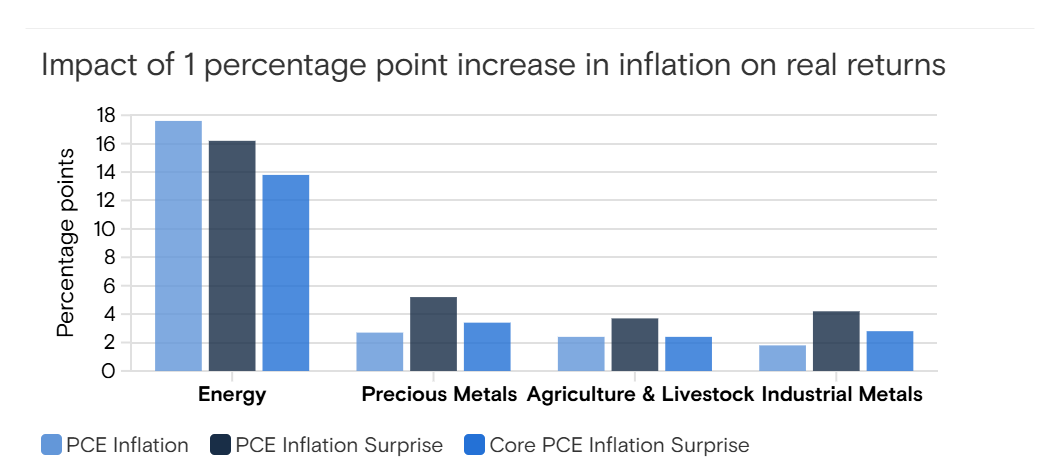
Such a belief is backed by hard data, as the chart below shows.
Response of Commodities’ Real Returns to Inflation
Source: Goldman Sachs
When inflation increases by 1%, crude oil experiences the highest increase in real returns compared to other commodities.
This is supported by an academic article published by Hilary Till, a research associate at EDHEC-Risk Institute, an academic research centre created by the EDHEC Business School. He reviewed studies that show that while all commodities can provide an inflation hedge for bond portfolios, crude oil is required to effectively hedge stock portfolios.
6. Strong liquidity
One of the benefits of investing in oil and gas is that the market is very liquid.
As we have seen, oil and gas play crucial roles in the global economy. There is hardly any sector that does not feel the impact of the oil and gas market.
Crude oil futures, traded in the New York Mercantile Exchange (NYMEX) and the Intercontinental Exchange (ICE), are among the most actively traded derivatives globally.
“Over 1 million contracts of WTI futures and options trade daily, with approximately 4 million contracts of open interest,” according to the CME Group.
Millions of crude oil ETFs are also traded on various stock exchanges.
This strong liquidity ensures that institutional investors can enter and exit their positions quickly without a large price impact. It also guarantees tight bid-ask spreads, which lowers transaction costs and supports efficient price discovery.
7. High dividend yields
Some institutional investors prefer to invest indirectly in oil and gas through energy stocks and ETFs. This can especially be a good strategy for those with an income-focused strategy.
Oil and gas stocks and funds often provide high dividend yields that can prove beneficial for institutional investors seeking passive income.
The basic materials sector has the highest dividend yield in the US at 4.92%, according to Dividend.com.
“The highest yielding industries in this basic materials sector are Oil & Gas Equipment & Services and Oil & Gas Refining & Marketing. Both of these industries have average yields over 5%.”
This high dividend yield is supported by strong free cash flows generated by oil and gas companies when oil prices rise.
8. Government support
Given the importance of oil and gas to global economic growth, governments across the globe often support oil and gas operators through subsidies, tax incentives, favourable policies, direct investment, and regulatory support.
For example, in the US, some of the tax benefits of investing in oil and gas include tax deductions of tangible drilling costs (expenditures for drilling equipment), depletion allowance (15% of gross income from oil and gas wells is tax-free), and tax deductions of intangible drilling costs (IDCs). All of these provide advantages to companies in the oil and gas sector.
Some countries also reduce corporate income tax rates for oil companies to attract foreign investment in new drilling projects.
All of these tax advantages (and related incentives) can support lower project costs, higher profitability, stable free cash flows, and greater interest in developing new energy projects. Consequently, they can make investments in oil and gas companies (through stocks and ETFs) profitable.
They also make many institutional investors interested in direct participation programs (DPPs) where they can join partnerships and joint ventures that invest in oil and gas exploration and development projects.
2. How to manage the volatility of the oil and gas market
Though the benefits of investing in oil and gas are numerous, the volatility of the market remains a concern.
How can you enjoy the advantages of oil and gas investing while navigating the risk introduced by high volatility?
There are three points to note:
- A commodities portfolio is a safer approach: When discussing the high return potential of crude oil, we mentioned an academic study that showed that while energy contributes disproportionately to the returns of a systematic commodities portfolio, non-energy commodities tend to help lower volatility.
Thus, a portfolio of commodities that includes energy and non-energy assets (gold and silver, other precious metals, industrial metals, and agricultural commodities, among others) may be the best way to navigate the high volatility of oil and gas.
- Consider other ways to invest in the oil and gas market: If direct investment opportunities like futures, options, exchange-traded commodities (ETCs), contracts for difference (CFDs), and DPPs are too volatile, you can consider indirect exposure through crude oil and natural gas stocks or exchange-traded funds (ETFs).
Though the stock prices of oil and gas companies are positively correlated with the spot prices of crude oil and natural gas, the correlation coefficient is not 1.
Companies with a diversified revenue base, strong free cash flow, sound management, and a sustainable economic moat can have stock prices that are less volatile than oil and gas prices.
This makes such indirect investing more appropriate for investors with lower risk tolerance.
- Employ an active management approach: Since oil and gas are volatile, you need to actively manage your exposure to them.
When inflation (or inflation expectations) rise, you may need to increase exposure to the oil and gas market. However, when geopolitical tensions, supply chain disruptions, or other macroeconomic developments (interest rate fluctuations) pose a big threat to energy prices, you may need to dial down on your allocation to the market a bit.
Also, though demand for fossil fuels continues to rise, renewable energy remains a viable energy supply rival in the medium-to-long-term. Keeping an eye on developments in this space can also help you manage your allocations to oil and gas.
At cio investment club, we provide you with a network of asset owners and managers with whom you can share information and ideas about the energy sector. By having lively discussions with other financial experts, you can make better portfolio allocation decisions.
We also organise exclusive roundtables and investment breakfasts where you can have face-to-face interactions and one-on-one networking sessions with other club members.
Are you ready to become a part of an investment community that will help you make sound investment decisions? Register today to join the cio investment club.
Takeaways
- Oil and gas prices react sharply to geopolitics and macro shocks, but that same volatility creates return opportunities for skilled investors.
- Despite the energy transition, global oil and gas demand is expected to keep rising, driven by emerging and developing markets.
- Low correlation with stocks and bonds, strong inflation-hedging properties, and high liquidity make energy a powerful diversifier.
- The best results come from diversified commodity exposure, selective energy equities, and dynamic allocation based on inflation and geopolitical risks.
This document is produced by Instaconnect Limited, trading as cio investment club, a company registered in England & Wales with registration number 15262951.
Instaconnect Limited is neither authorised nor regulated by the Financial Conduct Authority in the United Kingdom nor the Securities and Exchange Commission in the United States of America.
This document is a marketing documentation and is not intended to constitute an invitation or an inducement to engage in any investment activity. It is not intended to constitute investment advice and should not be relied upon as such. It is not intended and none of Instaconnect Limited, its holding companies or any of its or their associates, or any of the participants in the documentation, shall have any liability whatsoever for (a) investment advice; (b) a recommendation to enter into any transaction or strategy; (c) advice that a transaction or strategy is suitable or appropriate; (d) the primary basis for any investment decision; (e) a representation, warranty, guarantee with respect to the legal, accounting, tax or other implications of any transaction or strategy; or (f) to cause Instaconnect Limited to be an advisor or fiduciary of any recipient of this report or other third party.
The content and graphical illustrations contained in this document are provided for information purposes and should not be relied upon to form any investment decisions or to predict future performance. Instaconnect Limited recommends that recipients seek appropriate professional advice before making any investment decision. Although the information expressed is provided in good faith, Instaconnect Limited does not represent, warrant or guarantee that such information is accurate, complete or appropriate for your purposes and none of them shall be responsible for or have any liability to you for losses or damages (whether consequential, incidental or otherwise) arising in any way for errors or omissions in, or the use of or reliance upon the information contained in this document.
To the greatest extent permitted by law, we exclude all conditions and warranties that might otherwise be implied by law with respect to the document, whether by operation of law, statute or otherwise, including as to their accuracy, completeness, or fitness for purpose.
Instaconnect Limited and its logo are proprietary trademarks of Instaconnect Limited and are registered in the United Kingdom. Unauthorised copying of this document is prohibited.
© Copyright Instaconnect Limited 2026