




The year 2025 was a great one for collateralized debt obligations (CDOs) as sales of collateralized loan obligations (CLOs), the biggest CDO segment, in the US reached a new all-time high (ATH).
Issuance in Europe and Asia also grew significantly, making this a global phenomenon.
Despite economic uncertainty, there was a strong demand for CLOs from institutional investors, especially pension funds and insurance companies, according to Bloomberg.
CDOs are expected to continue to thrive in 2026, backed by lower interest rates, more active refinancing, lower collateral defaults, and more leveraged buy-out (LBO) activity.
Yet, economic slowdown, interest rate uncertainty, and illiquidity in secondary markets remain relevant concerns for investors in CDOs.
In what follows, we consider the outlook for the collateralized debt obligations market and how to manage the risks associated with CDO investing:
- The general outlook for credit markets in 2026
- Digging deeper: The outlook for collateralized debt obligations in 2026
- Investing in CDOs in 2026: How to manage risks
Do you want to learn more about the trends shaping various capital markets? Sign up today for the cio investment club’s newsletter.
1. The general outlook for credit markets in 2026
Analysts expect that current trends in the broader credit market are likely to continue into 2026.
Some of the most significant ones include:
- Strong fundamentals: In 2025, the fundamentals of the credit market improved, especially in the US and Europe.
Default rates decreased, more corporate borrowers refinanced their debt and deleveraged, corporate balance sheets became healthier, and interest coverage improved, according to Carlyle, a global investment firm.
They also noted that the distressed ratio of the credit market held around 6%, which is close to its historic low.
“Earnings have remained solid, and two more potential rate cuts from the Federal Reserve (Fed) – if delivered – should help further enhance interest coverage levels,” according to TwentyFour Asset Management, a London-based investment firm.
- Refinancing and debt repricing: TwentyFour Asset Management noted that an increase in refinancing activities meant debt repricing due to lower interest rates.
Although this led to higher interest coverage for issuers, it meant that the cash flow available to CLO equity holders, for example, became smaller.
They expect repricings to continue in both the US and Europe, though it would be more aggressive in the former.
- Lower defaults and the normalisation of liability management exercises (LMEs): TwentyFour Asset Management also expects loan defaults to reduce a bit in 2026.
However, they believe that the use of LMEs as an alternative to bankruptcies will become more standard in the US, since it is cheaper, more flexible, and keeps the company operating.
- Rising M&A and LBO activities: Rising M&A, refinancing, increasing LBOs, and deal flow in private equity are four factors that will be responsible for the rebound in leveraged finance markets in 2026, according to Moody’s, a global financial services firm.
In other words, we can expect more loan supply in 2026.
- Lower financing costs and increasing deal flow: Finally, Moody’s expects that lower financing costs and stabilised rates will contribute to rising deal flow and loan creation in 2026.
“Lower financing costs and stabilising rates will unlock new deal flow, particularly in noncyclical sectors like technology, healthcare, and business services,” they noted. “Mega deals will increasingly rely on hybrid financing, combining syndicated loans and private credit.”
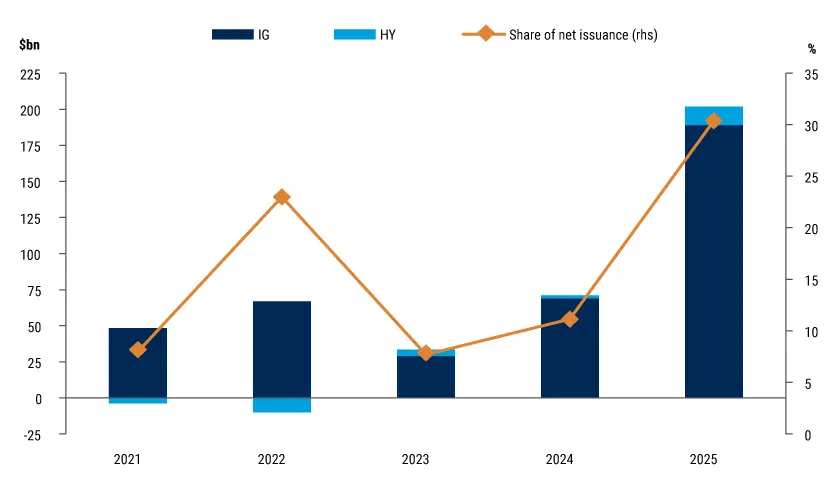
- Growth in AI issuances: Technology companies are now funding AI build-outs with debt rather than relying only on internal cash flow, according to PineBridge Investments, an investment management firm.
Issuance of Investment-Grade and High-Yield Bonds by Technology Companies
Source: PineBridge Investments
They expect this trend to continue.
2. Digging deeper: The outlook for collateralized debt obligations in 2026
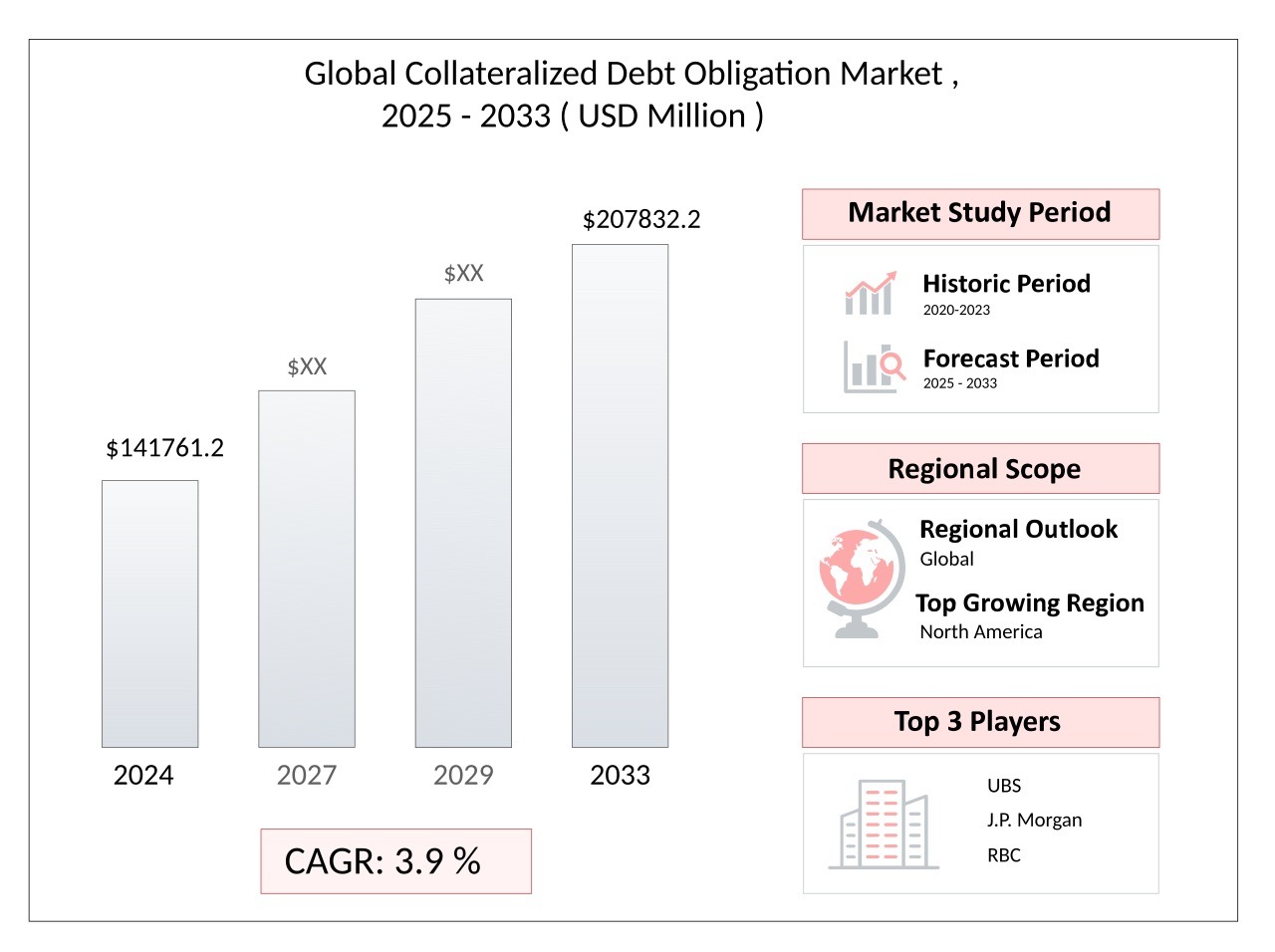
The CDO market is projected to grow at a 3.9% compounded annual growth rate (CAGR) to become a $207.8 billion market by 2033, according to The Market Intelligence, a market research company.
Global Collateralized Debt Obligation Market
Source: The Market Intelligence
We can define CDOs in terms of the debt instruments that act as collateral or underlying assets behind them.
The major types are collateralized loan obligations (CLOs), collateralized bond obligations (CBOs), collateralized synthetic obligations (CSOs, also known as synthetic CDOs), and structured finance CDOs (where we have mortgage-backed securities and asset-backed securities).
Also, for every CDO product, there are tranches with diverse risk-reward profiles. Senior tranches have the highest priority, resulting in a low-risk, low-yield profile. After them are mezzanine tranches with a moderate risk-moderate yield profile. At the bottom are equity tranches with a high-risk, high-yield profile.
It is important to re-emphasise these distinctions as we consider some of the trends that will shape each CDO market in 2026.
Outlook of the collateralized loan obligations market
The CLO market is the biggest and most liquid of all CDO markets. It is also the one analysts tend to focus their attention on as an indicator of the health of the overall CDO market.
Below are some of the trends shaping it in 2026:
- Strong fundamentals will persist in the CLO market: Companies issuing leveraged loans (bank loans) continue to maintain healthy balance sheets due to stable revenue and earnings growth, according to PineBridge.
They expect that lower interest rates will further reinforce this soundness, leading to lower default rates and LMEs.
However, they expect that lower interest rates could also reduce coupon yields on CLOs, making the current advantage they have over high-yield bonds (with similar credit ratings) less compelling.
- Demand for CLOs will continue to increase in Europe and the US: US and Japanese banks, on the one hand, and European pension funds, on the other hand, will continue to drive demand for CLOs, according to TwentyFour Asset Management.
Also, European insurers and banks will stimulate demand for AAA CLOs (senior tranches) as they compensate for the expected drop in demand by US insurance companies.
Moody’s also believes that rising M&A and LBO activity will spur new CLO issuance
- Higher demand and lower financing costs will reduce collateral defaults: Lower rates (due to Fed rate cuts) and extended maturities (due to refinancing) will reduce collateral defaults in the US, according to Moody’s.
They expect the same fall in default rates in the Europe, Middle East, and Africa (EMEA) market: “Strong liquidity and investor demand will keep defaults low and issuance high, with 2026 volumes near 2025’s €55 billion record.”
- Performance dispersion in the CLO market: The CLO market, especially CLO equity, continues to see dispersion in performance across CLO or collateral managers. This dispersion will continue as the economic cycle extends, according to TwentyFour Asset Management. Moreover, it is no longer a US affair, as even European loan markets are seeing dispersion among various issuers.
Proactive managers who have reduced position sizes, increased granularity, and limited exposure to struggling industries like chemicals, retail, and building materials are lowering risk and increasing flexibility.
Furthermore, there is a dispersion in performance between CLO resets (older deals that are being refinanced) and new issues, a trend they expect to continue.
All of these mean that manager selection is now crucial when investing in the US and European CLO market (especially in CLO equity).
“We believe a nimble and robust bottom-up approach to security selection is paramount given the dispersion in the loan market,” according to PineBridge.
- Tight spreads will make flexibility harder: We noted above that the spreads on US CLOs compared to high-yield bonds have been narrowing due to lower interest rates and rising demand.
Moody’s believes that such tight spreads will reduce managers’ flexibility in both the US and Europe. In other words, they will have fewer opportunities to optimise their portfolios by trading loans for better carry, relying instead on credit monitoring.
- High valuation of US senior tranche CLOs will reinforce interest in Europe: TwentyFour Asset Management believes that the pricing levels of US AAA CLOs will encourage reallocation to European AAA CLOs.
“For AAAs we continue to favour European over US CLOs; there is currently a 25-30bp currency-adjusted spread differential here that generally makes Euro AAAs look cheap (at Euribor + 1.3%), and we think they can benefit more from an increase in insurance demand in the longer run,” they said.
They also prefer European CLOs at the equity tranche level because of their less aggressive repricing and the conservative approach of their CLO managers.
Outlook of the collateralized bond obligations market
The CBO market is a very niche market, with neither the level of supply nor demand of the CLO market. Interest in the CBO market often follows from a more liquid CLO market.
Some of the trends that will define the CBO market in 2026 include:
- Rising valuations: Lower interest rates will make fixed-rate Treasury and corporate bonds look more attractive, resulting in higher bond prices. As the prices of the collateral assets of CBOs increase, their mark-to-market valuations will follow the same trajectory.
- Growing supply of underlying collateral: Lower borrowing costs will encourage companies to issue new bonds and refinance existing debt. This will lead to a greater supply in the collateral pool of CBOs and can encourage new issuances.
- Growing demand for CBOs: As lower rates reduce yields in traditional fixed income, investors may find CBOs more attractive as they search for higher returns.
- Spread compression: The higher demand for CBOs can then lead to rising prices and lower yields, resulting in spread compression.
Outlook of the synthetic collateralized debt obligations market
The synthetic CDOs market became popular as investors increasingly embraced the use of credit default swaps (CDS) for risk transfer and structured products for higher yields.
Banks and hedge funds in Europe and North America use CSOs for hedging, and the Asia-Pacific market is also catching up (despite concerns about counterparty risk).
Some of the trends that will shape this market in 2026 include:
- Rising demand for CDOs and growth in the CDS market: The rising demand and supply in CDOs market will lead to more interest in CSOs. This will be aided by growth in the credit derivatives market, resulting from increased liquidity and better electronic trading protocols.
- Growing interest in risk customisation: As institutional investors embrace risk customisation, CSOs will become popular, especially in an environment of yield compression.
- Lower default rates may lower demand: However, the expectation of lower default rates in the broader credit market may make some investors see CDOs as superfluous in the short term.
Outlook of the structured finance collateralized debt obligations market
The structured finance CDOs market includes asset-backed securities, residential mortgage-backed securities, and commercial mortgage-backed securities.
Given that the underlying assets are usually mortgage loans, corporate debt, and consumer debts, they are usually affected by larger macroeconomic factors (economic growth, inflation, and unemployment).
Some of the factors that will shape this market in 2026 include:
- Refinancing will increase in the commercial real estate (CRE) market: Continued economic growth and declining short-term rates will lead to more refinancing activities in the US CRE market, according to Moody’s.
As we saw in the case of CLOs, this will reduce credit risk and increase interest coverage for commercial mortgage-backed securities (CMBS). Also, investors in senior tranches benefit from lower risk.
However, when refinancing happens in a low-interest environment, the cash available for equity tranche investors will reduce.
- Uneven performance across CMBSs: Sectors like data centres, multifamily housing, industrials, and warehouse will keep thriving in 2026, while office spaces, traditional retail, and hospitality may continue to struggle.
This mixed performance will likely result in uneven performance across CMBSs, resulting in performance dispersion.
- Mixed geographical performance in residential MBS (RMBS): Moody’s expects risk in American RMBS to increase due to policy uncertainty. In contrast, they believe low unemployment and wage growth will support strong performance in Japan. They also expect strong performance in Australia.
- Lower interest rates will support refinancing and new issues in RMBS: Lower interest rates should continue to support refinancing and new issues, even though this comes with added risk for equity tranche investors.
- Mixed geographical performance in asset-backed securities: Moody’s expects policy uncertainty to also affect American ABSs. They also expect weakness in Chinese ABSs, strong performance in Japanese ABSs, and stable performance in European ABSs.
- The technology sector can support ABSs: Strong demand for AI infrastructure and cloud services can provide stability for ABSs that are heavily weighted in them, according to Moody’s.
3. Investing in CDOs in 2026: How to manage risks
Certain important factors have been repeatedly emphasised in the outlook for each CDO market. Paying attention to these factors and designing your investment strategy around them will be crucial for successful investment in this market.
We highlight those factors and how you can navigate them below.
Regional diversification
In the CLO market, we notice how high valuations in the US could drive investors to diversify into the European market.
For structured finance, we saw that Japan’s strong macroeconomic situation makes it attractive for investment in ABSs and RMBSs.
Also, when it comes to synthetic CDOs, North America and Europe continue to dominate.
The point here is that geographical diversification, rather than overconcentration in a single market, may be the best way to navigate the CDO market in 2026.
“In a market that we view as fairly priced and stable, fixed income investors will benefit from a cautious but constructive approach that balances yield retention with diversification across geographies and sectors,” said PineBridge.
Selecting the right managers
We also noted that performance dispersion will continue to be the hallmark of the CLO and CMBS markets, among others. This fact reinforces that the selection of managers (who bundle products from various lenders) will be crucial when investing in CDOs.
The important factors to consider are managers’ approach to risk management (especially in a post-Great Financial Crisis world), portfolio diversification, sector rotation, CDO structures (including the management of special purpose vehicles), credit quality control, overcollateralization requirements by rating agencies, credit enhancement, and other aspects of the securitization process.
Embracing a defensive portfolio bias
Given the situation with spread compression and high valuations (especially in the US), a defensive portfolio bias may be more appropriate in the short-term.
“While we believe CLOs’ total return potential looks attractive relative to similarly rated fixed income assets, tight valuations tilt us toward an incrementally more defensive portfolio bias,” said PineBridge.
Awareness of macro factors
Though broader macroeconomic factors are important for every type of CDO, they are especially crucial for structured finance CDOs due to the nature of the debt securities behind them.
Unexpected and severe changes in the macroeconomic situation can change the outlook of particular CDO markets or the broader market itself. For example, if inflation worsens and the interest rate goes up, for whatever reason, we will be in a different situation that requires a different approach.
Thus, institutional investors should always keep an eye on the global economy to quickly spot trends that are important to their portfolio management choices.
One way to do this is to become a part of an investment community where you can keep up on the latest developments in the global economy.
This is what we provide at cio investment club. We connect you with asset owners and managers from across the globe with whom you can exchange information and ideas that will help you make smarter investment choices.
We also organise exclusive roundtables and investment breakfasts where you can have face-to-face interactions and networking sessions with other club members.
Are you ready to become a part of an investment community that will help you make better portfolio allocation decisions? Register today to become a member of the cio investment club.
Takeaways
- Lower interest rates, refinancing activity, and healthier corporate balance sheets are expected to support issuance and performance across CDO markets.
- High US valuations are driving interest toward European CLOs, while Japan stands out in structured finance. Synthetic CDOs benefit from risk customisation but face softer demand if defaults remain low.
- Strong demand and low defaults persist, yet tight spreads and performance dispersion mean returns will increasingly depend on the collateral manager’s skill, especially in equity tranches.
- Regional diversification, defensive positioning, macro awareness, and disciplined manager selection will define successful CDO investing this cycle.
This document is produced by Instaconnect Limited, trading as cio investment club, a company registered in England & Wales with registration number 15262951.
Instaconnect Limited is neither authorised nor regulated by the Financial Conduct Authority in the United Kingdom nor the Securities and Exchange Commission in the United States of America.
This document is a marketing documentation and is not intended to constitute an invitation or an inducement to engage in any investment activity. It is not intended to constitute investment advice and should not be relied upon as such. It is not intended and none of Instaconnect Limited, its holding companies or any of its or their associates, or any of the participants in the documentation, shall have any liability whatsoever for (a) investment advice; (b) a recommendation to enter into any transaction or strategy; (c) advice that a transaction or strategy is suitable or appropriate; (d) the primary basis for any investment decision; (e) a representation, warranty, guarantee with respect to the legal, accounting, tax or other implications of any transaction or strategy; or (f) to cause Instaconnect Limited to be an advisor or fiduciary of any recipient of this report or other third party.
The content and graphical illustrations contained in this document are provided for information purposes and should not be relied upon to form any investment decisions or to predict future performance. Instaconnect Limited recommends that recipients seek appropriate professional advice before making any investment decision. Although the information expressed is provided in good faith, Instaconnect Limited does not represent, warrant or guarantee that such information is accurate, complete or appropriate for your purposes and none of them shall be responsible for or have any liability to you for losses or damages (whether consequential, incidental or otherwise) arising in any way for errors or omissions in, or the use of or reliance upon the information contained in this document.
To the greatest extent permitted by law, we exclude all conditions and warranties that might otherwise be implied by law with respect to the document, whether by operation of law, statute or otherwise, including as to their accuracy, completeness, or fitness for purpose.
Instaconnect Limited and its logo are proprietary trademarks of Instaconnect Limited and are registered in the United Kingdom. Unauthorised copying of this document is prohibited.
© Copyright Instaconnect Limited 2026