




Growth and value investing have long dominated institutional portfolio construction.
Asset managers were often torn between finding undervalued gems and betting on relatively overvalued companies with strong growth potential to justify their current valuations.
However, other factors drive expected returns, including momentum, quality, low volatility, liquidity, and dividend yield. Also, rather than choosing a single factor, a multi-factor approach can help stabilise returns across market cycles.
With factor investing, asset managers can now build portfolios that target multiple characteristics that drive higher expected returns or lower risk.
This lets them adopt a systematic approach to diversification and return generation that sits between passive and active management.
Yet, factor investing remains complex, with specific risk factors and limitations. In this article, we explore why this strategy is gaining popularity and how institutional investors can best combine it with other traditional methods.
- Why factor investing? Factors driving adoption
- How institutional investors are adopting factor investing
- The risks and limitations of factor investing
- Approaching factor investing: Some pointers for institutional investors
Want to keep a tab on the latest news and trends in the investment world? Subscribe today to the cio investment newsletter for expert insights that will improve your investment decisions.
1. Why factor investing? Factors driving adoption
The traditional Capital Asset Pricing Model (CAPM) explained expected stock returns based on a single variable: overall market risk.
Factor investing extends this approach by examining several factors that historically drive higher returns or lower risk. Popular drivers of return include value, size, momentum, quality, low volatility, and dividend/yield.
While some portfolio managers focus on individual factors, many use a multi-factor approach that combines multiple factors in a single portfolio.
Like passive investing, it uses a rules-based, systematic approach to portfolio construction, but it differs from the market portfolio by aiming for higher returns (factor premium) and reduced risk. It also uses factor weighting (smart beta) instead of market-cap weighting, reflecting the importance of the selected factor(s).
Though it seeks to generate alpha (excess return) like active investing, it is rules-based rather than discretionary. Assets are also selected based on desired factors rather than the manager’s judgment.
Why are institutional investors gravitating towards this middle-ground approach between active and passive investing?
- Maximising individual market cycles: Factors thrive in different market cycles. In a survey of growth, value, and quality as factors driving higher returns, J.P. Morgan found that each factor performs well under different conditions.
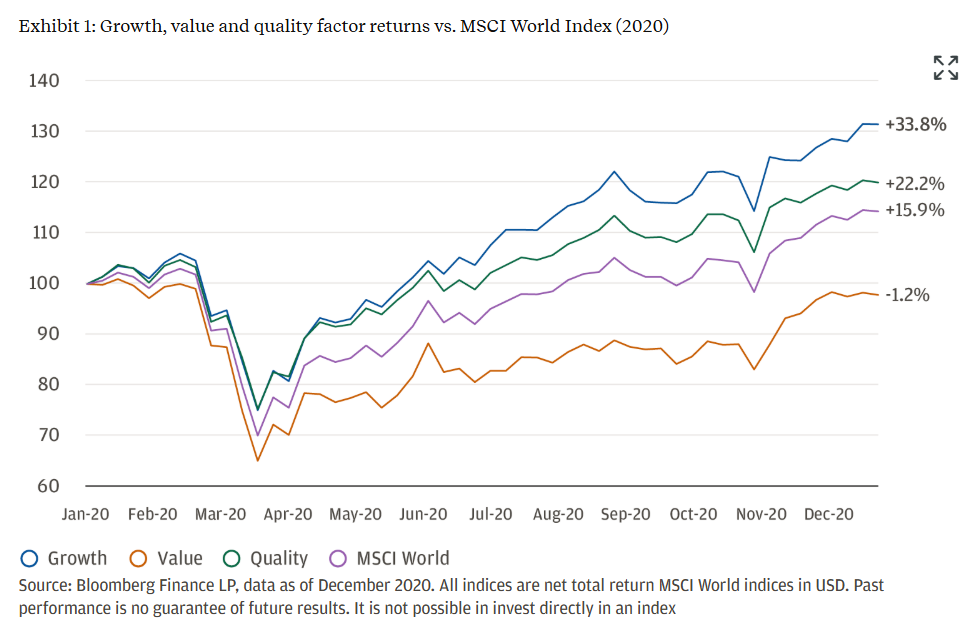
They noted that a growth approach (rapid revenue growth, high expected earnings growth, high valuations) excelled in the low-interest environment of 2020 and in the outperformance of technology stocks in 2023-2024. As the chart below shows, growth outpaced value and quality in 2020:
Growth, Value, and Quality Factors in 2020
Source: J.P. Morgan
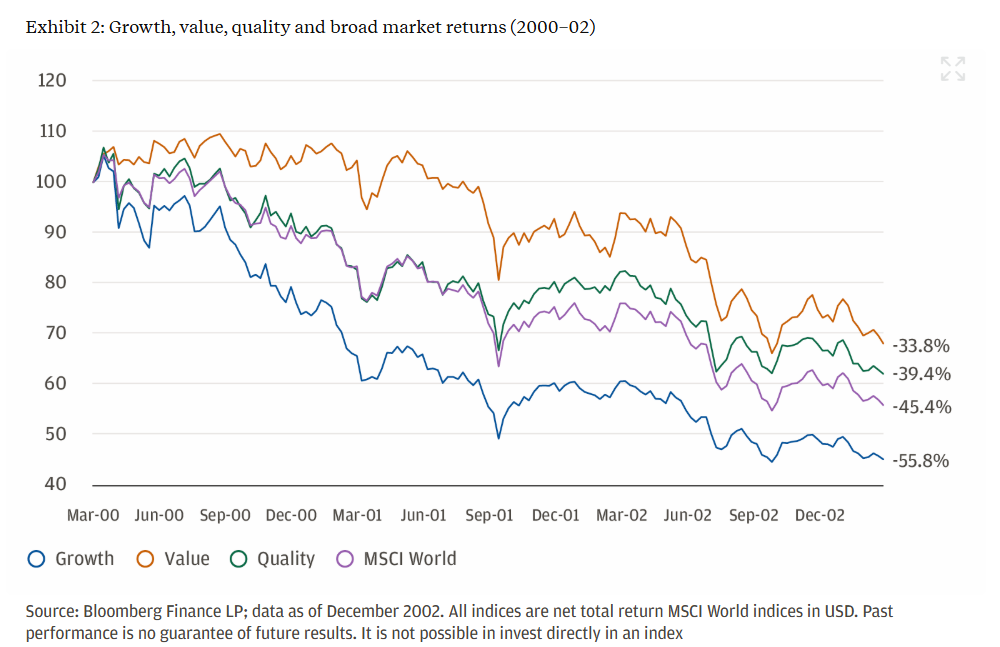
The value factor outperformed during the dot-com bubble of the 2000s and at the start of the economic rebound after the COVID-19 lockdowns (late 2020 to early 2021).
Growth, Value, and Quality Factors in 2000-2002
Source: J.P. Morgan
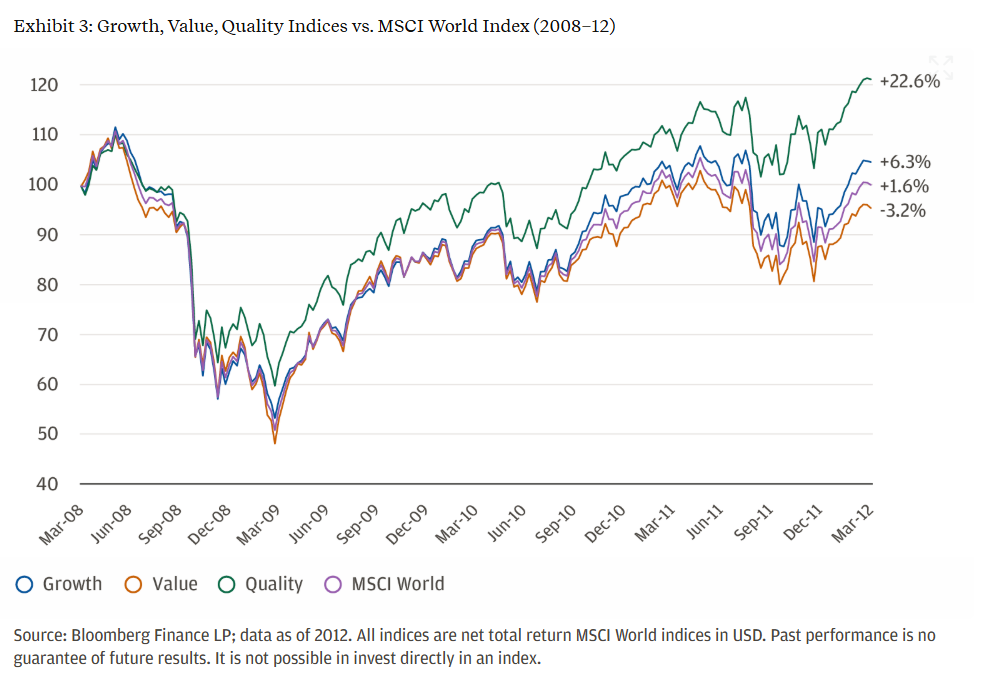
Finally, quality stocks (strong balance sheets, high profitability, strong earnings growth) outperformed during the global financial crisis and the bull run (2008-2012) that followed it.
Growth, Value, and Quality Factors in 2000-2002
Source: J.P. Morgan
“Growth stocks may outperform during periods of economic expansion but lag during recessions or corrections,” they noted. “Conversely, value stocks can be expected to excel during the periods of economic recovery that follow downturns. Quality stocks are generally more neutral and cyclical: They have historically served as a safeguard during both bullish and bearish markets, offering stability and reliable returns across market cycles.”
By prioritising a factor when it tends to thrive, institutional investors can generate a factor premium.
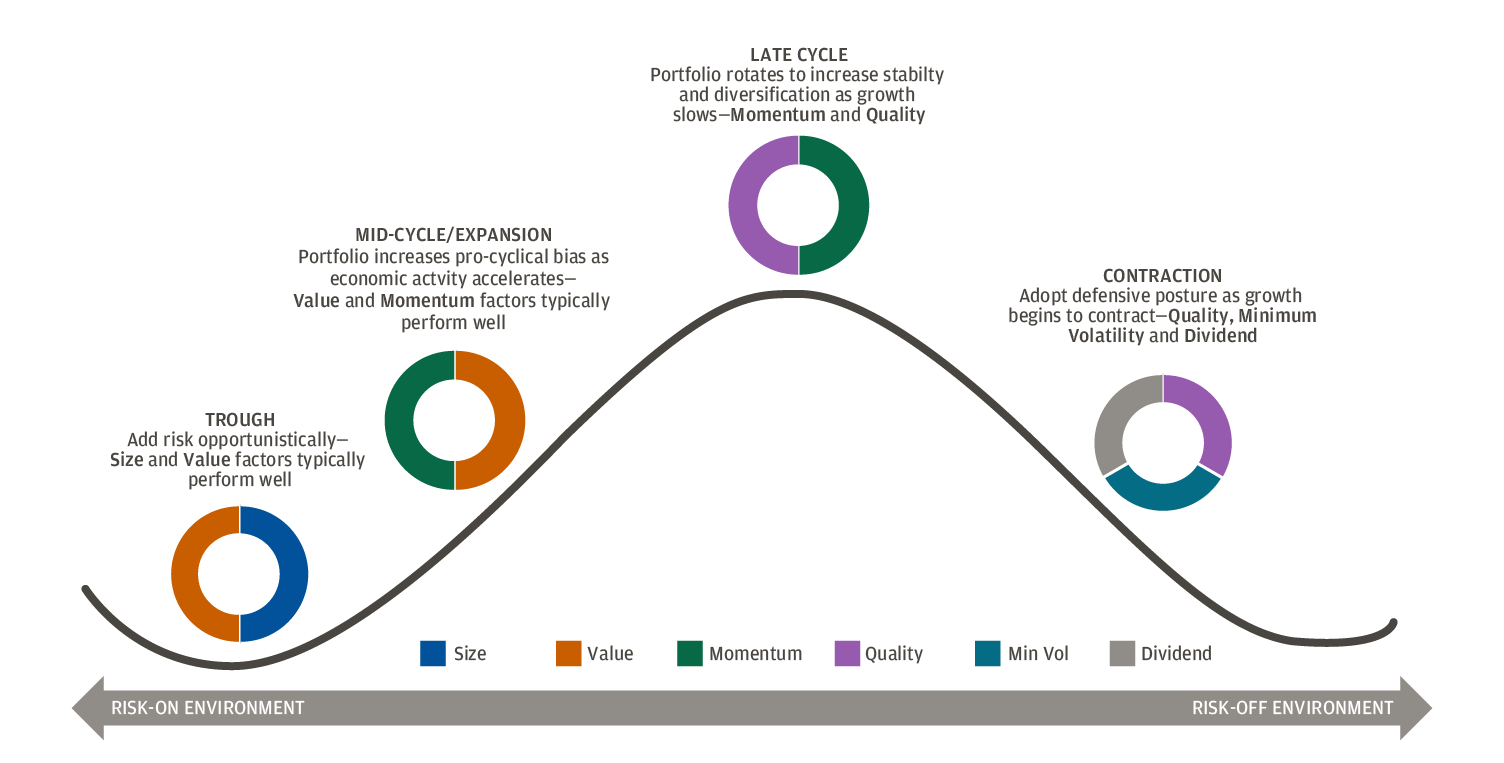
- Stabilising returns across market cycles: Similarly, a multi-factor investing strategy can stabilise portfolio returns across market cycles.
In other words, instead of choosing a single factor for each market cycle, they combine multiple equity factors in a single portfolio and reallocate the portfolio as the market moves through its cycles.
Adjusting a Multi-Factor Portfolio Across Market Cycles
Source: J.P. Morgan
- Correcting portfolio biases with diversification: “Correcting unintended biases in their equity portfolios” is another reason why institutional investors adopt factor investing, according to Scientific Beta, an investment analytics platform.
This goal often leads institutions to adopt multi-factor strategies that diversify away from a particular style.
- Improving transparency while pursuing higher returns: Factor investing offers transparency similar to passive investing. Investors know the methodology guiding asset selection and portfolio weighting because it’s a rules-based, rather than discretionary, strategy.
Yet it can generate higher returns than a passive strategy while staying transparent and rules-based.
- Lowering cost while pursuing higher returns: Active funds have come under scrutiny for failing to outperform their indices while charging higher expense ratios.
Factor-based funds are less expensive given their systematic approach. This lets institutional investors still pursue outperformance while paying lower fees.
2. How institutional investors are adopting factor investing
There’s no single factor investing strategy.
Instead, institutional investors can choose from three types of strategies:
- Single-factor strategies: A single-factor strategy focuses on one of the main factors that drive higher returns and lower risk.
For example, an institution prioritising low-volatility investing can select a low-volatility ETF that invests in stocks that perform well based on a volatility measure.
Similarly, an institution looking to profit from value investing due to market uncertainty can choose a smart beta ETF that invests in stocks with low prices relative to fundamentals (intrinsic value) based on metrics like price-to-book-value and price-to-earnings ratio.
Though single-factor strategies are simple and transparent, they can underperform for long periods when the market cycle no longer favours that factor.
“Factor investing works on average over long horizons, but individual factors go through multi-year drawdowns and premiums can compress when crowded,” according to Quantt, a quantitative finance education platform.
- Multi-factor strategies: Multi-factor strategies combine different equity factors in a single portfolio. Many fund managers combine value and quality, value and momentum, quality and momentum, low volatility, and value, quality, momentum, and size, among other combinations.
Multi-factor strategies are popular since they can help stabilise returns during different market cycles. They also offer better diversification and can help to manage a premium drought.
However, these strategies can be complex, and fund managers may be tempted to concentrate the portfolio in a factor that is performing well in a given market cycle.
- Custom strategies: These are multi-factor funds created specifically for institutional investors based on their objectives and investment philosophy. The institution determines the factors to use, the weighting methodology, sector limits, geographic diversification, and the importance of ESG requirements.
Custom strategies can better align with investors’ goals and strengthen risk management. But they can be more expensive and require more active monitoring and rebalancing.
Investment vehicles for factor investing are as diverse as the strategies. Below are the common ones institutional investors use:
- Internal separate account: Large institutions have quantitative fund managers that build custom portfolios through smart beta investing. As we have seen, this allows them to align investment choices with broader objectives and investment philosophy.
- Smart beta ETFs: These are ETFs that track benchmark factor indices from providers like MSCI, S&P Global, and FTSE. Smart beta ETFs can pursue single-factor or multiple-factor strategies.
- Quantitative active funds: Some mutual funds implement factor investing from scratch.
Instead of tracking a factor index, they construct a portfolio based on selected factor(s) and continuously optimise it to outperform the index.
However, unlike traditional active management, quantitative funds use a systematic, rules-based approach.
Though some quantitative factor funds embrace a long-only strategy, others combine long and short positions.
Some also go beyond stocks, diversifying across multiple asset classes (especially currencies, commodities, and fixed-income assets like bonds) to capture style premia.
3. The risks and limitations of factor investing
Factor investing, irrespective of the strategy or investment vehicle, comes with its own risks. As they say, there is no free lunch in investing.
In response to claims that “factor investing is dead,” Morningstar considers why AQR’s factor fund is performing well. By highlighting what this fund does well, it also brings to the fore some of factor investing's challenges.
We evaluate some of them below:
- Single-factor strategies can underperform in certain market cycles: We highlighted this point above when discussing the strategy. Factors can underperform for extended periods when the market cycle does not favour them.
“A long-only value fund, for example, can underperform because equities decline, because value stocks have lower market betas, or because its sector and country exposures differ from the benchmark,” according to Morningstar.
- Factors can do well due to general market performance: Morningstar also noted that a factor can perform well when a bull market lifts all boats. “Conversely, it (a long-only value fund) may look successful simply because the equity market rose. Those outcomes do not cleanly identify the return to the value spread itself.”
- Not all factors matter: Many researchers have tested hundreds of factors to find those that would have predicted higher returns in the past.
Because so many ideas are tested, some may appear to predict higher returns simply by chance. This is known as the factor zoo problem.
Selecting a factor based solely on successful backtesting can be dangerous. Many factors that look great in backtests fail in live markets. That is why investors should focus on the strongest factors.
“The evidence is strongest for value, momentum, size, quality/profitability, and low volatility across markets — not for every published ‘factor zoo’ paper,” according to Quantt.
- Many smart-beta funds still carry sector bets, country exposures, and market direction risk: A factor fund can underperform not because the factor itself is underperforming, but because other factors are in play.
For example, a value fund with little exposure to technology companies can underperform when technology outperforms the market for several years.
A value fund can also be heavily weighted to Japan when Japanese stocks outperform. It’s easy to construe this as value outperformance rather than the impact of country exposure.
- Implementation costs: Though factor investing may be cheaper than active management, investors must also consider whether the style premium justifies the implementation costs.
“Ignoring implementation costs and capacity” is one of factor investing's challenges, according to Quantt. “Real-world implementation involves bid-ask spreads, market impact, commissions, and taxes - all of which reduce net returns.”
High-turnover strategies, such as momentum factor strategies, can also increase both costs and taxes, according to Rubric Advisors, a financial advisory firm.
- Crowding risk: Even with a multi-factor strategy, factor investing can still face drawdowns, model error, crowding, trading costs, and manager-specific decisions, according to Morningstar.
Let’s focus on crowding risk.
When more investors pursue the same factor, valuations stretch, and future premiums may decline.
“When too much capital chases the same factor signals, several things can happen: entry prices for factor stocks get pushed up (reducing future premiums), exit prices during drawdowns get pushed down (amplifying losses), and correlation among factor portfolios increases (reducing diversification benefits),” as Quantt explained.
- Tracking error: A smart-beta ETF's tracking error against a traditional index like the S&P 500 is usually higher than that of standard passive funds.
4. Approaching factor investing: Some pointers for institutional investors
Given these risks and limitations, institutional investors should take a cautious, strategic approach to factor investing.
Let’s consider some pointers:
Have a clear goal in mind
AQR highlights four ways investors can use factor investing, depending on risk tolerance and overall investment objectives:
- Core allocation: A factor fund can serve as the core allocation and foundation of a diversified portfolio.
- Tactical tilt: It can be a strategic tool to profit from specific market cycles. For example, an investor can allocate to quality stocks when economic growth slows down.
- Volatility management: Some investors use factor investing primarily to reduce drawdowns and manage volatility.
- Return enhancement: Investors can also combine multiple style factors to enhance long-term return.
A clearly defined goal can help you choose a strategy and investment vehicle. A multi-factor strategy works well for core allocation, while a single-factor strategy is better suited to tactical tilt. Also, a core allocation may require an internal account, while a smart beta ETF suits tactical tilts.
Focus on the most important factors
You should not place too much value on factors discovered through backtesting and historical data mining.
Instead, stick to factors like value, momentum, dividend yield, minimum volatility, and quality, which have sound economics supported by multiple academic studies.
Before considering any additional factor, ask for both the economic and behavioural rationale behind it rather than the results of backtests.
A long-term horizon is crucial
Factors can underperform and experience drawdowns over significant periods. Even multi-factor strategies can stretch into periods of underperformance, though they help stabilise returns over the long term.
“Factor premiums are risky and time-varying; they are not supposed to produce a smooth, guaranteed return stream,” argued Morningstar. “A difficult stretch does not establish their demise, just as a good stretch does not establish permanence.”
Consequently, you should only consider factor-based investing if you have a long-term horizon.
Consider a broadly diversified approach
Morningstar has shown that the “factor is dead” claim is wrong. For them, strategy choice matters most.
Based on the fund they analysed, they suggested an approach that combines the following:
- Long/short risk premia investing rather than a long-only strategy
- Multiple asset classes rather than stocks only
- Multiple factors rather than a single factor
- Adjustment for sector and country exposures
- Attention to implementation costs
Institutional investors with internal accounts and quantitative mutual funds can consider these points when constructing a factor-based portfolio.
Use diversification to manage crowding risk
Although many investors worry about crowding risk, enthusiasts argue that factor premiums can persist even as demand rises and that diversification can manage it.
“Precautions against crowding risks can be taken by proper implementation of factor investing and Smart Beta indices,” according to Scientific Beta. “In particular, the best precaution against crowding seems to be diversification.”
Institutional investors exploring factor investing can benefit from sharing their ideas with other investment professionals. This can help focus on the factors that matter and explore how changing market cycles may require a strategy change.
At the cio investment club, we provide a platform to connect with other asset managers and investment professionals to discuss developments in global financial markets.
We also organise exclusive roundtables and investment breakfasts where you can share ideas and explore collaboration opportunities with other experts.
Want to be part of the cio conversation? Register today to gain access to a growing network of investment professionals and exclusive roundtable events.
Takeaways
- Factor investing bridges active and passive management. It uses a transparent, rules-based approach to target characteristics such as value, quality, momentum, size, and low volatility while seeking higher returns or lower risk.
- Combining factors with different performance drivers may help institutional investors reduce reliance on a single investment style and manage prolonged periods of underperformance.
- Smart beta ETFs allow asset owners to access individual or multiple factors without building a custom portfolio, while quantitative funds and separate accounts offer other implementation options.
- Crowding, tracking error, trading costs, sector biases, and extended drawdowns can erode returns, making careful factor selection and a long-term investment horizon essential.
This document is produced by Instaconnect Limited, trading as cio investment club, a company registered in England & Wales with registration number 15262951.
Instaconnect Limited is neither authorised nor regulated by the Financial Conduct Authority in the United Kingdom nor the Securities and Exchange Commission in the United States of America.
This document is a marketing documentation and is not intended to constitute an invitation or an inducement to engage in any investment activity. It is not intended to constitute investment advice and should not be relied upon as such. It is not intended and none of Instaconnect Limited, its holding companies or any of its or their associates, or any of the participants in the documentation, shall have any liability whatsoever for (a) investment advice; (b) a recommendation to enter into any transaction or strategy; (c) advice that a transaction or strategy is suitable or appropriate; (d) the primary basis for any investment decision; (e) a representation, warranty, guarantee with respect to the legal, accounting, tax or other implications of any transaction or strategy; or (f) to cause Instaconnect Limited to be an advisor or fiduciary of any recipient of this report or other third party.
The content and graphical illustrations contained in this document are provided for information purposes and should not be relied upon to form any investment decisions or to predict future performance. Instaconnect Limited recommends that recipients seek appropriate professional advice before making any investment decision. Although the information expressed is provided in good faith, Instaconnect Limited does not represent, warrant or guarantee that such information is accurate, complete or appropriate for your purposes and none of them shall be responsible for or have any liability to you for losses or damages (whether consequential, incidental or otherwise) arising in any way for errors or omissions in, or the use of or reliance upon the information contained in this document.
To the greatest extent permitted by law, we exclude all conditions and warranties that might otherwise be implied by law with respect to the document, whether by operation of law, statute or otherwise, including as to their accuracy, completeness, or fitness for purpose.
Instaconnect Limited and its logo are proprietary trademarks of Instaconnect Limited and are registered in the United Kingdom. Unauthorised copying of this document is prohibited.
© Copyright Instaconnect Limited 2026