




The search for alpha, income, and diversification has led institutional investors to show a greater interest in alternatives in recent years, according to J.P. Morgan.
Commodities have especially been of interest.
The performance of gold when the global equity market experienced a slowdown after Liberation Day was a reminder to global investors of the important role of commodities in an efficient portfolio.
Investors also embraced crude oil in anticipation of the inflationary impacts of Trump’s tariffs. This was one of the factors that led to a rally in oil prices in early 2025, according to Reuters, a global news platform. Crude oil has also been known for its low correlation to traditional markets and its ability to generate high risk-adjusted returns.
Thus, as the search for alpha, income, and diversification continues, amidst inflation fears and other global economic risks, considering how to invest in crude oil can be a positive step for institutional investors.
In this article, we will examine five reasons why crude oil should be included in institutional investors’ portfolios and discuss how to manage the risks associated with crude oil investing.
We will consider:
- 5 reasons why crude oil belongs in your portfolio
- How to manage the risks of crude oil investing
Do you want to become a better investor by understanding how the global economy should influence your investment decisions? Subscribe today for the cio investment club’s newsletter.
1. 5 reasons why crude oil belongs in your portfolio
It’s no news that the price of crude oil is very volatile. The effect of such volatility is often faced by both businesses and consumers, especially in oil-producing countries.
Why then should institutional investors even consider including such a volatile asset in their portfolio?
There are at least five reasons:
i. Inflation hedge
There are two challenges investors face when inflation is high and/or rising, according to TD Asset Management, an investment management firm: the need to hedge against inflation and the increasing correlation between equity and fixed income.
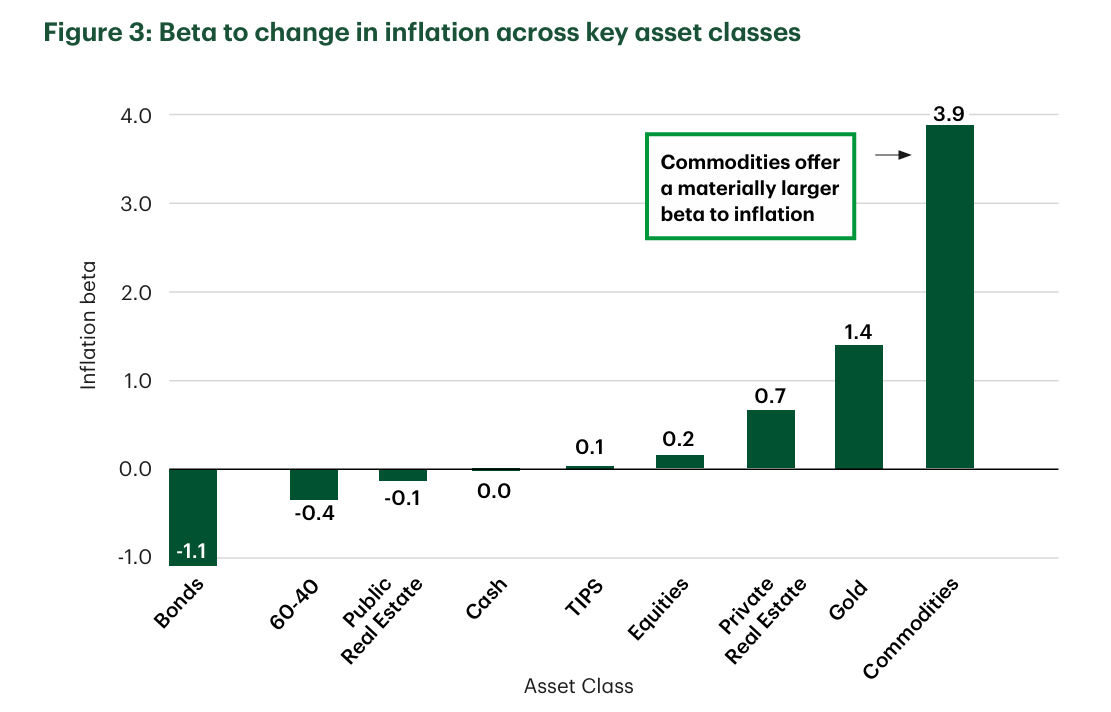
Commodities help to solve the first challenge. This is because they have tended to exhibit a high and positive beta to inflation. That is, they tend to rise in value more than other assets when inflation increases, as seen below.
Beta to Inflation of Multiple Asset Classes
Source: TD Asset Management
In all five inflationary episodes of the past 50 years (the oil embargo of the early 1970s, the Iranian Revolution, China’s economic boom in 2005, China’s late-cycle boom in 2007-2008, and the post-pandemic recovery that began in 2021), commodities outperformed equities and bonds, according to a survey by Goldman Sachs, a global financial firm.
“Commodities are considered a hedge against inflation due to their intrinsic value and tend to perform well when prices for consumer goods are on the rise, while equities tend to perform poorly when high inflation leads to increases in interest rates, which tend to decrease the value of cash flows in the future for companies due to the effects of inflation,” according to CME Group, a derivatives marketplace.
Although stocks and bonds may act as inflation hedges when high inflation is expected, commodities tend to perform better when inflation is higher than anticipated, according to Morgan Stanley, a global financial firm.
The inflation hedge property of commodities is especially true for crude oil. As mentioned above, investors purchased crude oil futures in anticipation of higher inflation following Trump’s tariff policy.
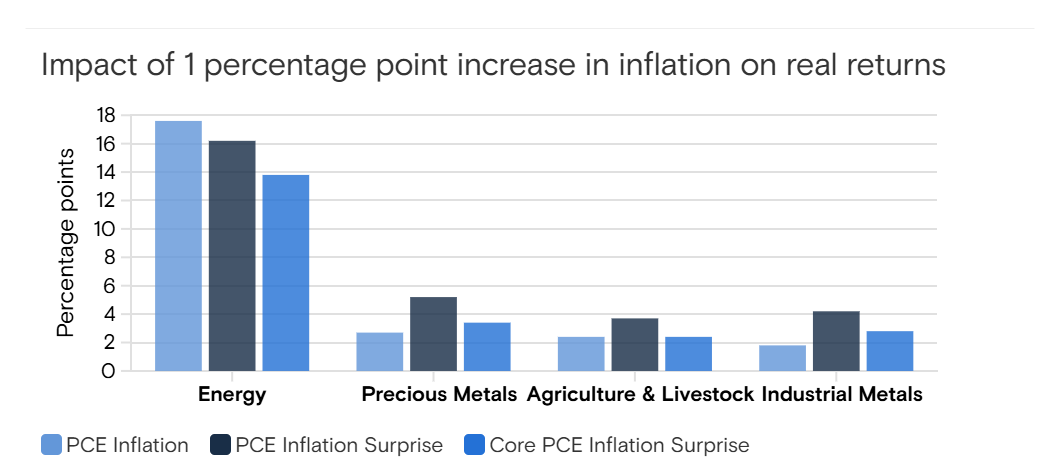
After comparing the performance of different types of commodities during these five inflationary episodes, Goldman Sachs concluded: “Historically, energy generated the strongest real returns across assets when inflation surprised to the upside.”
As seen below, a 1% percentage increase in inflation results in the largest increase in real returns in energy, compared to other commodities.
Response of Commodities’ Real Returns to Inflation
Source: Goldman Sachs
Though inflation fears may have eased, as evidenced by the Fed’s decision to finally lower interest rates, investors cannot treat it as a non-issue.
“We continue to forecast that the lagged effects of widespread monetary policy easing will support growth in most major economies and regions into 2026, but sticky inflation is a potential spanner in the works,” according to S&P Global, a financial firm. “While our latest round of inflation forecasts generally shows lower headline rates in 2026 compared to 2025, this partly reflects the expected sharp drop in crude oil prices from later this year.”
In other words, investors will always have to keep inflation in the picture, and commodities like crude oil are poised to serve as an inflation hedge.
ii. Diversification
The second challenge noted by TD Asset Management was that rising inflation increases the correlation between equity and fixed-income. In these circumstances, commodities can be very helpful since they tend to have a low to negative correlation to equity and bond markets.
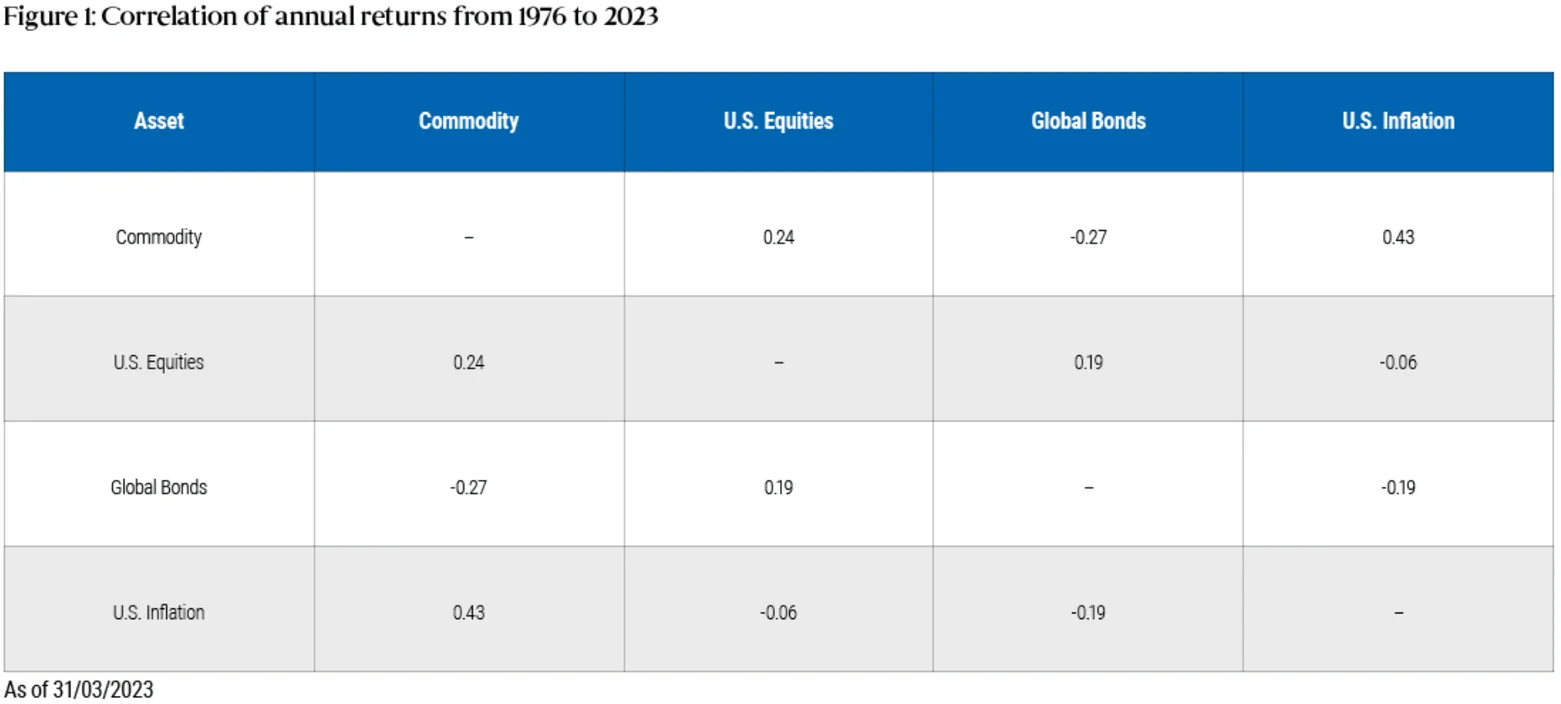
Between 1976 and 2023, commodities had a -0.27 correlation to global bonds and a 0.24 correlation to US equities, according to data from PICOM, an investment management firm, quoted by Resonanz Capital, an investment management firm.
Correlation of Annual Returns Among Various Asset Classes
Source: Resonanz Capital
Given their low correlation to equities and bonds, commodities like crude oil can provide diversification benefits to institutional investors’ portfolios.
As we have seen, the impact of this diversification can be seen in inflationary times, especially when inflation is higher than expected. For example, on June 21 2022, crude oil was up 48% YTD while the S&P 500 was down by 22%, according to data from CME Group. An institution with exposure to crude oil would have weathered the stock market storm better than one without any exposure to crude oil or other commodities.
iii. Higher risk-adjusted returns
Adding commodities to a portfolio can also reduce its risk and increase risk-adjusted returns.
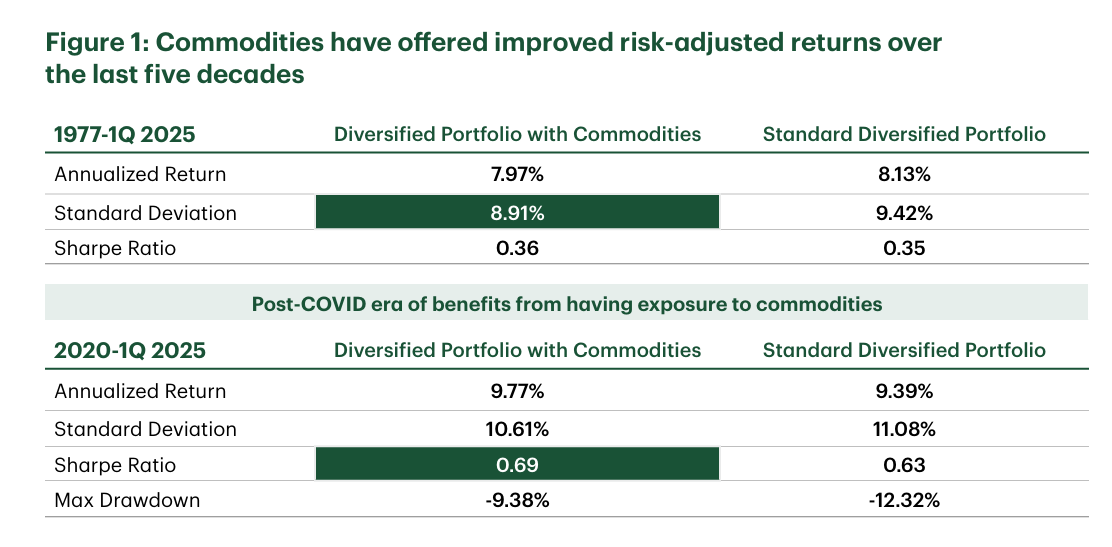
Between 1977 and Q1, 2025, a diversified portfolio that included commodities had a lower standard deviation and a higher Sharpe ratio than one that included only stocks and bonds, according to a survey by TD Asset Management:
How Commodities Reduce Risk and Improve Risk-Adjusted Returns
Source: TD Asset Management
Similarly, if we focus on the post-COVID-19 era, a diversified portfolio with commodities also provides lower standard deviation and a higher Sharpe ratio than one with only stocks and bonds.
iv. Steady demand
Though renewable energy continues to mount a formidable competition to crude oil in the global energy market, demand for the latter remains steady.
Global oil demand is projected to increase by 740,000 barrels/day year-on-year in 2025, according to data from the International Energy Agency. Interestingly, demand growth in 2025 has been driven more by OECD countries than by emerging economies.
What about the long-term?
Given the role that crude oil plays in the global economy, the expectation is that demand should continue to rise in the long term.
“Oil underpins the global economy and is central to our daily lives,” according to the Organisation of Petroleum Exporting Countries (OPEC). “Out to 2050, we see oil demand continuing to expand and reaching 123 million barrels a day (mb/d). There is no peak oil demand on the horizon.”
Though one can argue that OPEC is biased in its estimation, it is worth noting that both Goldman Sachs and the IEA also expect oil demand to continue to grow at least until 2034 and 2030, respectively.
v. Liquidity
Alternative assets are typically illiquid. This is especially true for private assets like private equities and private credit.
However, commodity markets tend to be very liquid. Crude oil, for example, has a very liquid futures market. People trade millions of futures contracts every day on both the NYMEX and the ICE. The same thing happens on the crude oil ETFs market.
Thus, institutional investors should have no issues liquidating their investments and reallocating their portfolios as their investment objectives change.
2. How to manage the risks of crude oil investing
Interestingly, allocation to commodities is still lower than it should be. In 2024, Bloomberg noted that allocations to commodities were only 1.4% while an allocation of 4-9% from a traditional 60/40 portfolio was needed to enjoy its diversification benefit and 6.7% to enjoy its inflation-hedging property.
In the chart above, TD Asset Management also showed how only a 10% allocation to commodities can reduce standard deviation and increase the Sharpe ratio.
Why then is allocation to a commodity like crude oil still low? Some risk factors that have typically discouraged some asset managers include:
- Volatility: As we have mentioned, oil prices are quite sensitive to demand and supply shifts, OPEC decisions, inventory reports, geopolitical tensions, and macroeconomic trends.
- Environmental concerns: Some institutions adhering to climate policies and ESG mandates may discourage investment in fossil fuels (crude oil, natural gas, coal, etc.), despite their advantages. Asset managers who include them in the portfolio may end up clashing with asset owners.
- Concerns about competition with renewable energy: Some asset managers are still worried that global demand for crude oil may stagnate in the future due to the rising demand for renewable energy.
In addition, each of the financial instruments through which investors gain exposure to crude oil prices has its own risks.
Futures contracts require rolling, which can lead to losses in contango markets.
When crude oil prices increase with inflation, crude oil stocks will lose value in correlation with the broader stock market.
ETNs carry issuer credit risk, especially since there are no underlying securities providing a guarantee.
How can institutional investors manage these risks? Below are some considerations:
- Diversification: Other commodities provide many of the benefits that crude oil does. Thus, by investing in other commodities, institutional investors can reduce exposure to the unsystematic risks of the crude oil market.
The risk of geopolitical shocks can also be managed through exposure to the two types of oil (WTI and Brent crude).
- ESG screening: If ESG mandates are a concern, institutional investors can still gain exposure to crude oil by purchasing crude oil stocks of companies that qualify based on some ESG screens. Alternatively, they can consider low-carbon energy ETFs.
- Hedging: Institutional investors with large exposure to the crude oil market can use options contracts to hedge against the risk that the market goes against them.
- Monitoring of the global energy market: Given that many global geopolitical and economic factors affect oil prices, asset managers must continuously keep a tab on the latest developments to make the right portfolio decisions.
At the cio investment club, we provide you with a network of asset managers and owners with whom you can share information and ideas. You can discuss the latest developments in the global energy market with other interested financial experts so you can make better portfolio allocation decisions.
We also organise exclusive roundtables and investment breakfasts where you can have face-to-face interactions and one-on-one networking sessions with other investment experts.
Are you ready to become a part of an investment community that will help you keep a tab on developments in the global economy? Register today to join the cio investment club.
Takeaways
- Institutional investors can gain direct and indirect exposure to crude oil through futures, stocks, ETFs, ETNs, or CFDs.
- Crude oil performs strongly during inflationary periods, making it a valuable tool for preserving real returns.
- With low or negative correlation to equities and bonds, crude oil can help improve portfolio stability and risk-adjusted returns.
- Crude oil markets are highly liquid, but investors should actively manage volatility, ESG concerns, and geopolitical risks through hedging and diversification.
This document is produced by Instaconnect Limited, trading as cio investment club, a company registered in England & Wales with registration number 15262951.
Instaconnect Limited is neither authorised nor regulated by the Financial Conduct Authority in the United Kingdom nor the Securities and Exchange Commission in the United States of America.
This document is a marketing documentation and is not intended to constitute an invitation or an inducement to engage in any investment activity. It is not intended to constitute investment advice and should not be relied upon as such. It is not intended and none of Instaconnect Limited, its holding companies or any of its or their associates, or any of the participants in the documentation, shall have any liability whatsoever for (a) investment advice; (b) a recommendation to enter into any transaction or strategy; (c) advice that a transaction or strategy is suitable or appropriate; (d) the primary basis for any investment decision; (e) a representation, warranty, guarantee with respect to the legal, accounting, tax or other implications of any transaction or strategy; or (f) to cause Instaconnect Limited to be an advisor or fiduciary of any recipient of this report or other third party.
The content and graphical illustrations contained in this document are provided for information purposes and should not be relied upon to form any investment decisions or to predict future performance. Instaconnect Limited recommends that recipients seek appropriate professional advice before making any investment decision. Although the information expressed is provided in good faith, Instaconnect Limited does not represent, warrant or guarantee that such information is accurate, complete or appropriate for your purposes and none of them shall be responsible for or have any liability to you for losses or damages (whether consequential, incidental or otherwise) arising in any way for errors or omissions in, or the use of or reliance upon the information contained in this document.
To the greatest extent permitted by law, we exclude all conditions and warranties that might otherwise be implied by law with respect to the document, whether by operation of law, statute or otherwise, including as to their accuracy, completeness, or fitness for purpose.
Instaconnect Limited and its logo are proprietary trademarks of Instaconnect Limited and are registered in the United Kingdom. Unauthorised copying of this document is prohibited.
© Copyright Instaconnect Limited 2025