


Gold has been surging this year, and it's no secret.
However, as of the time of writing, silver has a higher yield-to-date (63.73%) than gold (56.33%), according to data from Trading Economies, a global economic data platform.
But is silver a good investment, or is it just benefiting from the success of gold?
Instead of focusing on gold and silver investment as if silver is just a cheaper alternative for those who can’t afford gold, it is essential to consider silver as an investment option in its own right.
In this article, we consider the investment potential of silver as a safe haven, inflation hedge, store of value, portfolio diversifier, among others, and the current factors that are driving its medium-to-long-term desirability.
We’ll cover:
- Is buying silver a good investment? A look at its investment value
- Is silver a good investment in 2026? Drivers of silver’s long-term value
- How institutional investors should approach silver investment
Do you want more insights about the roles precious metals can serve in your portfolio? Subscribe now to the cio investment club’s newsletter for regular updates about the global financial market.
1. Is buying silver a good investment? A look at its investment value
There are at least four reasons why institutional investors should consider including silver in their portfolios:
Silver as a store of value
An asset will serve as a store of value if it can combine growing demand with limited supply. Silver is one of the assets that does this.
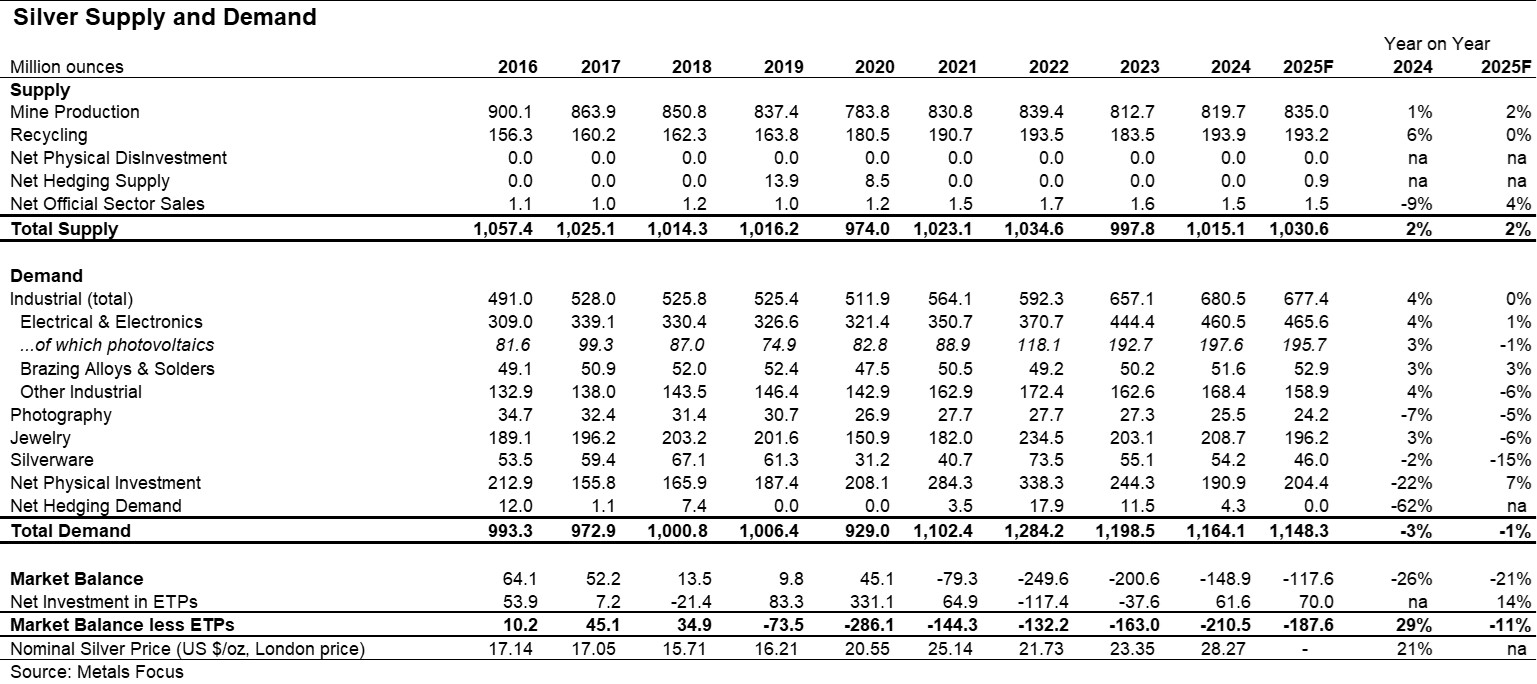
On the one hand, the silver market continues to experience a deficit, as supply remains lower than the rate of consumption.
This deficit has been noticeable since 2019, according to data from The Silver Institute, a silver industry association. They forecast that for 2025, there would be a shortfall of 187.6 million ounces of silver.
Silver Supply and Demand, 2016-2025(F)
Source: The Silver Institute
On the other hand, the demand for silver continues to increase.
A large portion of this growth is due to rising industrial demand. At the end of 2024, industrial demand was responsible for 50% of silver demand, according to The Royal Mint.
“Silver isn’t just a precious metal — it’s the most electrically conductive element on Earth,” according to GoldSilver, a precious metals investment and education platform. “That property makes it indispensable for the renewable energy transition, from solar panels to electric vehicles (EVs) and 5G electronics.
They also note the growing use of silver due to large investments in AI data centres, smart devices, and battery technologies, among others.
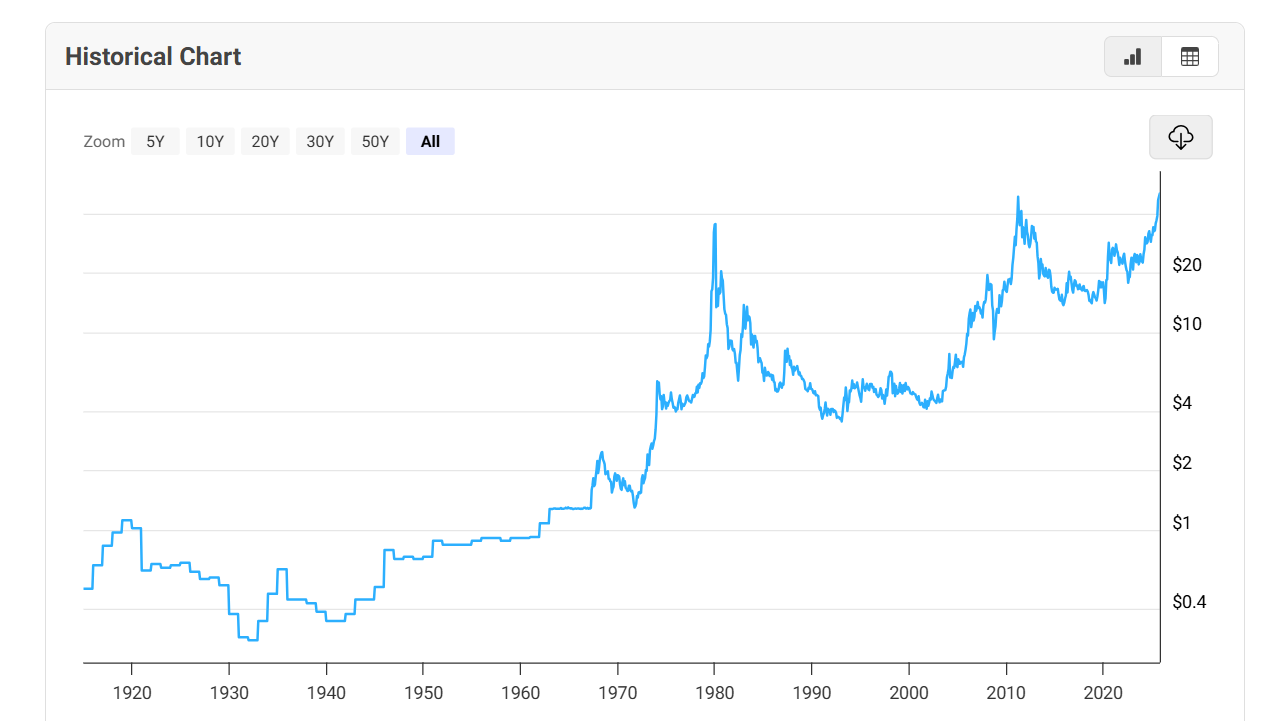
As the chart below shows, silver has been on a consistent upward trend over the past 100 years:
Silver Historical Chart
Source: Macro Trends
This shows that silver has consistently maintained its quality as a store of value, unlike fiat currencies that are subject to inflationary episodes.
Silver as a safe haven
Silver has historically been a safe-haven asset during periods of geopolitical tensions and financial crises.
Let’s start with geopolitical tensions.
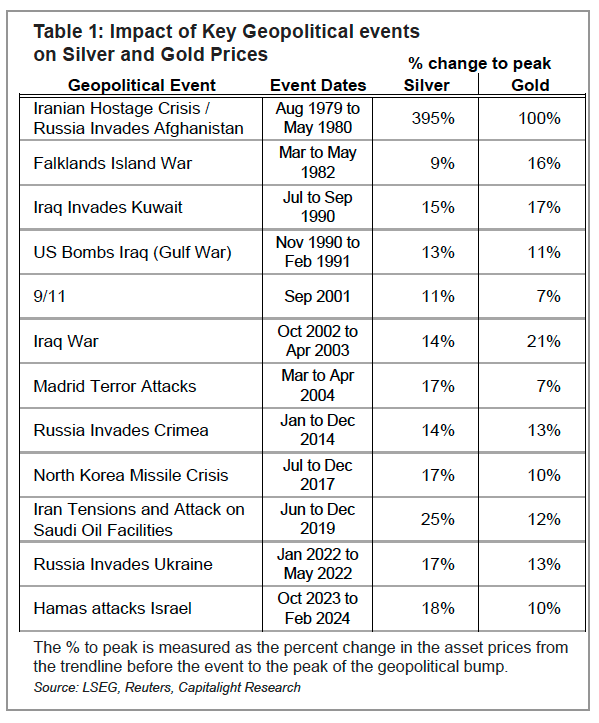
In twelve of the geopolitical tensions that have afflicted the world since 1979, silver’s price experienced a jump, according to a study by Capitalight Research, a precious metals and economic analysis research firm, referenced by Investing.com.
Impact of Geopolitical Crises on Silver’s Price, 1979 - 2024
Source: Investing.com
What about its role as a safe haven asset during financial crises?
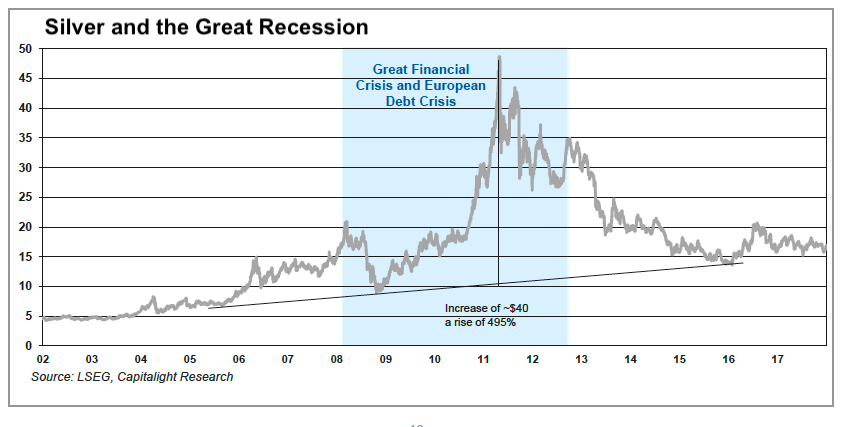
During the Great Financial Crisis and the European Debt Crisis, silver experienced a 495% move to the upside.
Silver’s Performance During the Great Financial Crisis and the European Debt Crisis
Source: Investing.com
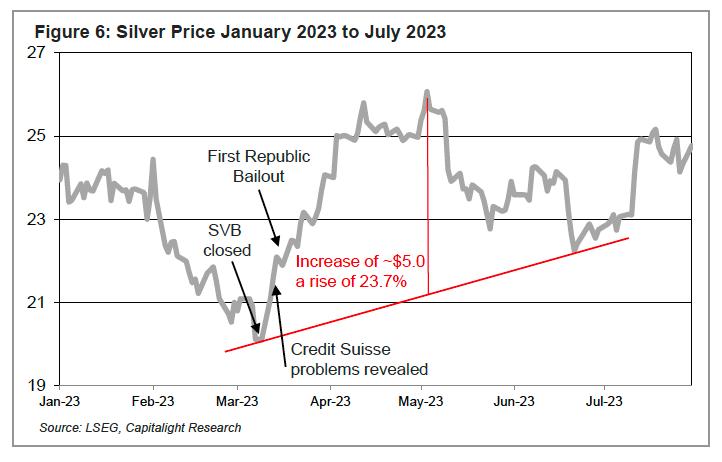
Also, during the 2023 banking crisis that started with the bank run at Silicon Valley Bank (SVB), silver went up by 23.7%.
Source: Investing.com
Silver also proved its mettle again in 2025 when Trump’s tariffs caused uncertainty in the global financial market.
While the S&P 500 Index fell by 9.42% between January 2 and April 9, 2025, silver surged by 3.1%.
“Traders have turned to hard assets like gold and silver this year as safe investments and tools to hedge against geopolitical instability and economic uncertainty, from concerns about tariffs and inflation to worries about Federal Reserve independence and government debt burdens,” reported CNN.
In other words, when uncertainty causes panic in equity markets, investors turn to precious metals like silver for protection.
Silver as a portfolio diversifier
Given silver’s role as a safe-haven asset, many investors include it in their portfolio to reduce risk.
Modern Portfolio Theory teaches that an asset can reduce the overall risk of a portfolio if it has low correlation to other assets in that portfolio.
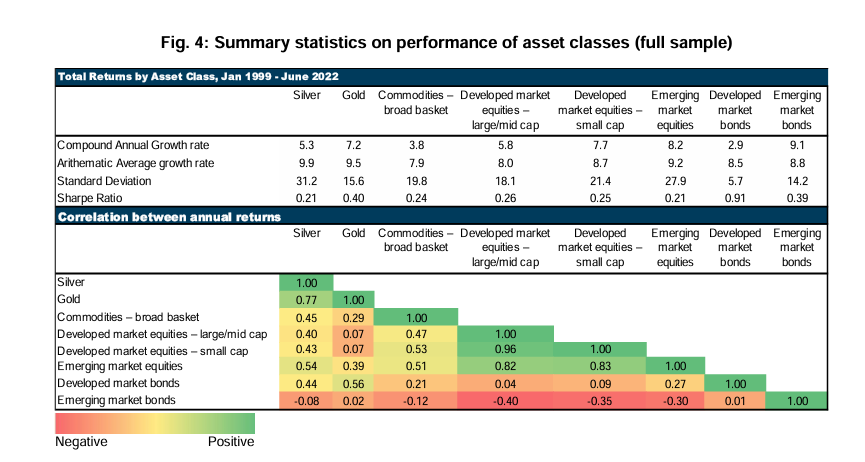
Silver has this quality of low correlation to traditional assets and other commodities, according to a study by Oxford Economics, published by The Silver Institute.
Correlation Among Various Traditional and Alternative Assets
Source: The Silver Institute
Of course, silver’s correlation to traditional assets is not as low as gold’s. However, a correlation coefficient between 0.3 and 0.5 will generally be considered low, according to Andrews University.
Thus, we can still say that silver had a low correlation to most of the traditional assets surveyed by Oxford Economics.
However, one can argue that things may have changed since 2022. Can we still be confident in silver’s role as a portfolio diversifier?
Silver has indeed become more correlated to the equities market in recent years, as noted by a Market Watch article on Morning Star.
However, this does not take away silver’s place as a diversifier. Rather, it may imply that silver’s role in the portfolio should be seen as returns amplification (due to its high price volatility) rather than risk reduction.
In other words, similar to Bitcoin, the value of silver will be seen in how it can increase risk-adjusted returns.
Silver as a potential inflation hedge
Silver has also historically shown its ability to provide a hedge when there is inflationary pressure.
“Silver's role as an inflation hedge has captivated investors for decades, with the precious metal delivering a 1,546% return during the 1970s stagflation era while inflation averaged 7.4% annually,” noted Gainesville Coins, a precious metals investment platform.
They also noted how silver delivered 15% real returns in the inflationary period that followed COVID-19 (2020-2021).
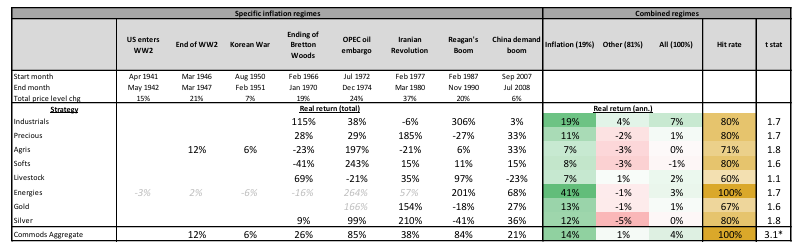
Also, between 1926 and 2021, silver delivered an average real return of 12% across major inflationary periods, according to an academic article published by SSRN.
Performance of Hard Assets During Inflationary Regimes, 1926-2021
Source: SSRN
Also, silver can provide a hedge during periods of low inflation, according to an academic article available on Science Direct.
2. Is silver a good investment in 2026? Drivers of silver’s long-term value
Though the potential of silver as an investment asset is well known, certain factors are making it even more valuable for investors with short-, medium-, and long-term investment horizons.
Current undervaluation
In Q1, 2025, many analysts believed that silver’s undervaluation (as seen in the historically high gold-silver ratio) meant the asset was due for a big run that would outperform gold.
“The gold-to-silver ratio will generally fall sharply during the latter part of a bull market for gold, meaning that silver will ‘vastly outperform gold,’ predicted Stefan Gleason, the CEO of Money Metals Exchange, a precious metals dealer, interviewed by Morning Star.
Also, Adrian Ash, the director of research at BullionVault, a precious metals investment service, in an interview with Morning Star, projected that silver could produce 3X the returns of gold if a global economic recession does not materialise.
At the time, the gold price had a higher YTD. Seven months later, the tables have turned, with silver making a new all-time high of $54.5 per troy ounce on October 17.
Despite the current rally (which led to a record high), analysts at Berenberg, Investing News Network, and GoldSilver all believe that silver remains undervalued and the current rally can go on for more months.
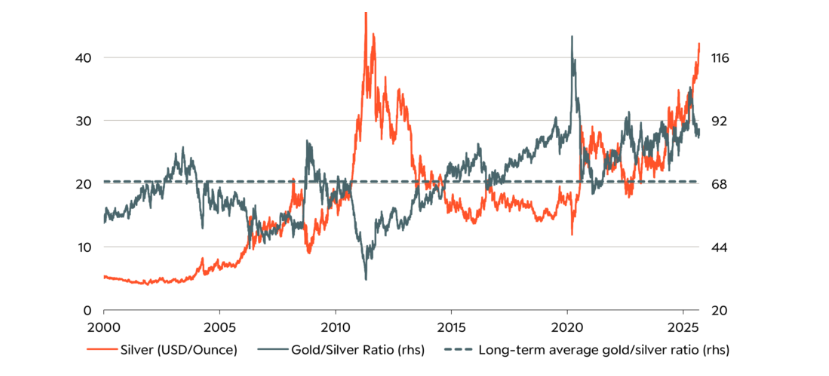
As the chart below shows, the gold-silver ratio is still trading above its historical average:
Relationship Between Silver Price and the Gold-Silver Ratio, 2000-2025
Source: Berenberg
Rising industrial demand
Though industrial demand has always been a key component of silver’s overall demand, it has been playing a more important role. This is primarily due to current trajectories in the global economy.
There is global interest in renewable energy, electric vehicles, artificial intelligence, and 5G technology. Interestingly, all of these technologies will increase silver’s industrial applications.
Given that many businesses and investors are betting big on these trajectories, it makes sense to expect silver to keep delivering high returns in the medium-to-long term.
“Silver straddles two investment narratives: store of value and industrial commodity,” noted Saxo, a global financial firm. “This dual role gives it flexibility—functioning as a partial hedge during market stress while offering upside during periods of economic expansion.”
Investment demand for a safe haven
In his interview with Morning Star, Gleason also noted that silver should benefit from the sell-off of American assets and the weakening of the US dollar that followed Trump’s trade tariffs.
De-dollarisation efforts across the globe have also increased interest in precious metals, according to Queen's Business Review, a publication by students of Queen's University in Canada.
Though they recognise that the dollar won’t lose its dominance overnight, they believe that the erosion of its dominance could reinforce the desire for a safe haven among investors.
Also, the economic uncertainty introduced by Trump’s trade policy and ongoing geopolitical uncertainty in the Middle East and Eastern Europe continue to nurture the desire for a safe haven.
GoldSilver agrees.
They also noted that low real returns (despite falling inflation rate) could be another trigger for fresh interest in silver. As we have seen, silver tends to produce a relatively higher average real rate of return than traditional assets and some hard assets.
The continuous demand for lower interest rates by major economies like the US can also play into the rising demand for silver.
Institutional support
As the de-dollarisation efforts continue in some circles, silver has been receiving institutional support. Russia and India have added to their reserves, while Saudi Arabia purchased a silver ETF.
“Sovereign wealth buyers now view silver as both an industrial growth asset and a monetary hedge,” commented GoldSilver.
3. How institutional investors should approach silver investment
Is buying silver a good investment?
Yes!
Given all we have said, institutional investors may find silver to be a useful asset in their investment portfolio.
But how should asset managers approach silver investment?
There are four important points:
Embrace diversification
We have seen that the recent increase in correlation with equities may imply that silver may not be the best for reducing risk in a portfolio. It might play a better role as a return amplifier (especially given its greater price fluctuations).
In this case, you might also consider adding gold to your portfolio since it has a lower correlation to equities and bonds. “Silver is no substitute for gold,” as State Street Investment Management noted.
Tap into the dual role of silver
On the one hand, the current trends that are driving the global economy (clean energy, AI, 5G, etc.) are also driving demand for silver. This means that silver can be pro-cyclical and benefit from economic prosperity.
On the other hand, the investment demand for silver during geopolitical tensions and financial crises means that silver can still serve as a good hedge when the stock market tumbles.
A combination of these two demand sources implies that silver can be a good long-term investment asset that will always find a role to serve in an efficient portfolio.
Choose an efficient investment vehicle
There are many ways to invest in silver – silver bullion (silver bars and silver coins), silver exchange-traded funds (ETFs), silver mining stocks, and silver derivatives.
Each of these vehicles comes with its pros and cons.
For example, physical silver (in the form of silver bullion coins and bars) provides the most direct exposure to the price of silver, but it comes with extra safety and storage fees, price premiums, lower liquidity, and inconvenience.
Asset managers should weigh the pros and cons of each and choose the vehicle that is most efficient given their investment goals.
Keep evaluating long-term potential
Long-term investors must keep monitoring key factors like central bank purchases, industrial uses, global economic dynamics, geopolitical situations in key regions, and the long-term gold-silver ratio.
These factors will help asset managers revise their price targets for the commodity and adjust their portfolio holdings as needed.
At the cio investment club, we provide you with a network of asset managers, asset owners, and other financial experts with whom you can exchange and evaluate investment ideas.
By bouncing off your ideas about the future trajectory of silver off other experts, you can come up with a better-informed analysis that will lead to smarter portfolio decisions.
We also organise exclusive roundtables and investment breakfasts where you can interact and network with other financial market players and professionals.
Do you want to be part of an investment community where you can exchange ideas about precious metal investments, among others? Register today to become a part of the cio investment club.
Takeaways
- Silver’s demand–supply imbalance strengthens its role as a long-term store of value, driven by persistent market deficits and rising industrial consumption.
- Silver consistently acts as a safe haven, outperforming during geopolitical tensions and financial crises, including the Great Financial Crisis, European Debt Crisis, and recent tariff-driven uncertainty.
- As correlations shift, silver’s value today lies not only in risk reduction but also in its ability to amplify portfolio returns, especially during economic expansions.
- Is silver a good investment for the long term? Its medium-to-long-term outlook remains strong, supported by undervaluation, institutional buying, renewable-energy adoption, AI-related demand, and de-dollarisation trends.
This document is produced by Instaconnect Limited, trading as cio investment club, a company registered in England & Wales with registration number 15262951.
Instaconnect Limited is neither authorised nor regulated by the Financial Conduct Authority in the United Kingdom nor the Securities and Exchange Commission in the United States of America.
This document is a marketing documentation and is not intended to constitute an invitation or an inducement to engage in any investment activity. It is not intended to constitute investment advice and should not be relied upon as such. It is not intended and none of Instaconnect Limited, its holding companies or any of its or their associates, or any of the participants in the documentation, shall have any liability whatsoever for (a) investment advice; (b) a recommendation to enter into any transaction or strategy; (c) advice that a transaction or strategy is suitable or appropriate; (d) the primary basis for any investment decision; (e) a representation, warranty, guarantee with respect to the legal, accounting, tax or other implications of any transaction or strategy; or (f) to cause Instaconnect Limited to be an advisor or fiduciary of any recipient of this report or other third party.
The content and graphical illustrations contained in this document are provided for information purposes and should not be relied upon to form any investment decisions or to predict future performance. Instaconnect Limited recommends that recipients seek appropriate professional advice before making any investment decision. Although the information expressed is provided in good faith, Instaconnect Limited does not represent, warrant or guarantee that such information is accurate, complete or appropriate for your purposes and none of them shall be responsible for or have any liability to you for losses or damages (whether consequential, incidental or otherwise) arising in any way for errors or omissions in, or the use of or reliance upon the information contained in this document.
To the greatest extent permitted by law, we exclude all conditions and warranties that might otherwise be implied by law with respect to the document, whether by operation of law, statute or otherwise, including as to their accuracy, completeness, or fitness for purpose.
Instaconnect Limited and its logo are proprietary trademarks of Instaconnect Limited and are registered in the United Kingdom. Unauthorised copying of this document is prohibited.
© Copyright Instaconnect Limited 2025