




Consumer protection laws have been enacted worldwide to safeguard customers from the unethical practices of businesses and their owners.
As businesses get more creative with these unethical practices, consumer protection agencies have also strengthened the regulatory landscape.
In the investment world, securities litigation is a means by which governments protect investors from the unscrupulous activities of public and private companies. It ensures that every violation of securities laws is brought to the book and that the integrity of the investment space remains intact.
However, given the speed of creativity and change in the investment world (securitisation, tokenisation, etc.), securities law and litigation must adapt to new realities for it to keep protecting investors.
In this article, we will seek to understand what securities litigation is all about and the trends that are currently redefining its future. We’ll cover:
- What is securities litigation?
- What are the stages of a securities class action?
- 5 trends shaping securities litigation and investor protection
- Securities litigation trends and institutional investors
1. What is securities litigation?
Before considering how securities litigation is adapting to new realities, it’s essential to get a good grasp of what it is all about.
Securities litigation is a type of litigation that deals with disputes related to the issuance, purchase and sale of securities such as stocks, bonds, and mutual funds.
Since the issuance, purchase, and sale of these securities are covered by relevant securities laws, securities litigation can also be seen as a legal process that handles disputes and violations relating to securities laws.
The relevant securities law is the Financial Services and Markets Act 2000 (FMSA) in the UK, the Securities Act of 1933 (and the Securities and Exchange Act of 1934) in the US, and the Markets in Financial Instruments Directive (among others) in the European Union
Some of these violations include:
- Fraud and misrepresentation: This involves misstatements and omissions that mislead investors about the financial health of the company. It also happens when the company is not transparent about its risk exposure.
The Global Payments securities litigation is an example of this. In 2019, investors brought a class action suit against the company for making false and misleading statements about its subsidiary, Active Network, LLC.
- Market manipulation: This covers all forms of shady practices a company uses to artificially inflate or deflate its stock price. It also includes insider trading and wash sales.
In 2011, the Securities and Exchange Commission (SEC) and the Department of Justice (DOJ) brought an insider trading case against Raj Rajaratnam, the founder of Galleon Group.
Shareholders can also bring actions against companies involved in market manipulation. Such actions are called securities fraud class actions.
- Breach of fiduciary duty: This especially applies to financial advisors who fail to act in the best interest of investors.
It also applies to executives and board members who do not act in the best interest of the company or its shareholders.
Actions brought by shareholders on behalf of the company against executives and boards are known as shareholder derivative actions, shareholder derivative suits, or shareholder derivative litigation.
In 2020, Boeing investors sued its board of directors for failure to oversee safety protocols, which led to fatal crashes as well as financial losses.
Regulatory and shareholder claims of violations can be brought against a company during its normal course of operation, an initial public offering (IPO), a merger and acquisition (M&A), or a rights issue.
When these violations occur, investors can take legal actions individually (individual lawsuits) or as a group (class action lawsuits or group litigations). Similarly, government agencies can be the ones to identify such violations and prosecute the affected party (government or regulatory enforcement actions).
However, in a bid to reduce frivolous securities litigation (suing a company because its stock price fell), many countries have reformed securities litigation to focus on genuine grievances.
The United States introduced the Private Securities Litigation Reform Act (PSLRA) in 1995 to raise the bar for claimants (investors) and reduce the risk of litigation for companies, all while making investor protection primary.
This act required that claimants explain why a particular statement is false and misguided and show that the defendant intended to deceive investors. It also put a cap on the fees of attorneys and the damages plaintiffs could claim.
Though there is no PSLRA-equivalent, courts in the UK, Australia, Canada, the Netherlands, among others, have put in place processes and mechanisms to scrutinise claims for merit and discourage frivolous suits.
2. What are the stages of a securities class action?
What do securities litigation lawyers do?
They represent the interests of investors or companies and attempt to get the courts to rule in their clients’ favour.
A good way to understand their activities is to consider the different stages of a securities litigation case. Since class actions are the most common, we focus on them below:
- Triggering event and investigation: This is the stage where someone (whistleblower) discovers a case or cases of fraud and misrepresentation, market manipulation, and breach of fiduciary duty.
The whistleblower will usually work with a lawyer to investigate the case, gather evidence, and determine if a claim is viable.
2. Filing a complaint: If the claim is viable, a formal lawsuit is filed in a court (usually a federal court, but it can also be in a state court). The lawyer will draft the complaint, define the class period (the period during which the triggering event occurred), and identify all the defendants that would be included in the suit.
3. Appointment of lead plaintiff: The lead plaintiff is the investor with the largest financial interest. In some cases, this can be an institutional investor. The lawyer(s) will coordinate with the lead plaintiff and prepare them for the tasks ahead.
4. Motion to dismiss: The company’s litigation team will conduct internal investigations and then go on to defend the complaint and attempt to get the case thrown out. Many high-profile cases have ended at this stage. A shareholder class action against Lululemon Athletica, an athletic apparel retailer, in the U.S. District Court for the Southern District of New York was dismissed.
5. Class certification: Plaintiffs will ask the court to certify the case as a shareholder class action suit. Lawyers representing the plaintiffs will argue that the case should remain a class action and show evidence that the defendant’s actions have caused damage to the plaintiffs.
6. Discovery: Lawyers representing both sides will exchange relevant documents and conduct depositions. The aim is to build a compelling narrative that favours their clients.
7. Settlement negotiations: Most cases will end at the negotiation table. Lawyers representing both sides will negotiate a settlement amount that both sides can agree on.
8. Claims administration: Each investor in the class action suit will submit claims and receive a share of the settlement. Lawyers representing the plaintiffs will oversee the claims process and resolve disputes regarding eligibility.
9. Trial: If a settlement fails (it rarely does), the case goes to trial. An example of a case that went to trial was the class action suit against the Royal Bank of Scotland (RBS) for misleading statements in the prospectus for its 2008 rights issue.
10. Final judgment and dismissal: After the trial, the court will issue a ruling or approve a settlement. If any party is unsatisfied, they can appeal to an appellate court (the Courts of Appeals and the Supreme Court are the appellate courts in the US).
3. 5 trends shaping securities litigation and investor protection
Below are the five trends shaping the future of securities litigation:
I. Growing cases of AI washing
AI has arguably become the most trendy development in the business world today. To ride the wave, many companies are making bold claims about their AI capabilities.
This has resulted in AI washing, with many such companies now being sued for misrepresentation. For example, Innodata Inc., a data engineering company, was sued in 2024 for using offshore workers to digitise medical records, while claiming to employ a proprietary AI. A high-stakes claim was also brought against Zillow Group regarding its AI-powered home pricing tool.
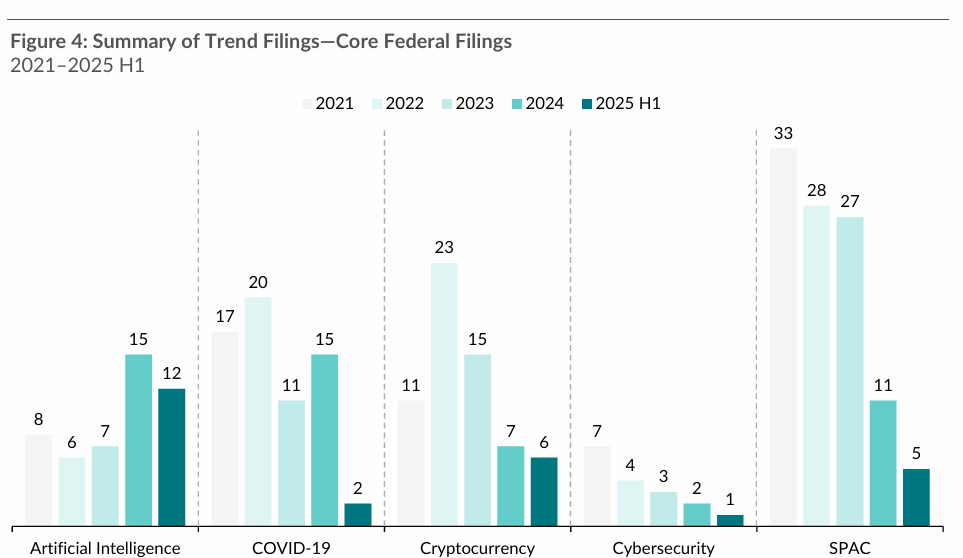
By the end of 2024, class action related to AI had doubled from 7 to 15, according to data provided by Stanford University.
This trend has not slowed down a bit.
In H1, 2025, the highest number of core federal securities class actions in the US (12) was in relation to artificial intelligence (AI). If the current trend continues, then core filings related to AI in 2025 will exceed those of 2024.
Securities Class Action Filings, Mid-Year 2025
Source: Stanford University
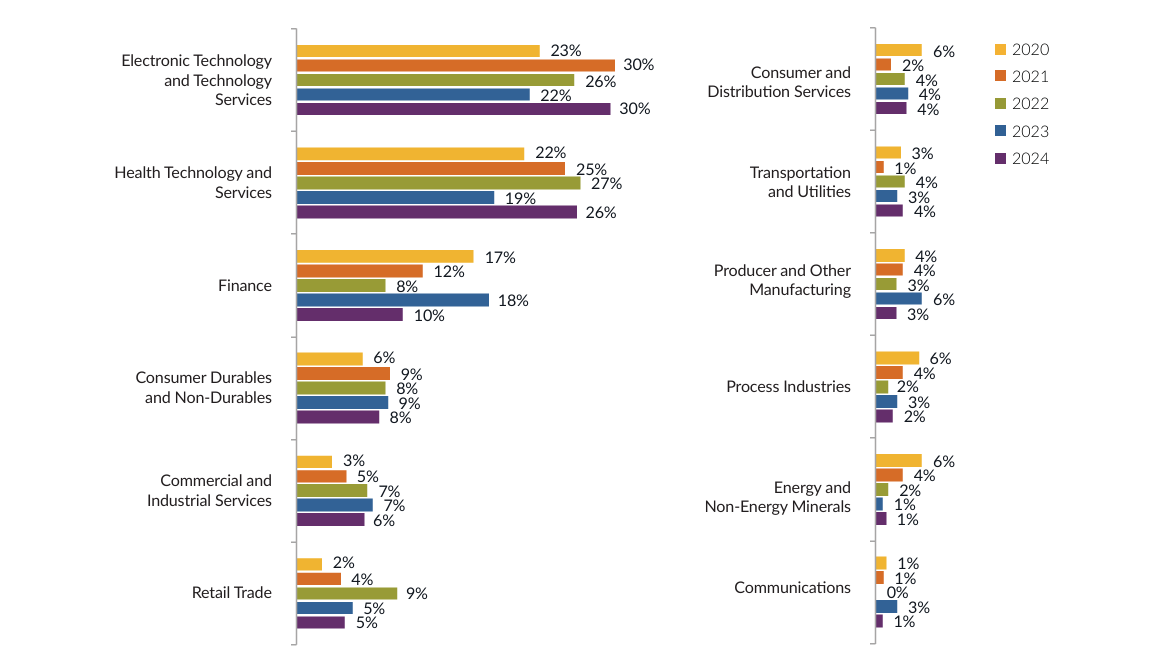
The trend with AI is consistent with data showing that technology and healthcare companies have been the major defendants of securities class actions:
Percentage of Class Action Federal Filings by Sector and Year
Source: Kehoe Law Firm
Will this trend with AI slow down? It doesn’t seem so. As AI continues to dominate discussions, more AI companies will spring up, and more traditional companies will seek to deploy AI in their operations.
“AI-related securities class actions are likely to become more frequent as public companies increasingly start disclosing how they use AI in their public filings,” according to Debevoise and Plimpton LLP, an international law firm. “Shareholder plaintiffs can scrutinise these disclosures in hindsight to contend that the company did not properly characterise its AI technologies or use.”
II. Securities litigation and digital assets
Digital assets like cryptocurrencies and tokenised real-world assets (RWA) have also opened up new vistas for securities litigation. There have been disputes about the practices of crypto exchanges and the public offering of unregistered securities offerings.
Though core filings related to cryptocurrency halved in 2024 (from 15 in 2023 to 7 in 2024), as seen in the chart above, there have been 6 core filings already in H1 2025. If the current trend continues, then 2025 filings will exceed 2024’s.
These filings include allegations against companies that engaged in cryptocurrency mining, cryptocurrency derivatives, sale or exchange of tokens (initial coin offerings) and non-fungible tokens (NFTs) as well as the design of blockchain-focused software, according to Stanford University.
The trend reversal we are seeing is a product of further acceptance of cryptocurrencies by traditional financial institutions. For example, top investment companies are issuing tokenised RWA and crypto ETFs. Financial and non-financial companies are also embracing stablecoins.
“These disputes often centre around allegations of fraud, misrepresentation, or failure to disclose risks related to digital assets,” according to Purely Investing, an investment research and education platform. “As regulators scrutinise these innovations, litigations are increasingly focusing on whether disclosures sufficiently inform investors of potential vulnerabilities and regulatory uncertainties.”
III. The fight against greenwashing: Securities litigation and ESG disclosures
When ESG factors sprang to prominence as investment criteria, many companies sought to ride the wave. Their disclosures included grand claims of ESG compliance, as they sought to be in the good books of asset and fund managers.
However, some of these grand claims turned out to be false. These companies were said to be engaged in a process now called greenwashing. In 2023, a high-stakes case was brought against Delta Air Lines regarding its carbon neutrality claims.
As of early 2025, over 2,700 ESG-related lawsuits have been filed globally, a more than 100% increase from 2020, according to Pearce Sustainability Consulting Group, a global consulting firm.
These lawsuits have covered greenwashing claims, climate-related liability cases, supply chain human rights violations, biodiversity and land use disputes, and misleading or inaccurate ESG disclosures, with the U.S., UK, Australia, the Netherlands, and Germany leading the way.
In the US, the Federal Trade Commission (FTC) deals with environmental marketing representations, the Securities and Exchange Commission (SEC) and the Environmental Protection Agency (EPA) handle emission representations, and the SEC manages claims about ESG-related investments made by investment management companies.
Will this trend continue? It seems so.
“Companies are now facing heightened scrutiny regarding their environmental practices, social responsibility, and governance standards,” according to Timothy Miles, a class action or group litigation lawyer. “Investors are becoming more proactive in holding companies accountable for their ESG performance, leading to a rise in litigation related to misleading ESG disclosures and greenwashing claims.”
IV. Globalised securities claims
In 2010, the US Supreme Court ruled in Morrison v National Australia Bank that US securities legislation cannot apply outside its borders and US investors cannot pursue claims against foreign issuers in the US. This ruling led to a rise in shareholder litigation in the UK and other jurisdictions.
The globalisation of financial markets continues to bring this jurisdictional issue to the fore.
Many companies now have investors across various jurisdictions. Thus, when a company faces a suit, investors from different countries will queue up for compensation.
Consequently, disputes have to be managed and legal action coordinated across jurisdictions. Since the legal frameworks differ across borders, managing globalised securities claims is usually difficult and complex.
The reality of globalised securities claims has led to four trends, according to Purely Investing:
- Jurisdictional conflicts due to overlapping legal claims:
- A concern about the choice of law and the enforcement of foreign judgments
- International treaties and cooperation agreements that facilitate transnational securities litigation
- The emergence of global regulatory bodies that can influence jurisdictional authority
Another consequence of this is that companies will not have to ensure that their corporate governance practices are regulatory-compliant in all jurisdictions where they have investors.
“This globalisation will necessitate comprehensive corporate governance practices that can withstand scrutiny across different legal systems and regulatory environments,” said Miles. “Consequently, corporations will need to be more vigilant in their compliance efforts, ensuring that they adhere to the standards of not just their home country but also those of other nations where they have a significant presence.”
V. AI and data analytics as tools to prevent and identify wrongdoing
Securities litigation has also benefited from the growing popularity of AI and big data analytics.
“With advancements in artificial intelligence and machine learning, plaintiffs’ attorneys will have enhanced tools to identify patterns of corporate behaviour that may indicate fraud or other wrongdoing,” noted Miles.
That is, the use of AI and big data analytics can help whistleblowers and securities litigators more easily detect patterns of misrepresentation, market manipulation, and other wrongdoing. This will make it easy to build a case against the defendants.
On the other hand, companies can also use these technologies to detect potential wrongdoing before it becomes a legal case.
As the adoption of AI continues, both trends will continue to impact securities litigations.
“The integration of advanced technology into both litigation strategies and corporate governance frameworks will thus play a critical role in shaping future securities class actions,” according to Miles.
4. Securities litigation trends and institutional investors
Asset owners like pension funds and sovereign wealth funds have often had to take lead plaintiff roles in various class action suits. Therefore, they are usually on the victim/plaintiff side of things.
But what can they do in view of current trends?
First, since prevention is better than cure, asset owners, through asset managers, should spend more time doing due diligence before investing in AI companies, digital assets, and companies making bold ESG claims. This will help avoid the stress and time wastage that comes with securities litigation.
Relatedly, such due diligence is especially necessary for investments in international jurisdictions. As we have seen, cross-border claims come with their challenges, and it is better to avoid such situations to begin with.
Second, asset owners should consider using AI and big data analytics to monitor the activities of companies in which they are heavily invested. Doing so can help them uncover patterns of wrongdoing that require an individual or class action suit.
Third, asset owners should be willing to take the lead plaintiff role when required. Due to their reputation and importance, they can signal to the wider business world that corporate misconduct will be treated with the severity it requires. (This is one reason why many asset owners prefer securities litigation to securities arbitration.)
Asset managers can improve their due diligence by interacting with other financial experts. Through these interactions, they can learn new information about potential investments that can help them make smarter decisions. They can also learn about recent developments in a company they own that require a fresh risk assessment.
At the cio investment club, we provide asset owners and managers with a global network of top financial industry players that can help them make smarter investment decisions. Members of this club can share ideas, discover fresh insights, and collaborate on interesting projects.
We also organise exclusive roundtables and investment breakfasts where you can meet up with club members and explore various opportunities together.
Do you want to be a part of a community that will help you make better investment decisions? Register today to become a part of the cio investment club.
Takeaways
- Securities litigation exists to safeguard investors against fraud, misrepresentation, and market manipulation.
- AI claims, digital assets, ESG disclosures, and globalisation are reshaping how securities litigation evolves.
- AI and big data not only expose corporate misconduct but also help firms strengthen compliance and governance.
- Asset owners and managers must lead in due diligence, litigation, and governance monitoring.
This document is produced by Instaconnect Limited, trading as cio investment club, a company registered in England & Wales with registration number 15262951.
Instaconnect Limited is neither authorised nor regulated by the Financial Conduct Authority in the United Kingdom nor the Securities and Exchange Commission in the United States of America.
This document is a marketing documentation and is not intended to constitute an invitation or an inducement to engage in any investment activity. It is not intended to constitute investment advice and should not be relied upon as such. It is not intended and none of Instaconnect Limited, its holding companies or any of its or their associates, or any of the participants in the documentation, shall have any liability whatsoever for (a) investment advice; (b) a recommendation to enter into any transaction or strategy; (c) advice that a transaction or strategy is suitable or appropriate; (d) the primary basis for any investment decision; (e) a representation, warranty, guarantee with respect to the legal, accounting, tax or other implications of any transaction or strategy; or (f) to cause Instaconnect Limited to be an advisor or fiduciary of any recipient of this report or other third party.
The content and graphical illustrations contained in this document are provided for information purposes and should not be relied upon to form any investment decisions or to predict future performance. Instaconnect Limited recommends that recipients seek appropriate professional advice before making any investment decision. Although the information expressed is provided in good faith, Instaconnect Limited does not represent, warrant or guarantee that such information is accurate, complete or appropriate for your purposes and none of them shall be responsible for or have any liability to you for losses or damages (whether consequential, incidental or otherwise) arising in any way for errors or omissions in, or the use of or reliance upon the information contained in this document.
To the greatest extent permitted by law, we exclude all conditions and warranties that might otherwise be implied by law with respect to the document, whether by operation of law, statute or otherwise, including as to their accuracy, completeness, or fitness for purpose.
Instaconnect Limited and its logo are proprietary trademarks of Instaconnect Limited and are registered in the United Kingdom. Unauthorised copying of this document is prohibited.
© Copyright Instaconnect Limited 2025