




For years, institutional investors diversifying into private credit have focused mainly on corporate direct lending, providing loans to businesses and receiving regular interest payments.
However, the search for diversification, tighter lending standards, and higher interest rates have opened up new opportunities: asset-based finance (ABF).
These loans are secured by specific assets and the cash flows they generate. These include hard assets (a house, aircraft, or energy infrastructure), financial assets (consumer loans, small business loans, auto loans, inventories, business receivables, credit card receivables, residential mortgages), and intangible assets (intellectual property rights).
Some structures also involve loan-on-loan financing where lenders provide financing to other lenders against a portfolio of receivables and loans.
Institutional investors are embracing ABF to diversify their private credit portfolio and potentially generate attractive risk-adjusted returns.
Yet, this asset class remains risky (credit risk, liquidity risk, and concentration risk, among others), and institutional investors must approach it carefully, smartly combining it with other private credit assets in a diversified portfolio.
In what follows, we consider how asset managers should handle ABF in a way that maximises its benefits while managing its risks. We’ll cover:
- Why institutional capital is moving into asset-based finance
- Asset-based finance vs. direct lending: How allocators decide
- How Institutions evaluate collateral quality and borrowing bases
- Where ABF fits in a private credit allocation
Want to learn more about the trends and opportunities in the private credit market? Sign up now for the cio investment club’s newsletter for regular updates from top experts.
1. Why institutional capital is moving into asset-based finance
The global ABF market (asset-backed lending (ABL), structured finance, speciality finance, and securitised asset exposures) was worth $7 trillion as of March 2026, according to J.P. Morgan.
They also noted that private capital represents a small slice of this. This implies that most ABF exposure remains in traditional bank lending and structured products like asset-backed securities (ABS) and collateralized debt obligations (CDOs).
But this trend is changing. ABF, which once represented a niche strategy in private credit, is now becoming more popular, according to Janus Henderson, an investment management firm.
J.P. Morgan also believes that the private credit story is extending to the asset-backed segment, and private investors are positioned to close the private capital gap in the ABF market.
But what factors are driving private capital’s interest in the ABF market?
Let’s consider some of the main trends:
- Diversifying credit risk: Institutional investors are embracing asset-backed finance to diversify risk profiles.
“Unlike direct lending, which typically relies on projected cash flows and often involves private equity sponsors, ABF is secured by tangible assets,” noted Janus Henderson. “ABF is less exposed to sponsor dynamics and market sentiment, which means it is aligned more closely with the real-time productivity of underlying assets.”
By diversifying into ABF, investors can diversify away from pure corporate exposure, especially as “corporate direct lending returns normalise,” according to J.P. Morgan.
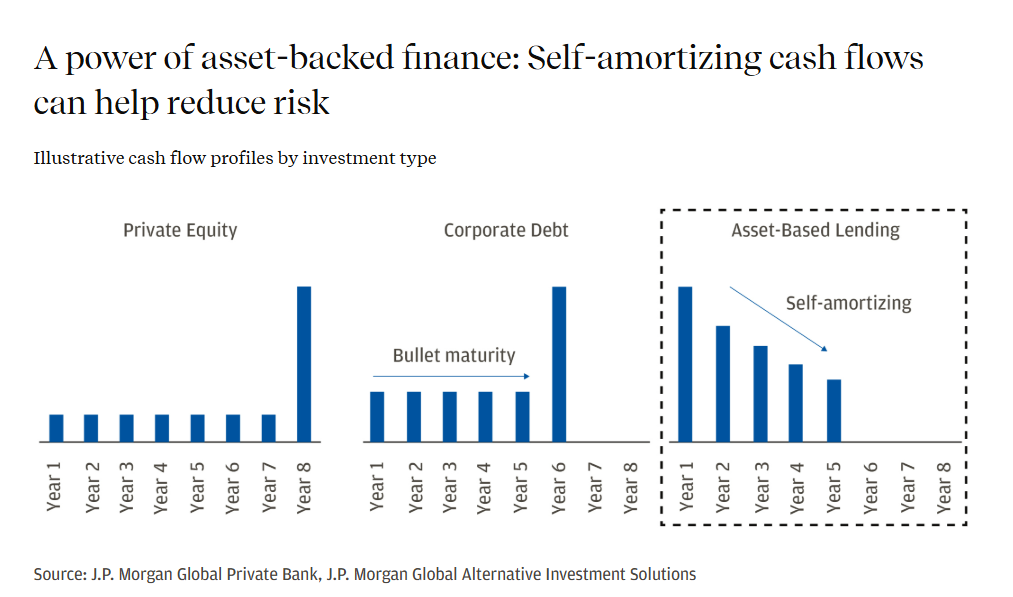
As the chart below shows, many ABF transactions return principal over the life of the investment, unlike bullet-maturity corporate loans that return most of the principal at maturity.
Cash Flow Structures of Private Equity, Corporate Debt, and Asset-Based Lending
Source: J.P. Morgan
However, repayment profiles can vary across ABF structures and collateral types.
- In search of portfolio resilience: Many ABF investments are supported by contractual cash flows from underlying assets. Depending on the collateral quality and deal structure, these predictable cash flows can provide a different source of income that makes a credit portfolio more resilient. However, default and delinquency risks remain.
ABF deals incorporate different structural protections, according to Janus Henderson, including first-loss equity subordination, borrowing-base tests, eligibility criteria for collateral, advance-rate limits, financial covenants, regular reporting, first-priority security interests and controlled collection accounts.
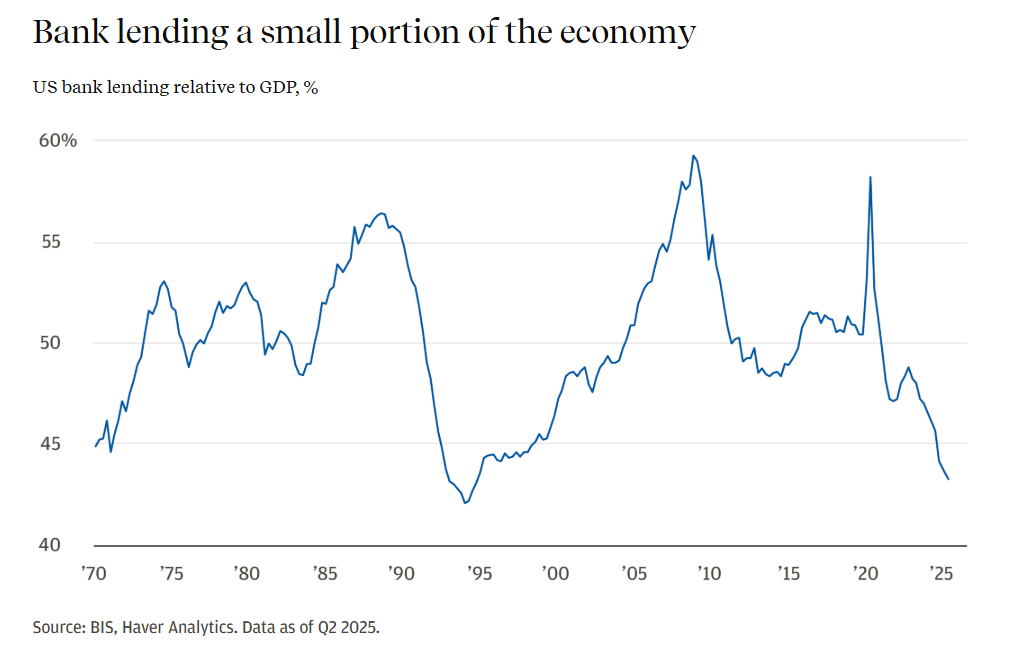
- Demand for non-bank financing: In recent years, bank lending has declined relative to the size of the US economy as financial institutions reassess balance sheet exposure and lending activities.
Bank lending is a small portion of the economy
Source: J.P. Morgan
This trend has increased the demand for non-bank financing, according to J.P. Morgan.
Alternative asset finance providers are stepping in to fill the gap, especially for working capital financing.
“Certain financing activity is shifting from traditional loan providers to alternative lenders, such as institutional investors, private equity firms, and corporate investors,” according to PIMCO, an investment management firm. “Because alternative lenders are subject to less stringent capital reserve requirements, they can offer more flexible funding solutions to address financing gaps.”
This shift reflects a broader expansion of private markets, where institutional investors and alternative asset managers are increasingly financing borrowers and businesses traditionally served by banks.
- Potential for higher risk-adjusted returns: PIMCO also noted that ABF can potentially offer higher risk-adjusted returns than other credit sources. J.P. Morgan puts the average returns in the high single digits while acknowledging that some segments target higher returns.
Asset-backed finance may also offer a yield premium over some public credit strategies. This premium compensates for its additional complexity, illiquidity, and other associated risks.
“ABF can offer an attractive and consistent yield relative to many traditional fixed income products, reflecting specialised structuring such as seniority, overcollateralization, and reserves,” according to KKR Global, an investment management firm.
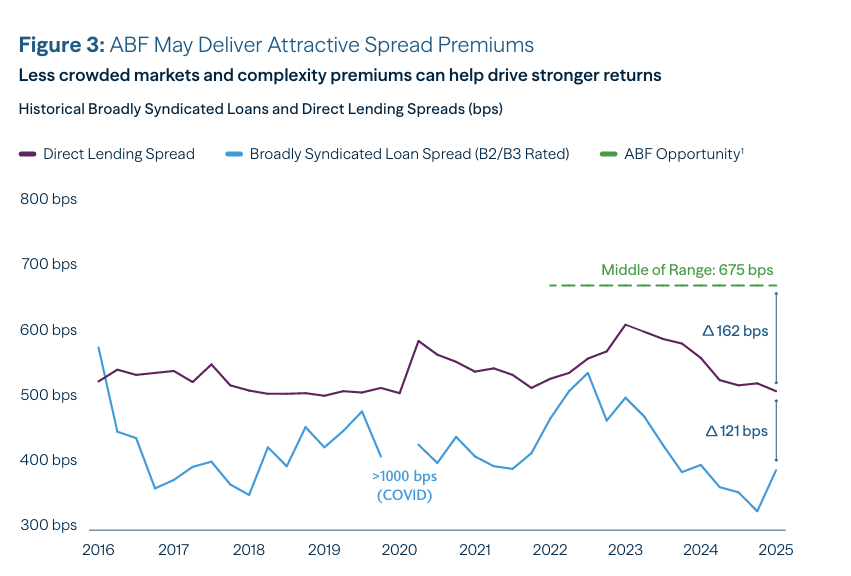
The chart below shows how ABF opportunity can deliver attractive spread premiums compared to direct lending and broadly syndicated loans.
Spread Premiums: Direct Lending, Syndicated Loan, and ABF
Source: Brookfield
2. Asset-based finance vs. direct lending: How allocators decide
Allocators are not embracing alternative asset finance as a replacement for corporate direct lending, but as another way to diversify their private lending strategies.
“Investors may complement, and diversify against, traditional forms of private credit, such as corporate direct lending, through exposure to ABF’s varied sectors and granular asset pools,” noted PIMCO.
Janus Henderson also sees ABF’s role as a complement to private credit portfolios concentrated in direct lending: “As institutional investors expand their private credit exposure, ABF is gaining recognition as a valuable complement to traditional direct lending.”
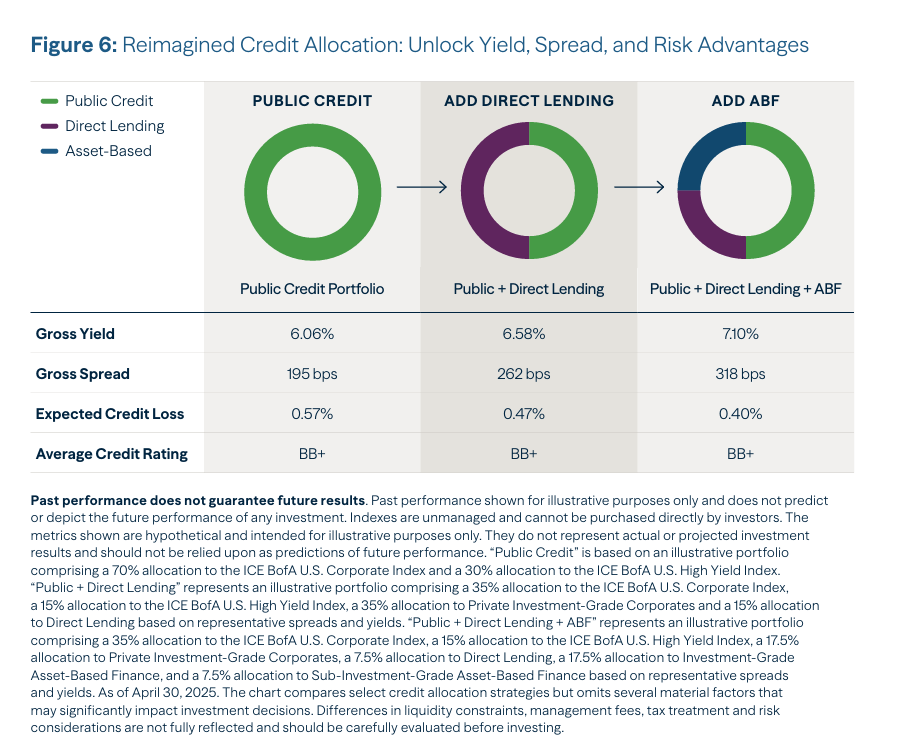
Brookfield Private Wealth, a wealth management firm, offers a hypothetical example of how adding ABF can improve a credit portfolio.
Diversifying a Credit Portfolio
Source: Brookfield Private Wealth
The first portfolio is a public credit portfolio. The gross yield is 6.06% with an expected credit loss of 0.57%. Diversifying this credit portfolio with a direct lending allocation increases the yield and reduces the expected credit loss. Adding ABF to the portfolio further increases the yield and reduces the expected credit loss.
(These figures are hypothetical and should not be interpreted as actual or projected results.)
“We believe that ABF should be viewed as a complement to, not as a substitute for, direct lending in a private credit allocation,” they noted. “Diversifying across private credit strategies can help strengthen portfolios by offering compelling income streams, attractive risk-adjusted returns, and important diversification benefits.”
Thus, the decision for investors is how much of their private credit portfolio should be in ABF.
There is no perfect approach, and each allocator must work out what makes sense. In this Brookfield Private Wealth hypothetical example, the writers allocate equally to investment-grade corporates and ABF (17.5%), as well as direct lending and sub-investment-grade ABF.
3. Where ABF fits in a private credit allocation
For institutional investors, the decision of how much to allocate to ABF should depend on a proper understanding of how it fits into their portfolio.
ABF spans a broad risk spectrum, as we saw from the hypothetical example above, from investment-grade to sub-investment-grade deals. Where it sits in a portfolio thus depends on credit quality, collateral, and investment structure.
Irrespective of the transaction type, ABF can serve three broad roles in a private credit portfolio, according to Schroders Capital, an investment management firm:
- Diversifying income beyond traditional corporate borrowers: Many private credit portfolios are now concentrated in the same corporate borrowers, making their risk profiles homogeneous.
ABF can diversify these exposures by spreading them across pools of obligors.
Also, the underlying securities offer a different risk profile than direct lending. “As direct lending allocations have grown, investors may have more corporate credit exposure than they realise,” noted J.P. Morgan. “ABF offers exposure to consumer payment behaviour, real asset values and contractual cash flows, all of which often move independently of corporate earnings.”
- Making income more resilient: Many ABF investments are supported by contractual cash flows and high-priority assets that help to mitigate the risk of default.
Also, as we have seen from J.P. Morgan, ABF deals amortise repayments through the life of the investment rather than accumulating refinancing risk as maturity gets closer. This means risk exposure reduces as the deal approaches maturity.
- Supporting flexibility and capital recycling: Many ABF deals have shorter maturities than traditional corporate credit. With amortisation, the weighted average life can even be shorter than the contractual maturity. This can give investors more flexibility to redeploy returned capital, although illiquidity risk still exists.
4. How Institutions should approach ABF
How then should institutions approach ABF?
Diversification should be a priority, according to Schroders Capital.
“ABF can be accessed through flexible, diversified strategies or less flexible “single sector” strategies,” they noted. “The diversified approach allows a skilled investment manager to shift capital deployment as relative value changes, rather than being tied to one part of the market for the full investment period or the life of a fund.”
Secondly, specialised expertise is a must.
Janus Henderson notes that while many generalist investors are entering the ABF space due to its perceived benefits, they often lack the expertise, infrastructure, and discipline needed to manage its complexities, a phenomenon they refer to as “ABF tourism.”
J.P. Morgan agrees with this view on ABF complexity: “ABF requires granular and ongoing assessment of loan collateral and the capabilities of loan servicers, among other considerations. Covenant compliance must be verified, and performance triggers tracked on a regular basis.”
This is why they recommend that ABF cannot be a passive allocation and must require specialised expertise, the same conclusion as Janus Henderson.
Third, institutions must prioritise due diligence and robust risk management.
For PIMCO, though ABF can improve a private credit portfolio’s risk-adjusted returns, certain risks remain.
“ABF can offer attractive return potential, but it also comes with important risks—like credit, liquidity, concentration, and legal or regulatory challenges,” they noted. “These investments span different asset classes and might not always meet business goals or deliver expected returns, especially when interest rates change. Since alternative lenders don’t have to hold as much capital in reserve, they may be less able to handle losses during tough financial times, which adds risk for investors.”
One of the ways to manage these risks is to adopt sound due dilligence and risk management protocols. Below are some pointers:
- Analysing the underlying collateral: Since cash flows depend on the collateral, institutions should pay attention to the default, delinquency, and recovery rates of the underlying assets.
- Evaluating originators: Institutions should also evaluate the originator of the assets, focusing on underwriting standards, track record, servicing capabilities, interest alignment, and regulatory compliance.
- Creating resilient deal structures: Institutions should evaluate collateral coverage levels, debt advance rates, loan-to-value (LTV) ratios, reserve accounts, cash-flow waterfalls, covenants, triggers, and SPVs.
- Evaluating liquidity: Though they have shorter maturities, institutions should still pay attention to expected holding period, secondary market availability, refinancing risk, and funding requirements during stressed markets.
- Modelling adverse scenarios: Institutions should also model how deals may perform in adverse scenarios, including higher default rates, lower recovery values, rising unemployment, and higher interest rates.
Interest in diversification and resilient portfolios will continue to drive interest in ABF, and it remains to be seen how large it will be in private credit portfolios in the future.
If you are an asset owner with ABF on your radar, you should discuss it with other asset owners who are exploring the best way to use it in a credit portfolio in general and a private credit portfolio in particular. With these discussions, you can gain insights that can help you make smarter allocation decisions.
At the cio investment club, we provide you with a platform where you can discuss the latest investment trends and opportunities with other financial market experts and players.
We also organise exclusive roundtables and investment breakfasts where you can have face-to-face interactions and one-on-one networking sessions with other investment experts.
Do you want to be a part of a community where you can exchange ideas that will improve your portfolio decisions? Register now to become a part of the cio investment club.
Takeaways
- Secured against pools of assets such as consumer loans, receivables, equipment and leases, ABF offers exposure beyond traditional corporate lending.
- As banks reduce certain lending activities, institutional investors are stepping in to fill financing gaps and potentially capture attractive risk-adjusted returns.
- Adding asset-based finance to private credit portfolios can diversify corporate credit exposure, introduce different cash-flow drivers and potentially improve portfolio resilience.
- Investors need to assess collateral quality, originator capabilities, servicing standards, deal structures, liquidity and downside protection before committing capital.
This document is produced by Instaconnect Limited, trading as cio investment club, a company registered in England & Wales with registration number 15262951.
Instaconnect Limited is neither authorised nor regulated by the Financial Conduct Authority in the United Kingdom nor the Securities and Exchange Commission in the United States of America.
This document is a marketing documentation and is not intended to constitute an invitation or an inducement to engage in any investment activity. It is not intended to constitute investment advice and should not be relied upon as such. It is not intended and none of Instaconnect Limited, its holding companies or any of its or their associates, or any of the participants in the documentation, shall have any liability whatsoever for (a) investment advice; (b) a recommendation to enter into any transaction or strategy; (c) advice that a transaction or strategy is suitable or appropriate; (d) the primary basis for any investment decision; (e) a representation, warranty, guarantee with respect to the legal, accounting, tax or other implications of any transaction or strategy; or (f) to cause Instaconnect Limited to be an advisor or fiduciary of any recipient of this report or other third party.
The content and graphical illustrations contained in this document are provided for information purposes and should not be relied upon to form any investment decisions or to predict future performance. Instaconnect Limited recommends that recipients seek appropriate professional advice before making any investment decision. Although the information expressed is provided in good faith, Instaconnect Limited does not represent, warrant or guarantee that such information is accurate, complete or appropriate for your purposes and none of them shall be responsible for or have any liability to you for losses or damages (whether consequential, incidental or otherwise) arising in any way for errors or omissions in, or the use of or reliance upon the information contained in this document.
To the greatest extent permitted by law, we exclude all conditions and warranties that might otherwise be implied by law with respect to the document, whether by operation of law, statute or otherwise, including as to their accuracy, completeness, or fitness for purpose.
Instaconnect Limited and its logo are proprietary trademarks of Instaconnect Limited and are registered in the United Kingdom. Unauthorised copying of this document is prohibited.
© Copyright Instaconnect Limited 2026