




In pursuit of a more diversified portfolio and return premium, institutional investors continue to gravitate towards private markets.
While many have paid attention to their interest in private equity, there has been an equally strong interest in the private credit market.
About 181 of the institutional investors tracked by PipelineRoad, a capital-raising intelligence platform for fund managers, allocate a portion of their investment portfolios to private credit. This represents 13% of all institutional investors tracked by the platform.
Similarly, 78% of institutional investors have an allocation to private credit, according to the Global Investor Insights Study 2026 by Schroders Capital, a financial firm. Also, 53% of respondents allocate between 1%-10% of their credit portfolio to private credit.
But where exactly do the opportunities lie in private credit, and how can institutional investors manage the common risks associated with private debt investments?
It is to those questions that we now turn.
We’ll cover:
- Why institutional investors are interested in the private credit market
- Private credit outlook: Where do the opportunities lie?
- Reasons for caution: The risks of private credit investing
- How institutional investors should handle private credit investments
Do you want to know more about the opportunities in the fixed-income investing world? Sign up now for the cio investment club’s newsletter for regular expert insights.
1. Why institutional investors are interested in the private credit market
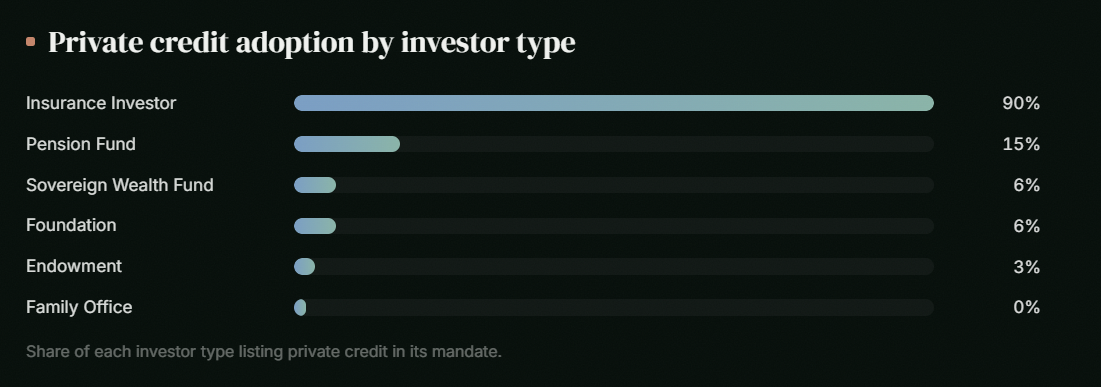
Institutional investors continue to adopt private credit at a growing pace. Among institutional investors tracked by PipelineRoad, adoption is strongest among insurance companies and pension funds. Only family offices have yet to catch up with the trend.
Private Credit Adoption By Investor Type
Source: PipelineRoad
Also, more than half of institutional investors surveyed by Schroders Capital allocate between 1-10% of their portfolio to private credit.
Allocation to Private Credit Among Institutional Investors

Source: Schroders Capital
What then are the main drivers of this interest in private credit?
We consider some of them below:
- Illiquidity premia: About 34% of institutional investors plan to increase their allocations to private credit, according to a survey by Capital Group, a global financial firm.
They found that for 84% of respondents, the desire to earn an illiquidity premium is the motivation for this planned allocation increase.
“In exchange for setting aside capital for predetermined periods, investors receive higher yields and lower volatility than they would get with comparable public debt, along with the potential downside mitigation that comes with bespoke structuring, negotiated legal documents, and direct borrower-lender relationships,” according to Alliance Bernstein, an investment firm.
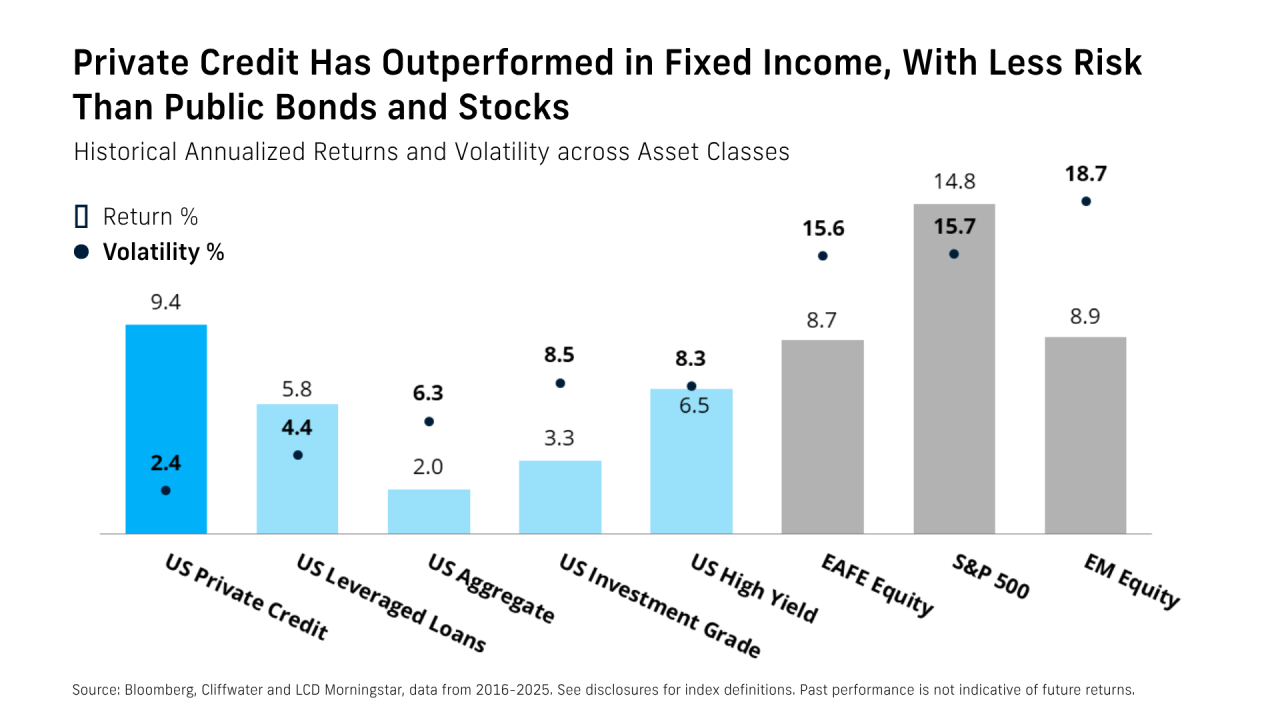
As the chart below shows, the US private credit market has outperformed other credit markets (including leveraged loans, investment-grade bonds, and high-yield bonds) based on data available from 2016 to 2025:
Private Credit Returns vs Other Fixed-Income Assets, 2016-2025
Source: BondBloxx
- Diversification benefits: 73% of those surveyed by Capital Group plan to increase allocations to private credit to enjoy diversification benefits.
“Private credit has been less correlated with public markets than other asset classes, such as equities and bonds,” according to Morgan Stanley, a global investment firm. “This can help reduce portfolio volatility and improve risk-adjusted returns.”
This historically low correlation is becoming more important as the correlation between stocks and bonds continues to increase. As seen in the chart below, the stock-bond correlation has been positive and increasing since 2022.
Trailing 5-Year Correlation between Stocks and Bonds (1/1/2000 – 2/28/2026)

Source: AQR
“The biggest portfolio benefit is not just higher yield, but differentiated yield,” according to Firdaus Syazwani, the founder of Dollar Bureau, a personal finance resource hub. “Private credit can offer floating-rate income, stronger negotiated terms, and exposure to parts of the economy that public markets do not capture well.”
- Lower volatility, compared to returns: Though private credit tends to have higher returns than fixed-income investments, they are also less volatile than public assets and other alternative asset classes.
As the chart from BondBloxx above shows, US private credit had lower volatility than public bonds and public equities between 2016 and 2025.
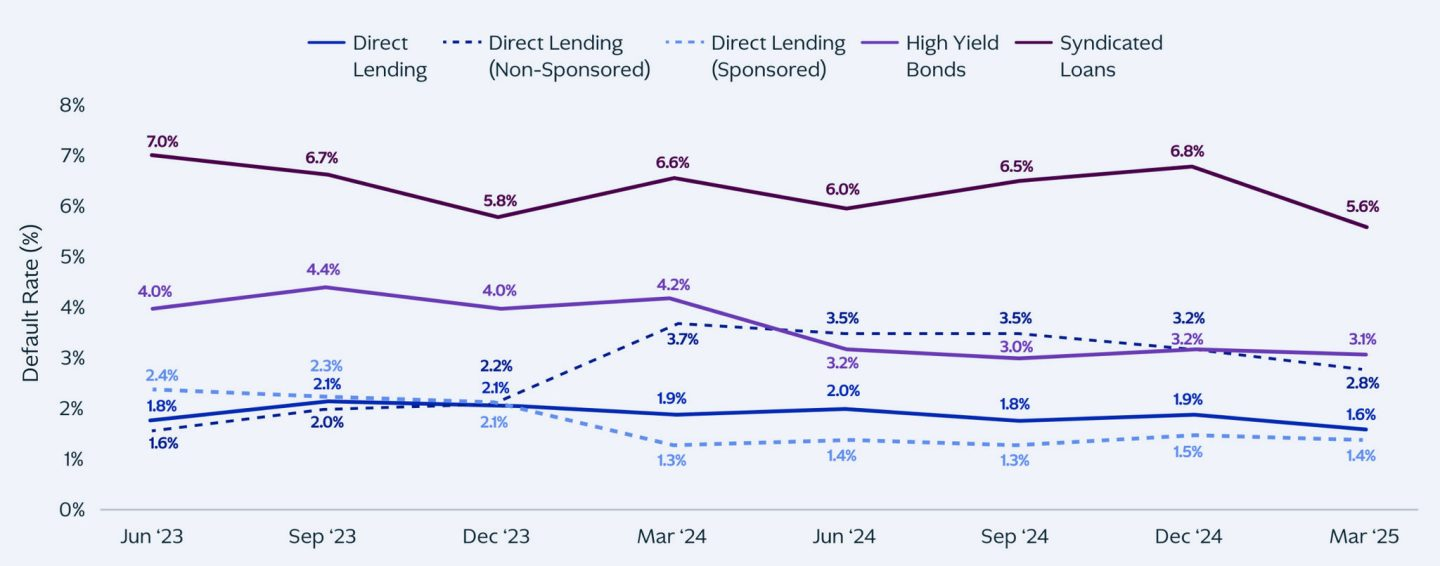
Also, direct lending (one of the key private credit assets) has historically had lower default rates than syndicated loans and even high-yield bonds, according to data provided by KKR Global, an investment management firm.
Default Rates: Direct Lending vs High-Yield Bonds vs Syndicated Loans
Source: KKR Global
Some of this can be attributed to the flexibility of the loan structures provided by non-bank lenders.
Both parties can create repayment schedules, operational covenants, and other repayment terms that are convenient for them, thus reducing the risk of default.
“I often explain this to readers as the difference between buying a packaged product off the shelf and negotiating a custom contract,” said Syazwani. “The custom contract may carry more complexity, but it can also give you better control over terms.”
- Potential inflation hedge: The floating-rate exposure of private credit also makes it a potential inflation hedge.
“Many private debt investments feature floating rates that act as buffers against further rising interest rates,” according to Westmount Partners, an investment management firm. “In other words, floating debt that is benchmarked to the London Interbank Offered Rate (LIBOR) or, more recently, the Secured Overnight Financing Rate (SOFR), is likely to benefit by paying higher yields as the central banking system raises rates in an effort to combat inflation.”
2. Private credit outlook: Where do the opportunities lie?
The private credit market is a broad one, with different strategies or assets that include direct lending, asset-based funding (or asset-based lending), junior debt, distressed debt, unitranche debt, venture debt, alternative credit, structured credit, mezzanine financing, and speciality finance, among others.
Though there is an extensive interest in this broad market, institutional investors who want to allocate to private credit should understand where the demand is strongest so they can better explore the available opportunities.
In what follows, we consider the areas of interest that institutional investors should prioritise:
Senior-secured debt is capturing the most attention
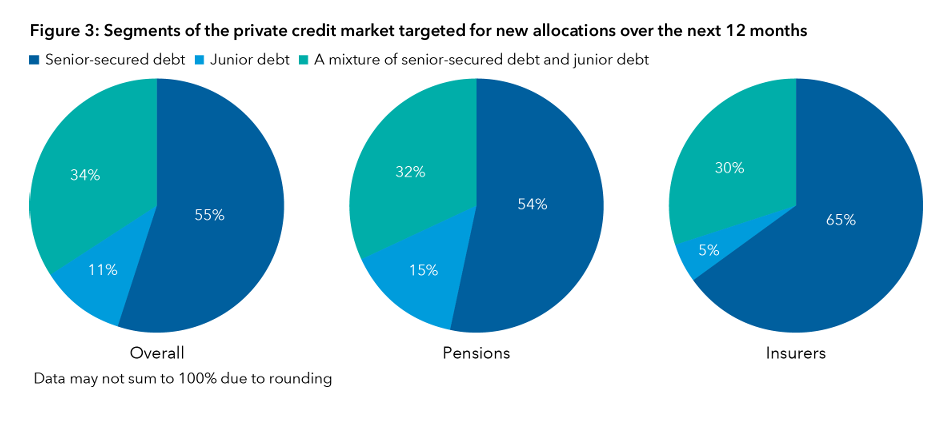
More than half of those who plan to increase allocations to private credit are targeting senior-secured debt, according to Capital Group.
Segments of the Private Credit Market Targeted for New Allocations Over the Next 12 Months
Source: Capital Group
They also notice that this interest in senior debt is strongest among insurance companies, which are known for the ability to achieve lower regulatory capital charges.
“In today’s environment, I think the best opportunities are in senior secured direct lending to resilient, cash-generative businesses, especially where lenders can demand stronger covenants and better pricing,” according to Syazwani.
Global diversification is still very much alive
We mentioned at the end of 2025 that global diversification is one of the best investment strategies for 2026. The private credit market is another area where this is manifesting.
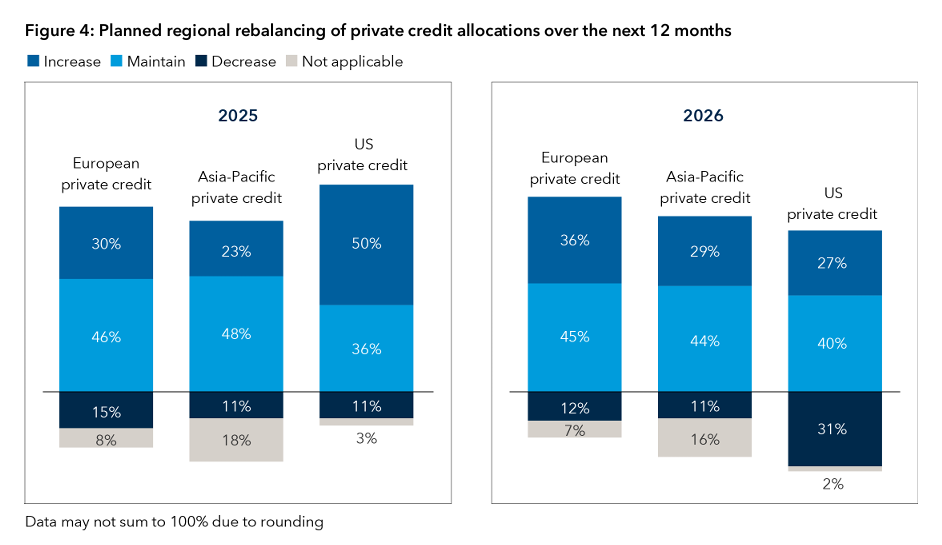
As the chart below shows, investors are showing more willingness to increase their allocation to private credit in Europe and the Asia-Pacific than in the US.
Planned Regional Rebalancing of Private Credit Allocations Over the Next 12 Months
Source: Capital Group
Also, notice the corollary: more investors are seeking to reduce allocation to the US private credit than they are in the European and Asia-Pacific markets.
Alpha seekers are targeting distressed debt and special situations credit
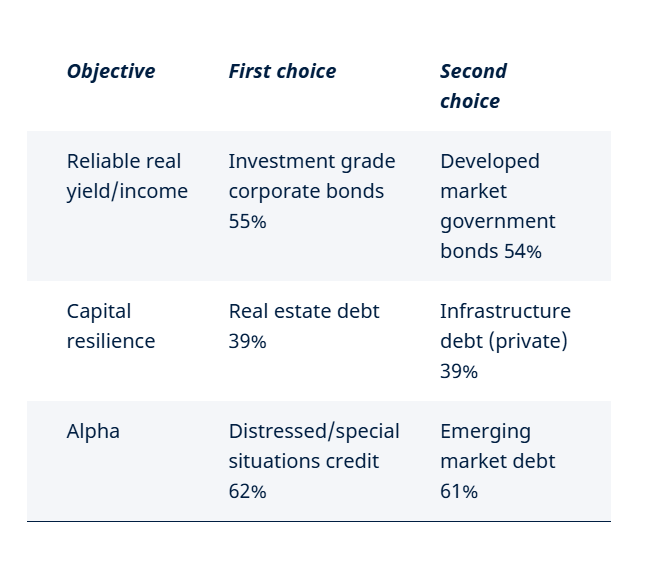
Schroders Capital has noticed a segmentation in the credit market whereby investors are matching their investment objectives with the relevant credit asset.
The part that is most relevant to us is that they are prioritising higher-risk and specialist strategies for alpha generation.
As seen below, the first debt finance asset considered by investors seeking alpha is distressed/special situations debt.
How Institutional Investors Match Credit Assets to Investment Objectives
Source: Schroders Capital
“Distressed credit situations are often highly security-specific, and specialist investors can influence or improve recoveries through restructuring expertise,” they mentioned.
One conclusion from this is that investors should look beyond traditional direct loans and explore how other forms of private credit can meet some of their objectives. For example, distressed debt funds can help to increase returns depending on the institution’s risk appetite.
“This reinforces the case for looking across the full credit continuum,” they concluded. “In a market where income, resilience, and alpha may come from different sources, investors are increasingly building allocations around portfolio objectives rather than asset-class labels. This suggests that flexibility matters more than ever: not simply in moving between public and private credit, but in identifying which parts of each market are best suited to the job at hand.”
Speciality finance is growing in popularity
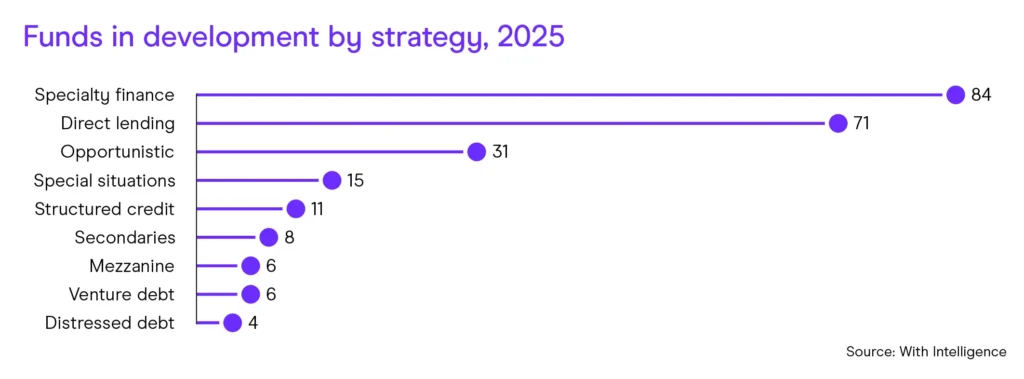
2025 was a breakthrough year for speciality finance (litigation finance, insurance premium finance, merchant cash advances, healthcare receivables, royalty finance, among others).
In terms of new private credit launches, they eclipsed direct lending in the first three quarters of 2025, according to data from With Intelligence, an alternative investment data platform.
New Private Credit Launches By Strategy
Source: With Intelligence
Interestingly, many speciality finance funds started 2026 with high fundraising targets as they seek to ride on the wave of renewed demand for these assets.
This ties into Moody’s expectation that asset-backed financing will grow the fastest in the coming years.
“ABF will lead growth as partnerships, asset origination accelerates,” they said. “Alternative asset managers are looking to fund newer, more diverse pools of assets – increasingly, consumer loans and data infrastructure credit. New partnerships are spurring origination opportunities while alternative asset managers will continue stepping up as banks remain constrained in certain lending activities.”
3. Reasons for caution: The risks of private credit investing
Though private credit funds have delivered strong returns and attracted institutional flows, they are not without their vulnerabilities.
Some of these vulnerabilities have been made manifest in recent years, even as private credit kept becoming more popular among institutional investors.
We consider the most important ones below:
- Liquidity strain: Private market investments have always been plagued by an illiquidity problem, and private credit markets are not immune.
This illiquidity has come to the fore between late 2025 and 2026, as chronicled by Amina Group, a Swiss Bank.
They noted how BlackRock’s HLEND fund faced redemption requests that exceeded 9% of its net asset value (NAV), which forced it to enforce withdrawal caps. Similarly, Blackstone’s BCRED fund faced $3.7 billion in redemption requests, which led it to inject more capital and sell some assets. Finally, they mentioned Blue Owl, an investment fund that had to resort to secondary sales and share buybacks to meet redemption requests.
All of these episodes reiterate that liquidity in private credit is often conditional, and private credit funds can resort to withdrawal caps when redemption requests exceed what they can handle.
- Borrower defaults and collateral fraud: Though the default rate in the private credit market has been historically low, there has been an upward trend in 2026.
“Default rates in private credit, which were running at 3–4% earlier this year, have accelerated to approximately 8–9%, and UBS projects they will climb toward 15% by the second half of 2026,” according to Amina Group.
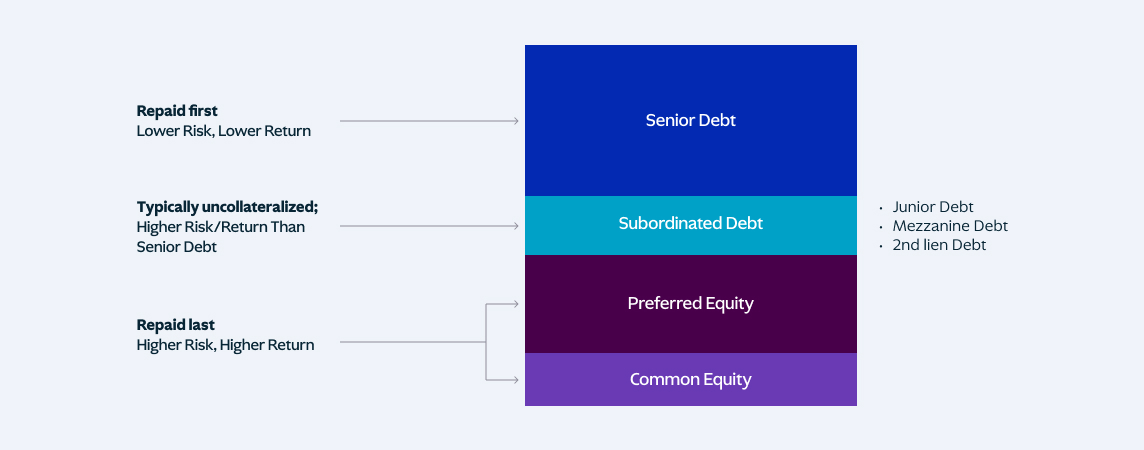
This growing default rate is especially significant the further down the capital structure you go, with the greater concern among subordinated debt structures (junior debt, mezzanine debt, and second lien debt).
No wonder many institutional investors seem to be prioritising senior-secured debt, as reported by Capital Group, and investment-grade private credit (with higher credit ratings), as reported by Wellington Management, an investment management firm.
How Debt Seniority Affects Risk and Return
Source: KKR Global
Two high-profile default and fraud cases in 2025 were especially concerning, as reported by Long Angle, a wealth management firm.
In the first case, Tricolour, a supreme auto lender, was found to have used the same auto loan collateral to access credit from multiple lenders. It had to file for bankruptcy when these lenders froze its funding.
Similarly, FirstBrands was found to have fabricated receivables and used the same inventories to secure funds from multiple lenders. It also filed for bankruptcy when lenders decided to pull funding.
- Refinancing risk: Many borrowers issued debt in the low-rate era of 2020-2022. However, as rates have failed to come down due to inflation fears, borrowers now face a refinancing wall maturing between 2026 and 2028 at higher costs.
“Companies with near-term maturities, particularly in the software sector, may face more challenging refinancing conditions if liquidity remains constrained,” according to Carlyle, a global investment management firm.
- Concentration risk: In recent months, there have been concerns about whether private lenders are over concentrated in technology companies and how the dominance of AI will affect the performance of these companies.
“Investors regard new AI tools as an ‘existential threat’ to the software sector that has the potential to erase the competitive advantages of established software platforms and automate tasks that underpin traditional software pricing power,” according to Carlyle. “While this is primarily an equity story (“Software do we go now”), markets have taken a ‘sell first, ask questions later’ approach to anything touching the sector.”
This is becoming concerning in the private credit market because many private credit managers have up to 25-30% of their portfolios in software and technology companies, according to Vivek Bantwal, global co-head of private credit in Goldman Sachs Asset Management.”
- Regulatory risk: It has been noted that a few firms dominate the origination of private credit deals. Also, many private credit fund managers use fund-level borrowing (leverage) to enhance returns (and meet investors’ expectations), which adds more risk, especially in downturns.
These issues constitute regulatory risk as they can introduce weaknesses that threaten the stability of the financial system. We are already seeing leverage ratio redefinitions and a structural tightening of leverage standards across institutional capital, as reported by ExecVex, a market analysis platform for business executives.
- Valuation lag and lack of transparency: Private credit assets are not marked to market daily like public bonds; rather, they are valued every quarter or semi-annually.
One implication of this is that even when borrower fundamentals deteriorate, fund valuations may remain flat until it is time to perform a write-down. Similarly, this valuation lag makes private credit assets look less volatile when compared to public credit.
Furthermore, many private credit deals are confidential, which makes it difficult to take a sneak peek at the loan terms and the borrower’s financial health. As a result, lenders often suffer from an information asymmetry that makes some companies look better than they actually are.
“The risk nobody talks about enough is information asymmetry at the underwriting stage,” according to Einar Vollset, the founder of Discretion Capital, an M&A advisory firm for SaaS companies. “In my world, sellers routinely present metrics that look better than the underlying reality — that's exactly why we do pre-diligence before going to market. Private credit managers face the same problem without always having the sector depth to catch it. Specialisation in a specific vertical isn't optional anymore; it's the whole game.”
We have also seen that fund-level debt leverage exposure can be hard to detect until it becomes a problem for the fund.
Similarly, loan valuations often depend on managers’ judgment rather than publicly available market prices.
4. How institutional investors should handle private credit investments
Given both its benefits and risks, institutional investors need to approach private credit carefully, irrespective of the investment mode: private credit funds, business development companies (BDCs), or evergreen private credit funds.
Below are some tips that will help institutional investors get the best out of private credit investments:
- Sector and geographic diversification are essential: As we saw above, the popularity of AI has led to concerns about the future profitability of software companies in the portfolio of private lenders. Also, we saw that many institutional investors are exploring non-US markets in search of alpha and less portfolio risk, a trend that is in line with the great global restructuring.
Both of these developments reiterate the need for institutional investors to choose well-diversified (sector and geographic) private credit funds when allocating to this asset class.
- Match private credit assets with investment objectives: Schroders Capital has shown us how investors are matching private credit assets with investment objectives rather than asset-class labels.
Instead of investing in private credit because everyone else is doing it, clarify your investment objectives so you can select the appropriate private credit assets.
- Manager selection is crucial: There is dispersion in returns among private credit funds that can be attributed to differences in fund management quality, according to Crisil, a global analytics company.
In fact, the difference between the best and worst managers in private credit markets is far wider than in public credit markets. They attribute this to differences in managers’ deal sourcing acumen, access to off-market deals, and ability to improve the operations and cash flow of the businesses they lend to.
This implies that conducting due diligence on private credit managers is crucial to succeeding in this market.
“Private credit is not an alternative to traditional fixed income, but rather an alternative that can supplement fixed income through disciplined underwriting and manager selection,” according to Dinesh Kumar, a Chartered Financial Advisor and the owner of Sheet Rows, a platform offering free Excel and CSV tools.
For Crisil, you should focus on four factors when selecting private credit managers: business management (experience, track record, and organisational structure), alignment (of managers’ and investors’ interests), strategy (investment focus, deal sourcing processes, risk management practices), and track record (loan performance, credit selection, and portfolio management).
They believe that each of these metrics provides insights into the manager’s ability to consistently generate high returns for investors.
- Embrace a long-term approach: Many of the liquidity and redemption concerns about private credit funds arose from the expansion of private credit markets to retail investors.
As an institutional investor, you should embrace a long-term approach to private credit investment that reduces the stress you will feel about redemption limits. Thus, when making portfolio allocation decisions, you should remember that private credit is a long-term investment.
- Monitor macro and structural shifts: Private credit markets are affected by evolving interest rate regimes, regulatory developments, and sectoral structural shifts (as we saw with concerns about software and technology companies).
This is why a passive approach might not work. You must constantly evaluate relevant macro and structural factors and adapt your private credit allocation to new realities.
One way asset managers can keep abreast of macro and structural shifts is to be in constant conversations with other financial market experts.
At the cio investment club, we provide you with a network of asset managers, asset owners, and other financial experts, where you can discuss the latest developments in the global economy.
We also organise exclusive roundtables and investment breakfasts where you can physically interact and exchange ideas with other club members on different relevant topics.
If you work in a pension fund, you can join us for the Pension Investment Club Conversation and Lunch on September 9 at Ten Trinity Club in London. You can contact me to book your spot.
Are you interested in being a member of the cio investment club? Register now to join other experts shaping the future of the financial markets.
Takeaways
- Private credit is becoming a strategic allocation, not a niche asset. Pension funds, insurers, and other institutional investors continue increasing exposure in pursuit of higher yields and diversification.
- Senior-secured debt, speciality finance, and non-US markets are attracting the strongest institutional interest.
- Higher returns come with evolving risks: liquidity constraints, refinancing pressures, borrower defaults, valuation lags, and regulatory scrutiny.
- Success in private credit increasingly depends on choosing experienced managers with disciplined underwriting, diversification, and strong deal sourcing.
This document is produced by Instaconnect Limited, trading as cio investment club, a company registered in England & Wales with registration number 15262951.
Instaconnect Limited is neither authorised nor regulated by the Financial Conduct Authority in the United Kingdom nor the Securities and Exchange Commission in the United States of America.
This document is a marketing documentation and is not intended to constitute an invitation or an inducement to engage in any investment activity. It is not intended to constitute investment advice and should not be relied upon as such. It is not intended and none of Instaconnect Limited, its holding companies or any of its or their associates, or any of the participants in the documentation, shall have any liability whatsoever for (a) investment advice; (b) a recommendation to enter into any transaction or strategy; (c) advice that a transaction or strategy is suitable or appropriate; (d) the primary basis for any investment decision; (e) a representation, warranty, guarantee with respect to the legal, accounting, tax or other implications of any transaction or strategy; or (f) to cause Instaconnect Limited to be an advisor or fiduciary of any recipient of this report or other third party.
The content and graphical illustrations contained in this document are provided for information purposes and should not be relied upon to form any investment decisions or to predict future performance. Instaconnect Limited recommends that recipients seek appropriate professional advice before making any investment decision. Although the information expressed is provided in good faith, Instaconnect Limited does not represent, warrant or guarantee that such information is accurate, complete or appropriate for your purposes and none of them shall be responsible for or have any liability to you for losses or damages (whether consequential, incidental or otherwise) arising in any way for errors or omissions in, or the use of or reliance upon the information contained in this document.
To the greatest extent permitted by law, we exclude all conditions and warranties that might otherwise be implied by law with respect to the document, whether by operation of law, statute or otherwise, including as to their accuracy, completeness, or fitness for purpose.
Instaconnect Limited and its logo are proprietary trademarks of Instaconnect Limited and are registered in the United Kingdom. Unauthorised copying of this document is prohibited.
© Copyright Instaconnect Limited 2026