




It is not an exaggeration to say that artificial intelligence is one of the defining stories of our time.
Technology executives are racing to integrate AI into their businesses. Governments are creating national AI strategies. Venture capital firms are pouring billions into AI startups. And the world's largest technology companies are spending unprecedented sums on data centers, chips, and AI infrastructure.
The excitement has been so intense that some commentators have compared AI to the internet, electricity, and even the Industrial Revolution.
Yet not everyone is convinced.
Some experts in Silicon Valley and on Wall Street are concerned that an AI bubble is already forming and may soon burst. They see evidence for this in the extremely high valuations of AI companies, the inability of many AI companies to make a profit, and the overconcentration of investment funds in AI companies.
Also, some experts express concern over the actual impact of AI on the bottom line. While everyone is quick to jump on the AI train, only a few companies report any significant impact of AI on their profitability.
So, are we living in an artificial intelligence bubble, and more importantly, will the AI bubble burst? It is to those questions that we turn.
Do you want to know more about the economic and financial impacts of technologies like artificial intelligence? Subscribe now to the cio investment club’s newsletter for expert insights.
We’ll cover:
- Are we living in an AI bubble? Overview of the warning signs
- Will the AI bubble burst? The good sides of the AI revolution
- Will AI become a revolution: Exploring three possible scenarios
- Approaching AI investment: The need to strike a balance
1. Are we living in an AI bubble? Overview of the warning signs
While many AI enthusiasts will wave off any concerns about an AI bubble as mere fear of the revolutionary impacts of the technology, there are actually good reasons to be concerned.
We explore some of them below:
Lack of proven economics
Though there has been a huge hype about AI technology, many companies in the AI industry still struggle to become profitable, exert pricing power, retain customers, or create a competitive advantage.
“After documenting 80+ economic intelligence systems and studying real-world AI company outcomes, I’ve seen a pattern repeat with mathematical precision: brilliant models, passionate teams, enthusiastic early users — and catastrophic unit economics that kill the company before they can fix them,” said Kimberly Goertz, the founder of Nocturne AI, an innovation studio dealing with LLM memory management.
Many AI companies start with a few users that they can service with free credits from cloud providers, according to Hustle Commons, a venture capital fund. However, as usage increases, the cost per user is equal to or even more than the revenue per user, leading to thin or non-existent margins.
Yet, these companies struggle to raise prices since everyone else is giving away free stuff and keeping prices constant. Consequently, many AI companies continue to burn through their capital with no viable path towards profitability.
Overvaluation of AI companies
Despite this unit economics problem, investors continue to pour funds into AI companies, leading to their overvaluation.
Bloomberg puts the problem succinctly: “Never before has so much money been spent so rapidly on a technology that remains somewhat unproven as a profit-making business model.”
For example, 10 AI startups with zero dollars in profit gained $1 trillion in market value between October 2024 and October 2025, according to the Financial Times.
“Many AI companies today trade at 30 to 50 times revenue multiples while posting negative margins,” according to Hustle Fund, an angel investing fund. “That works when capital is free and investors will fund anything. It doesn't work when markets cool down.”
This market cool-down will happen sooner rather than later, according to Julien Garran, a researcher at MacroStrategy Partnership, an economic think tank. He believes that there is no obvious way for data centres, LLM developers, and software developers that use LLMs to turn around the current situation and become profitable. And when they run out of investors, the bubble will burst.
Unprecedented AI investment
Since 2024, tech giants have been pouring huge sums into AI infrastructure and companies.
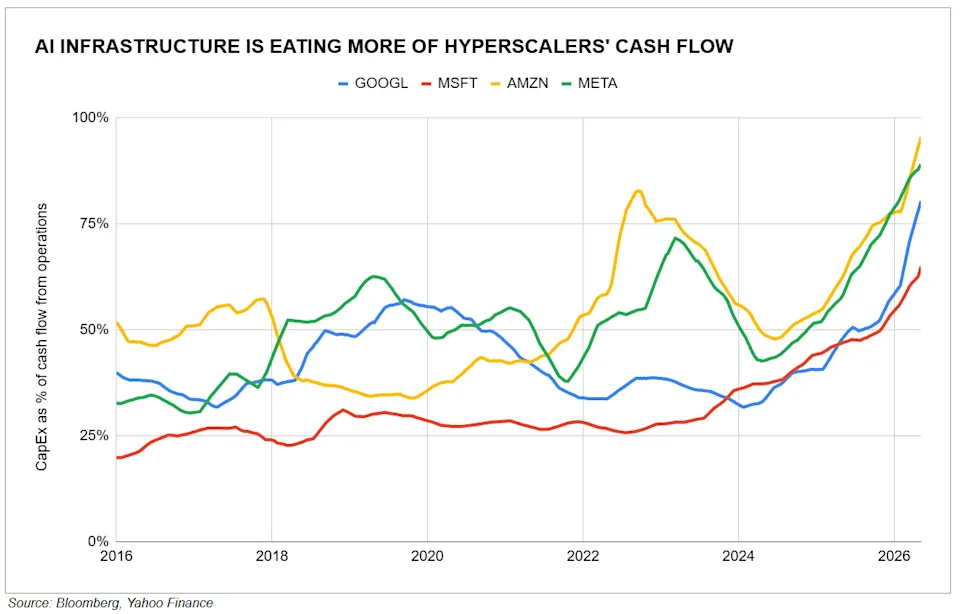
As the chart below shows, capital expenditure as a % of cash flow from operations of Google (Alphabet), Microsoft, Amazon, and Meta (Facebook) is the highest it has been since 2016.
Capex as a % of Cash Flow From Operations of Selected Tech Giants
Source: Yahoo Finance
Also, more than 60% of venture capital funding in 2025 went to AI startups, according to Startup Genome, a startup accelerator ecosystem.
Interestingly, while overvalued AI companies continue to raise funds (through various forms of financial engineering), non-AI companies that raised funds before ChatGPT have been left to struggle.
“The AI boom that funnelled more than $250 billion into OpenAI and Anthropic ahead of their expected mega-IPOs this year has left hundreds of startups built before ChatGPT’s arrival in 2022 stranded — effectively cut off from venture funding because of their inflated valuations and outdated technology, yet not profitable enough for the public markets,” according to CNBC.
Even Sam Altman acknowledged, in a conversation with Bloomberg, that we are in a phase where investors as a whole are overexcited about AI.
Yet, AI revenue has struggled to keep pace with the investment and spending scale.
OpenAI, one of the most prominent AI companies, is an example of this conundrum. While the company has committed to $1.4 trillion in infrastructure spending over eight years, it has also projected annual operating losses through at least 2028, according to Nadcab, a blockchain and AI development company. They also noted that the company has been projected to run out of money by mid 2027 without additional fundraising.
Furthermore, many AI investors have resorted to the bond market to raise investment capital. Debt used to fund data centres can rise to $1 trillion by 2028, according to analysts at Morgan Stanley. And this is another warning sign of a bubble, according to many critics, since many of these bonds are either BBB bonds or junk bonds.
Overconcentration of stock markets in AI companies
In recent years, the US stock market, as measured by the S&P 500 Index, has been dominated by a few mega-cap tech stocks, leading to concerns about overvaluation.
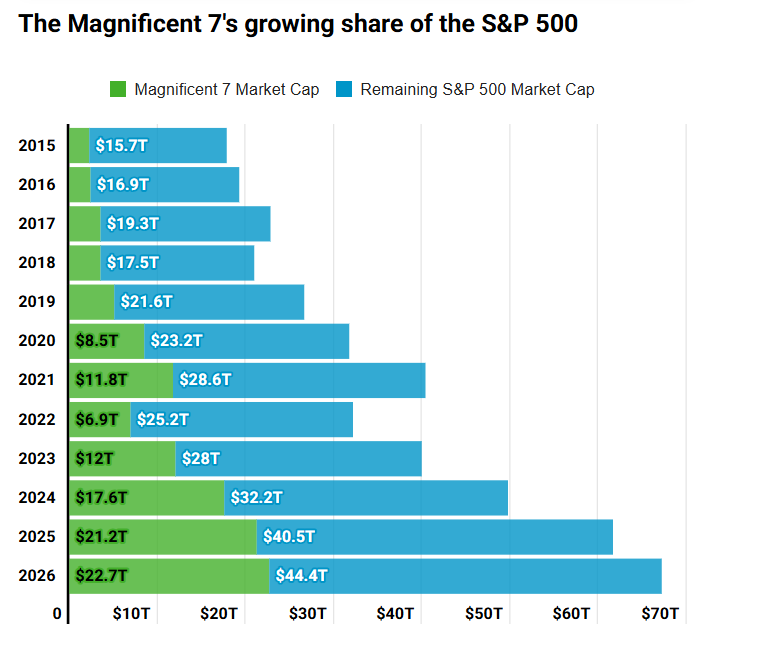
As of May 12, 2026, the magnificent 7 stocks (Apple, Alphabet, Amazon, Meta Platforms, Microsoft, Nvidia, and Tesla) represented 33.8% of the S&P 500 Index, as seen in the chart below.
Mag 7’s Share of the S&P 500, 2015-2026
Source: The Motley Fool
The same dynamics operate at the global level.
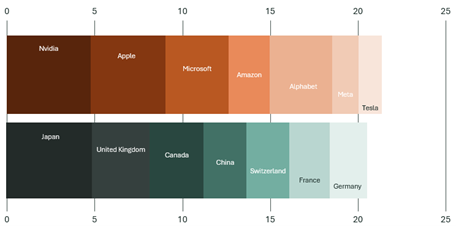
Mag 7 stocks now account for a greater percentage of the global stock market than the seven largest countries after the US, as seen in the chart below:
Mag 7 % of the Global Equity Market vs The Seven Largest Countries After the US
Source: McInroy and Wood
This concentration means that a third of the US and more than 20% of global equity performance rests on seven AI-linked firms, a level not seen since the dot-com crash. Any slowdown in AI revenue, chip demand, or AI adoption could trigger disproportionate market corrections.
Return on investment gap
At the end of 2025, McKinsey and Co released a report showing that AI adoption has not led to any significant impact on enterprise-wide EBIT for most companies.
“Thirty-nine per cent of respondents attribute any level of EBIT impact to AI, and most of those respondents say that less than 5 per cent of their organisation’s EBIT is attributable to AI use,” they noted.
Similarly, a study by MIT found that though enterprises invested $30-40 billion into GenAI, 95% of them got zero return. While these tools had effects on individual productivity, they didn’t have any impact on P&L performance.
The National Bureau of Economic Research came to the same conclusion after surveying over 6,000 executives from the US, UK, Germany, and Australia: “Executives report little own-firm impact of AI over the last 3 years, with nine-in-ten reporting no impact on employment or productivity.”
Circular financing
Circular financing, where money is moving in a circle of the same companies, has been one of the key concerns about AI.
The issue became more prominent with the announcement of the Stargate Project, a massive AI infrastructure initiative involving Oracle, OpenAI, and SoftBank Group.
Some critics argued that if SoftBank funds OpenAI and OpenAI buys compute capacity, then it will require Oracle to build infrastructure to serve OpenAI. In this case, some of the revenue growth may be dependent on continued investor funding rather than fully self-sustaining customer demand.
There have also been concerns about circular financial engineering involving companies like Amazon, Nvidia, AMD, and Coreweave.
Interestingly, critics have drawn comparisons between this and the vendor financing structures that preceded the dot-com crash.
2. Will the AI bubble burst? The good sides of the AI revolution
Many experts, including Garran, have compared the current situation with the dot-com bubble. Just as the dot-com bubble eventually burst, they expect the same trajectory for the AI bubble.
However, there are some reasons to be cautious about drawing a straight line from the dot-com bubble to the current AI revolution.
Below are a few of them:
Different funding dynamics
At the head of the AI revolution are stable and profitable companies that are financing investment in AI with cash flow from their operations.
We saw above that Capex as a % of cash flow from operations from the top tech giants has been on a steady increase since 2024, and it is now the highest it has been since 2016.
This is different from the debt-driven funding of internet startups during the dot-com era.
“Unlike the dot-com boom of the late 1990s, today’s AI expansion is being led by profitable global companies deploying existing cash flow,” according to VanEck, a global investment management firm.
Also, the performance of many of these tech giants is driven by sustained profits rather than excessive speculation, according to Peter Oppenheimer, chief global equity strategist at Goldman Sachs.
Furthermore, many AI startups have access to private capital funding, reducing the need for IPOs, which dominated the scene during the dot-com bubble.
Focus on infrastructure spending
A large part of this capex has been directed towards AI infrastructure, like data centres, that will sustain future commercial applications. This shows that the biggest companies in the world are bullish about AI and its impact on their long-term competitiveness.
More importantly, AI companies can rent this infrastructure instead of trying to raise funds to build out their own.
High valuations supported by earnings growth
Though many technology companies have high valuations, these are often supported by strong earnings growth and not just optimism about the prospect of AI.
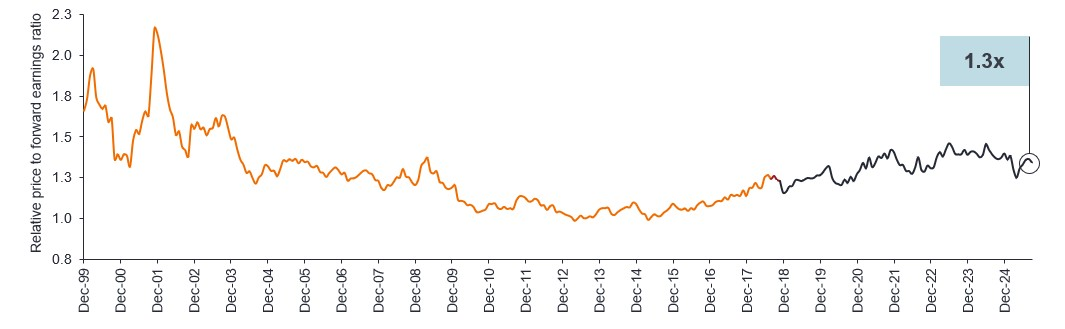
“The sharp run-up in share prices in AI-related names has been driven by corporate earnings growth, rather than pure multiple expansion (company valuation),” according to Janus Henderson, an investment management firm. “As noted earlier, with fewer start-ups, the public market large technology stocks have not shown signs of excess in the way that they did in 2000. In 2000, the technology sector traded at more than double that of the broader equity market. Currently, it trades lower, at around 1.34x the broader equity market.”
This difference in valuation can be seen in the chart below:
Relative Forward P/E Ratio of US Technology Stocks
Source: Janus Henderson
High adoption rates
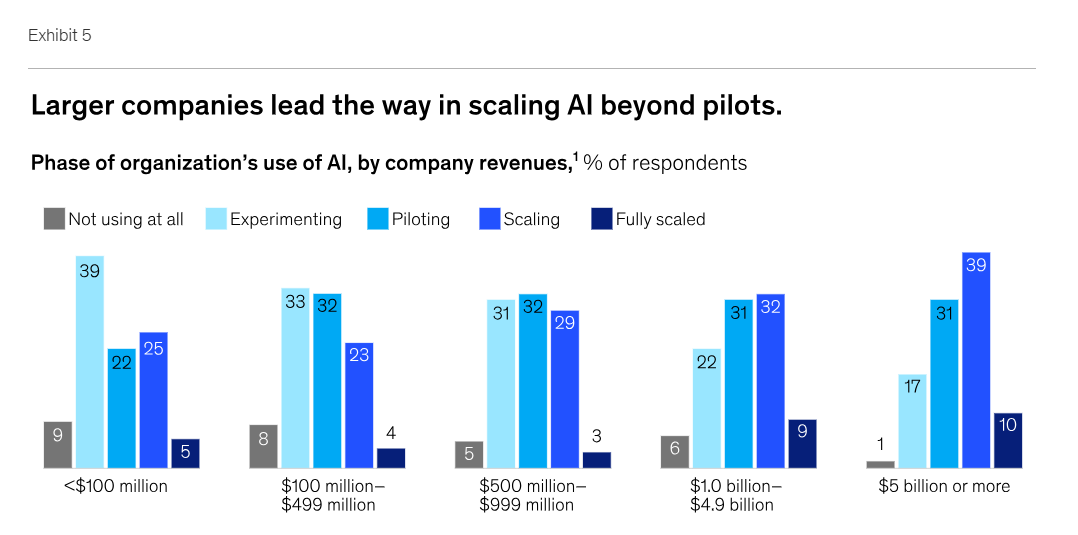
The adoption of AI by individuals has been astronomical. Interestingly, usage by enterprises has also been significant.
As the chart below shows, more companies are likely to be experimenting with AI, piloting its usage, or scaling it beyond pilots. Across all revenue sizes, only a few per cent of respondents are not using AI at all. Interestingly, the bigger the company, the higher the adoption rate.
Adoption of AI by Revenue Size
Source: McKinsey and Co
Real-world impacts
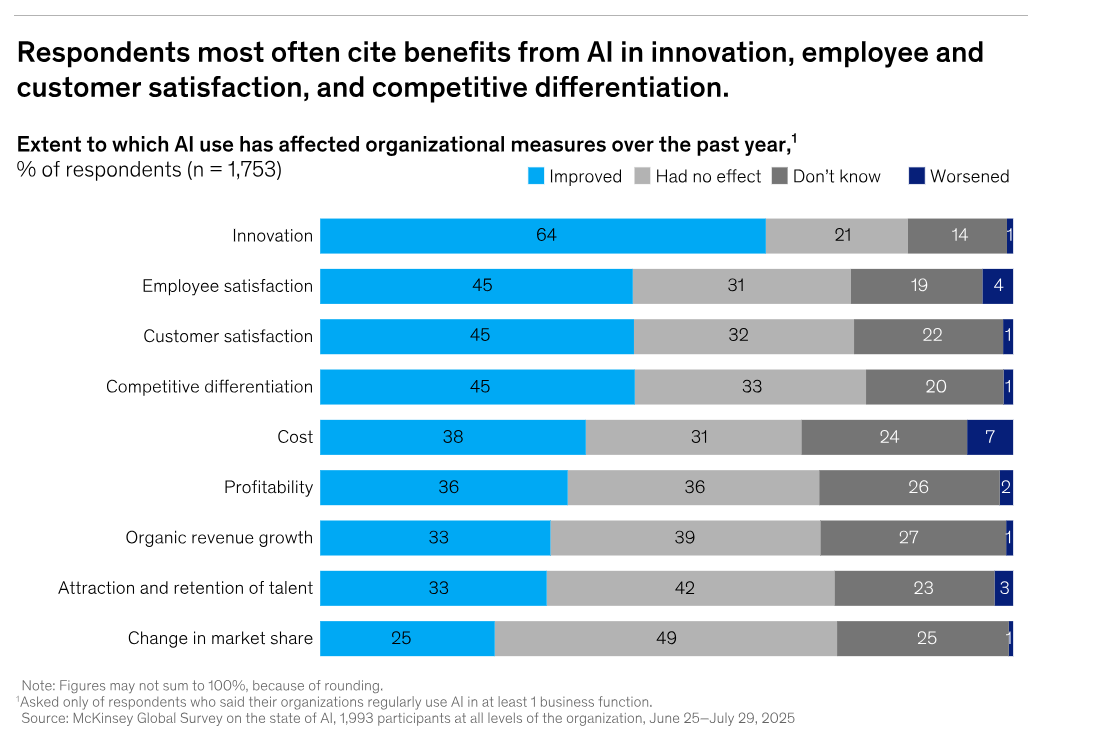
Though many companies are yet to report a significant impact on the bottom line, there is no doubt that AI has been transforming their operations in several ways.
As the chart below shows, AI is providing benefits in innovation, employee satisfaction, customer satisfaction, competitive differentiation, revenue growth, cost reduction, and profitability, among others.
How AI Has Affected Organisational Measures
Source: McKinsey and Co
“AI is simultaneously a bubble and a revolution, which sounds contradictory until you separate infrastructure from expectations,” according to Deepak Shukla, the CEO of Pearl Lemon Capital, a business financing company. “I believe many AI-related valuations have run ahead of reality, but the underlying technology is already transforming how businesses operate.”
The main benefit will be in improved productivity, which will contribute to higher GDP, according to Lisa Cook, a Federal Reserve Governor.
“As firms incorporate AI more systematically into their production processes, I expect that AI will further boost productivity growth, contributing to my expectation that GDP will grow robustly in the near to medium term.”
Global policy alignment
Governments are embedding AI into national strategies, seeking to align funding with regulation.
The National Artificial Intelligence Initiative Act in the US coordinates AI R&D across federal agencies, linking funding to ethical and security standards. In the EU, the AI Act has been designed to tie innovation funding with a comprehensive AI regulation.
China’s The New Generation AI Development Plan also integrates AI into industrial policy and education, aiming to tie state-backed funding with cybersecurity and data-governance rules. India has also allocated funds for AI research under the India AI Mission.
We can go on and on. But the point is simple: governments across the globe are creating policies for safe and effective usage of AI, which shows their perspective on AI as a potentially revolutionary technology.
Different macroeconomic situation
During the dot-com bubble, the Federal Reserve was implementing contractionary monetary policy to bring down inflation. Though inflation is not yet at the 2% target, monetary policy is less contractionary.
3. Will AI become a revolution: Exploring three possible scenarios
So, is the AI bubble going to burst, or will AI become a revolution that will transform the global economy?
Below are three possible scenarios as we approach the future of AI:
- Scenario 1 (Soft landing): In this scenario, AI adoption continues growing rapidly while revenue increases to match expectations. In other words, both AI companies and enterprises adopting AI experience revenue growth.
If this happens, many AI companies will grow into their valuations, and valuation multiples will reduce. This will result in a moderation of concerns about overvaluation.
“In a soft scenario, delays in progress or modest growth rates allow valuations to moderate gradually, and tech giants absorb the adjustment,” according to Intuition Labs, an AI software provider for pharmaceutical and life science companies.
Similarly, as revenue growth matches expectations, returns will moderate as opportunities for positive surprises will become minimal and earnings growth becomes the main driver of stock prices.
In other words, this scenario envisages the end of the AI frenzy and a transition to a more normal and stable climate.
- Scenario 2 (Correction): Investment in AI moderates as investors realise that AI is a multi-decade long-term play rather than an avenue to make some quick bucks.
As said above, current valuations of AI companies reflect investors’ belief that AI will result in massive enterprise adoption, significant productivity gains, strong pricing power, and high profit margins and that hyperscalers will continue to spend on infrastructure.
Though these things will happen (in this scenario), they will be at a slower pace than expected. Investors will then realise that AI profits will take longer to materialise than they expected.
This realisation will cause a correction in the market. AI stocks will fall into correction territory even as investors become more cautious about investing in AI startups.
Strong companies with sound fundamentals survive and continue to grow after the weak ones get trampled upon in the market correction wave.
“If history is any guide, overheated markets often experience a correction followed by consolidation,” according to Intuition Labs. “In 2001–02, only a few survivors (Amazon, Google [in 2004], eBay) endured. Today’s tech giants are diversified enough to weather downturns, but smaller AI pure-plays could vanish. A painful reset might clear weaker projects and leave stronger companies better capitalised.”
- Scenario 3 (AI bubble burst): In this scenario, corporate adoption worsens, spending by the Mag 7 slows down, valuations collapse, and investors lose confidence in the technology.
In other words, investors discover not that AI adoption is slower than expected but that the economic value it provides is actually far lower than assumed. This could mean a very small impact on productivity or the bottom line. This will result in many enterprises refusing to pay for AI products and services, leading to worsening financials for AI companies.
A combination of all of these will then result in significant market declines, even as many AI startups fail and infrastructure providers start experiencing excess capacity due to lower demand.
“Plenty of companies with no real product will die while the underlying capability will keep compounding anyway,” according to Roee Tsur, CTO and co-founder of Sponja, an AI product for webinar follow-ups. “That combination is exactly what the early internet looked like.”
Finally, we can see spillover effects in the broader economy.
“In a hard scenario, a sharp ‘pop’ could cause knock-on effects (like tech layoffs, funding droughts, even a small recession if enough capital evaporates),” according to Intuition Labs.
In other words, we can see a classic play out of the fear and greed cycle.
When will the AI bubble burst if this scenario plays out? No one can say for sure. But it seems there is enough funds to sustain the bubble in the short term and a crash might take a while to occur, if it ever will.
4. Approaching AI investment: The need to strike a balance
AI remains one of the best investment strategies for 2026 for institutional investors.
However, they need to strike a balance when designing an AI investment strategy since three different scenarios could play out.
Below are some insights for approaching AI investment:
- Invest in companies with strong fundamentals: Even in the worst-case scenario (an AI bubble burst), companies with strong fundamentals will continue to thrive.
“History cautions us that not all that glitters is gold – speculators in dot-coms lost fortunes when the bubble popped,” according to Intuition Labs. “But equally, those who quietly built internet businesses enjoyed decades of growth afterwards.”
Institutional investors should aim at companies capable of quietly building AI businesses that can enjoy decades of growth after the hype moment is over.
Such companies will display strong fundamentals like stable revenue, scalable business model, product-market fit, and moderate-to-high profitability.
“For institutional investors, I’d look past flashy demos and ask: does this company reduce cost, improve security, create measurable workflow value, and survive compliance scrutiny?” according to Randy Bryan, founder of TekRESCUE, a cybersecurity company. “I’d favour AI companies tied to durable business operations and cybersecurity, not ones depending only on novelty or vague ‘AI-powered’ branding.”
- Reduce risk exposure with diversification: Though AI startups have the highest return potential, a portfolio consisting of only startups will be very volatile. Such a portfolio will experience significant losses in scenarios 2 and 3.
Institutional investors should have a portfolio that combines sound AI startups with stable hyperscalers and mature AI companies building solutions in industries like healthcare, finance, and industrials.
Hyperscalers are important as the builders of the infrastructure upon which the AI revolution depends.
“Separate the infrastructure layer from the application layer,” advised Nicky Zhu, a product manager at Dymesty, a company producing AI smart glasses. “The infrastructure plays — compute, power, cooling, networking — have more durable economic moats than most application-layer AI companies.”
And while selecting application-layer AI companies, the focus should be on utility rather than decoration.
“At the application level, back companies where AI is load-bearing, not decorative. If you removed the AI from the product and the product still works perfectly fine, that is not an AI company worth a premium multiple.”
Such a diversified portfolio can help reduce risk and even improve risk-adjusted returns.
- AI is a long-term play: Scenarios 2 and 3 will be manageable for investors who are in AI for the long term. They might even be in a position for some value investing – capturing sound businesses at a discount due to a market correction or a bubble burst.
“We continue to believe that AI represents a major new wave in technology,” according to Janus Henderson. “These waves typically take multiple years to play out, and while we are no longer in the very early stages of the AI wave, we remain excited about the breadth of investment opportunities that continue to emerge. Despite parallels with the dotcom era in terms of the levels of spending and disruption, we believe that this wave is more likely to ebb and flow – creating higher returns accompanied by higher volatility as it evolves – rather than bursting as the internet bubble did, given multiple unique characteristics.”
Only long-term investors who can manage this ebb and flow can enjoy any potential long-term gains from the global restructuring that AI will potentially propagate.
So, will the AI bubble burst? That is a possible scenario under certain circumstances. However, we have seen that it is not the only one.
Revenue could catch up with expectations, resulting in moderate valuations and returns and more stability. Also, a market correction could occur, separating the gold from the dross.
Institutional investors should continue to keep a tab on developments. More importantly, they should design an AI investment strategy that will hold up irrespective of the scenario that plays out.
One way to keep abreast of conversations about AI is to be a part of an investment community where experts and professional investors reflect on investment opportunities occasioned by new technologies like AI.
At the cio investment club, we provide you with such a community. This is a network of asset managers, asset owners, and other investment experts who are committed to understanding how global economic trends affect the financial markets and the opportunities they provide.
We also organise exclusive roundtables and investment breakfasts where investors can interact with and explore partnerships with one another.
Are you ready to become a part of an investment club where you can explore the best ways to invest in new and potentially revolutionary technology? Register now to become a part of the cio investment club.
Takeaways
- Many AI firms are attracting huge valuations despite weak unit economics and limited profitability.
- The AI boom differs from the dot-com bubble because investment is largely led by profitable tech giants funding AI with cash flow rather than speculative debt.
- Three futures are possible: a soft landing, a market correction, or a full AI bubble burst, each with very different implications for investors.
- Investors should focus on fundamentals, diversification, and long-term thinking. The winners of the AI era may not be the companies generating the most hype today.
This document is produced by Instaconnect Limited, trading as cio investment club, a company registered in England & Wales with registration number 15262951.
Instaconnect Limited is neither authorised nor regulated by the Financial Conduct Authority in the United Kingdom nor the Securities and Exchange Commission in the United States of America.
This document is a marketing documentation and is not intended to constitute an invitation or an inducement to engage in any investment activity. It is not intended to constitute investment advice and should not be relied upon as such. It is not intended and none of Instaconnect Limited, its holding companies or any of its or their associates, or any of the participants in the documentation, shall have any liability whatsoever for (a) investment advice; (b) a recommendation to enter into any transaction or strategy; (c) advice that a transaction or strategy is suitable or appropriate; (d) the primary basis for any investment decision; (e) a representation, warranty, guarantee with respect to the legal, accounting, tax or other implications of any transaction or strategy; or (f) to cause Instaconnect Limited to be an advisor or fiduciary of any recipient of this report or other third party.
The content and graphical illustrations contained in this document are provided for information purposes and should not be relied upon to form any investment decisions or to predict future performance. Instaconnect Limited recommends that recipients seek appropriate professional advice before making any investment decision. Although the information expressed is provided in good faith, Instaconnect Limited does not represent, warrant or guarantee that such information is accurate, complete or appropriate for your purposes and none of them shall be responsible for or have any liability to you for losses or damages (whether consequential, incidental or otherwise) arising in any way for errors or omissions in, or the use of or reliance upon the information contained in this document.
To the greatest extent permitted by law, we exclude all conditions and warranties that might otherwise be implied by law with respect to the document, whether by operation of law, statute or otherwise, including as to their accuracy, completeness, or fitness for purpose.
Instaconnect Limited and its logo are proprietary trademarks of Instaconnect Limited and are registered in the United Kingdom. Unauthorised copying of this document is prohibited.
© Copyright Instaconnect Limited 2026