




Fixed income has gone from being the forgotten corner of institutional portfolios to one of their most closely watched asset classes.
After years of ultra-low interest rates left bonds offering little appeal, the landscape has changed dramatically. Higher yields mean investors can once again earn meaningful income without taking excessive risk, though choosing where to invest has become far more complex.
In 2026, institutional investors are looking well beyond traditional government bonds. They're selectively adding investment-grade credit, private lending, asset-backed securities, and inflation-sensitive instruments while carefully managing duration and credit risk.
Also, as elevated bond yields, persistent geopolitical risks, and an uncertain interest rate outlook persist, today's portfolio managers are actively repositioning their fixed income allocations to generate income, manage volatility, and capitalize on pricing dislocations.
In what follows, we consider how institutional investors are designing their fixed-income portfolios and where the opportunities lie, given the current state of the global financial market. We’ll cover:
- Why are fixed-income assets making a comeback?
- Designing a fixed-income portfolio: What are investors prioritising
- Fixed income outlook: Tailwinds and headwinds for fixed-income investing
- Fixed income investing strategy: What should institutional investors do?
Do you want to better understand the financial markets and the opportunities they present? Sign up now for the cio investment club’s newsletter for regular updates from top experts.
1. Why are fixed-income assets making a comeback?
Institutional investors are once again attracted to fixed-income assets for several reasons that highlight the current state of the global economy. We consider a few of them below:
- High real yields: Higher fixed-income returns, resulting from an increase in real yields, are one of the reasons for renewed interest in fixed income.
Higher yields also translate into larger coupon payments on newly issued bonds, allowing investors to generate more income without taking significantly more credit risk.
“Fixed income is currently offering some of the most attractive income opportunities in over a decade, as higher starting yields reshape the return profile for investors,” according to BlackRock.
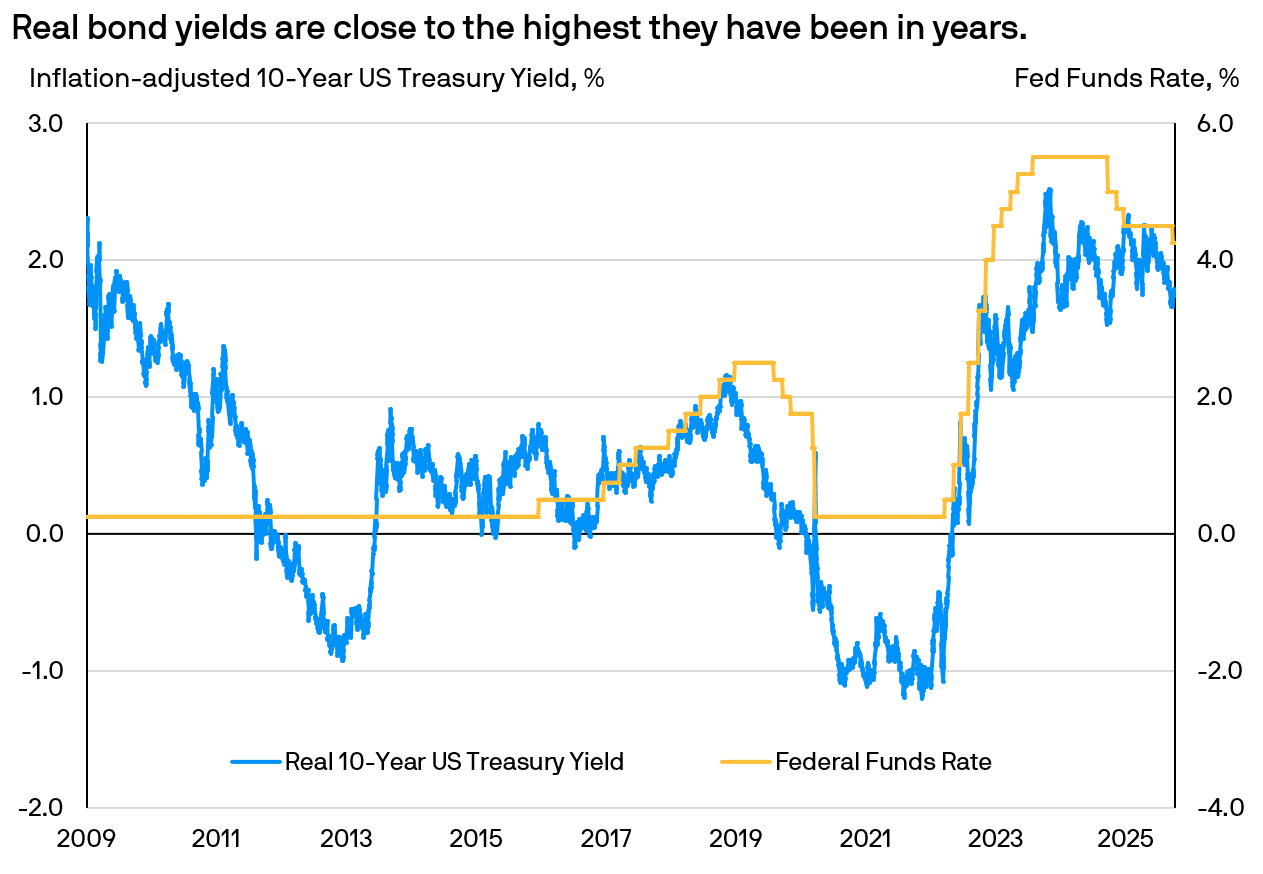
As the chart below shows, the inflation-adjusted 10-Year US Treasury yield has been on an upward trend since the end of 2022.
10-Year US Treasury Yield, 2009-2025
Source: JP Morgan
Notice also that the yield exceeded its 2009 high for the first time in late 2023.
The recent high real yield can be attributed to how nominal interest rates have risen faster (and stayed higher) than inflation expectations in recent years.
“This steep climb can be traced back to the Federal Reserve’s rapid rate hike cycle in 2022-2023, aimed at quelling inflationary pressure,” according to JP Morgan. “Three years on, nominal yields continue to offset expected inflation, with real yields firmly back in positive territory. As such, the asset class continues to maintain its relevance as an income-generating ballast for portfolios.”
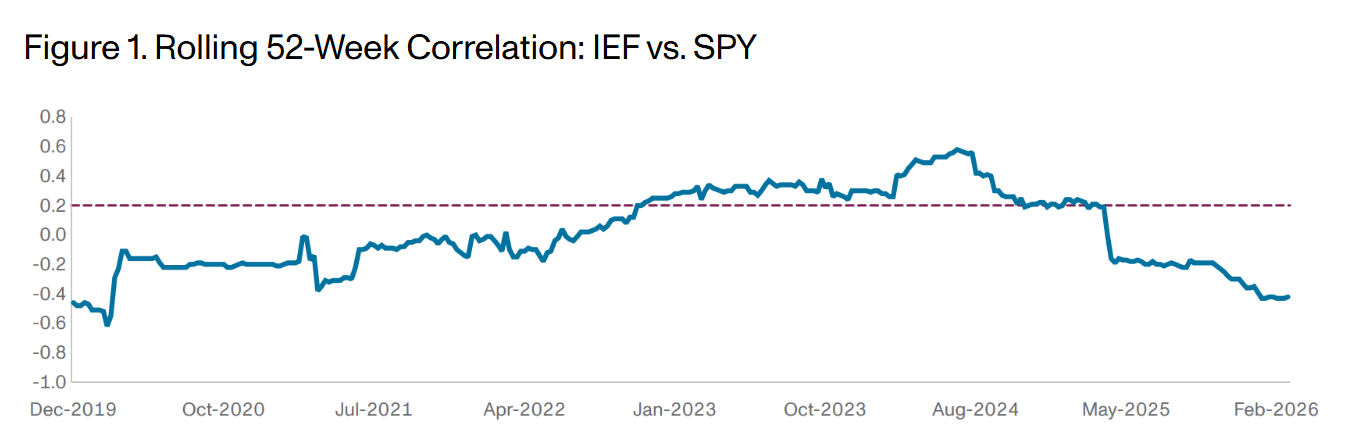
- Lower correlation to stocks: Though bonds have always been perceived as a portfolio diversifier due to their low correlation to stocks, the situation was reversed after the massive rate increases that occurred in 2022 and 2023.
Many investors worried about whether combining fixed-income securities and equity in a balanced portfolio made any sense, as both asset classes struggled at the same time.
However, this situation is already changing, according to TCW, an investment management firm.
“More recently, however, markets have normalised, and the correlation between bond and equity markets has returned to more typical negative territory, indicating fixed income markets have regained their traditional role as an offset to equity volatility in a diversified portfolio,” they noted.
52-Week Correlation Between iShares 7-10 Year Treasury Bond ETF (IEF) and State Street SPDR S&P 500 ETF Trust (SPY)
Source: TCW
- Expectations of falling rates: Though economic uncertainty still holds many central banks back from lowering rates, the general outlook is that inflation fears are now lower, and policymakers are more likely to cut rates than to increase them.
“Global central banks have shifted into an easing mode, as inflation pressure recedes and growth momentum moderates,” said JP Morgan. “Falling rates may enhance the potential for capital gains.”
- Demand for quality bonds supported by interest in AI: As many companies continue to focus on building AI infrastructure, there will be a greater supply for new bond issues. However, this could lead to credit stress among lower-rated issuers, which reiterates the importance of quality issuers, according to Vanguard.
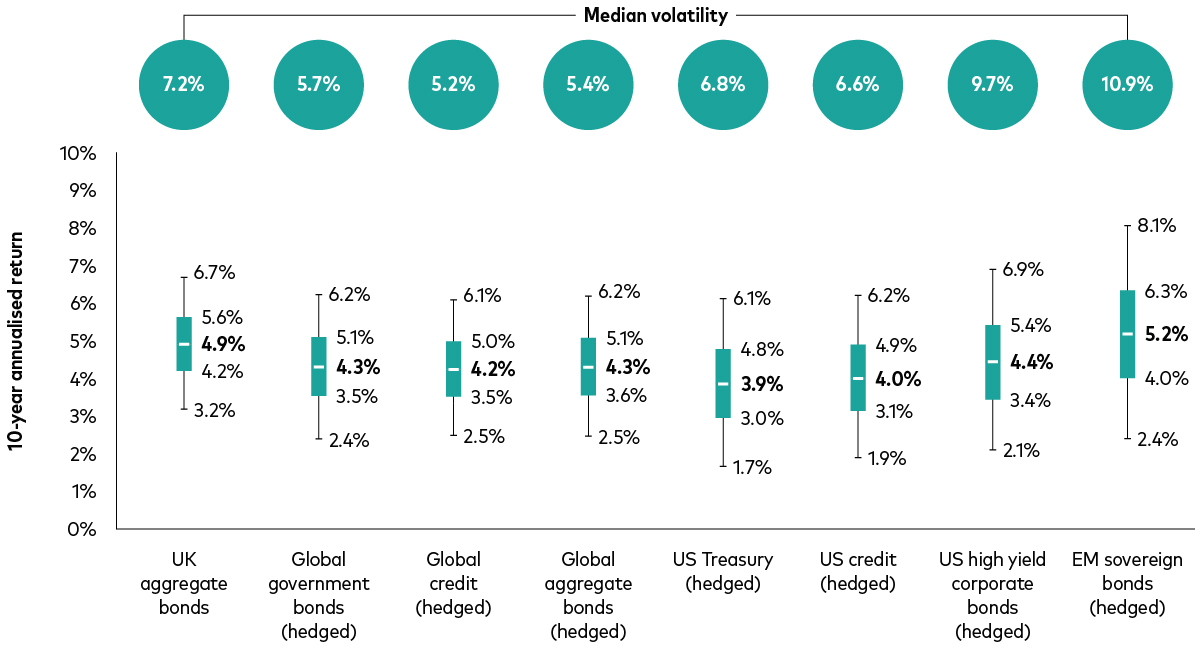
Thus, they expect global bonds to continue to deliver strong returns over the next 10 years, as seen below:
Expected Annualised Return and Median Volatility of Global Bonds Over the Next 10 Years
Source: Vanguard
2. Designing a fixed-income portfolio: What are investors prioritising
One of the main developments in the fixed-income world is that investors now have more bandwidth to have an expanded fixed-income portfolio.
For example, a higher-yield environment allows them to move beyond passive strategies that rely only (or solely) on government bonds.
“Traditional fixed income benchmarks only include a portion of the investable universe, with much of that concentrated in high-quality (and hence lower-yielding) government-guaranteed issues,” according to TCW. “Passive strategies using those traditional benchmarks, therefore, miss many higher-yielding opportunities that exist outside of those benchmark sectors.”
As a corollary, investment-grade corporate bonds are not expected to provide these higher yields as credit spreads tighten.
“With credit spreads so tight, we expect broad investment-grade corporate bonds to provide limited excess returns over government bonds with a similar duration profile,” said Vanguard. “Over the next 10 years, we expect US corporate bonds (GBP hedged) to produce annualised returns of 4.0%4, compared with 3.9% for US Treasuries (GBP hedged), both with a duration of around six to seven years.”
Consequently, institutional investors continue to make fixed-income portfolio allocation decisions that reflect these new realities. Below are some of the trends that define the fixed-income space:
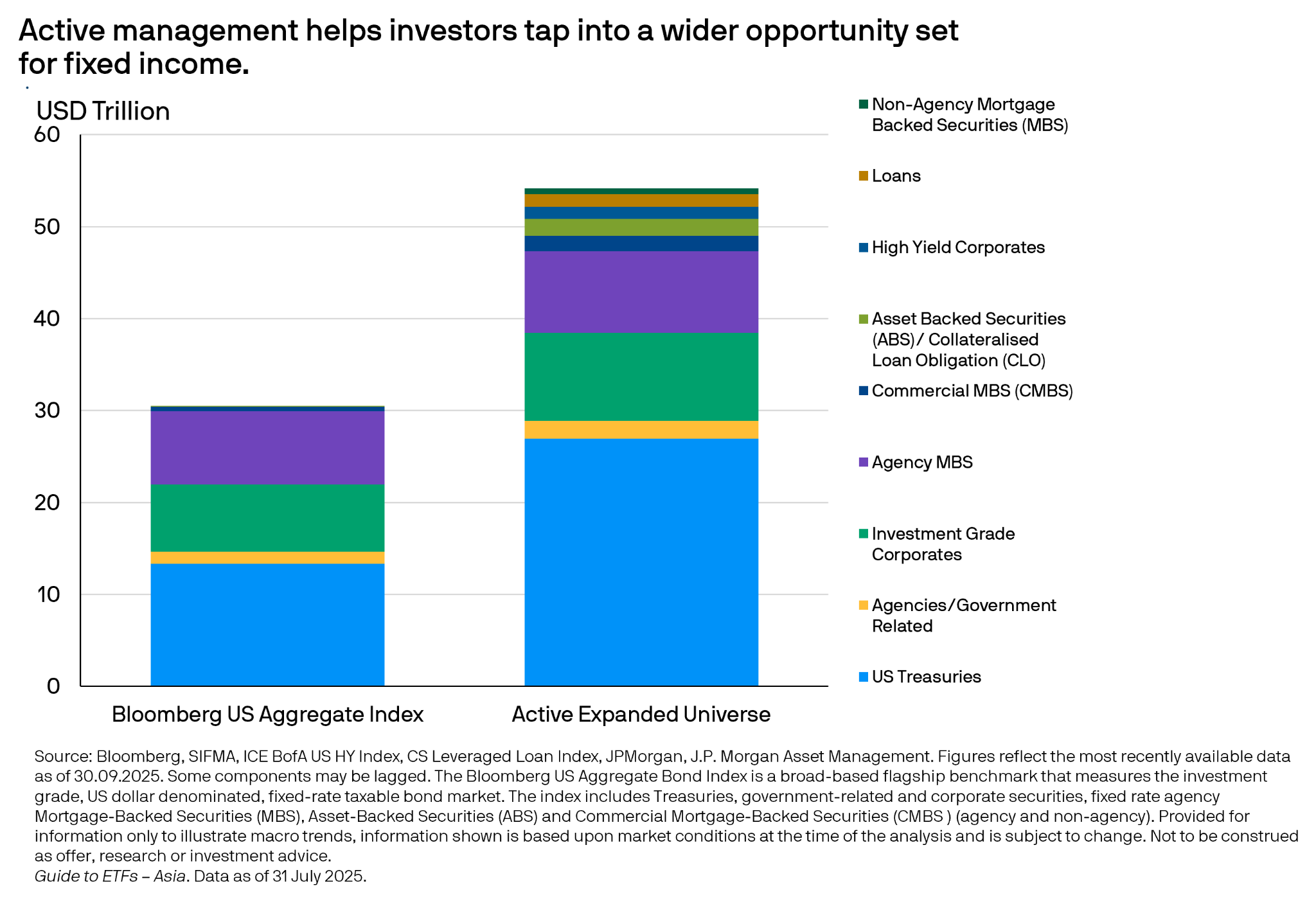
- Accessing a larger opportunity set with active management: JP Morgan agrees with TCW that passive strategies that track a bond index provide a limited opportunity set for investors in a high-yield environment. As a result, many are embracing active strategies that explore a larger opportunity set, including non-agency mortgage-backed securities (MBS), loans, high-yield corporates, asset-backed securities (ABS)/collateralised debt obligations (CDOs), and commercial MBS.
Portfolio Construction: Active vs Passive Managers
Source: JP Morgan
“Amid an environment where credit spreads in multiple bond sectors are trading at the tighter end of their historical ranges, active credit selection will be key to ensuring exposure to quality assets,” they noted. “More importantly, depending on the objective of the fund, active managers have the flexibility to adapt portfolios to changing market conditions and evolving information, which can be useful in managing credit and duration risks in a fast-moving market environment.”
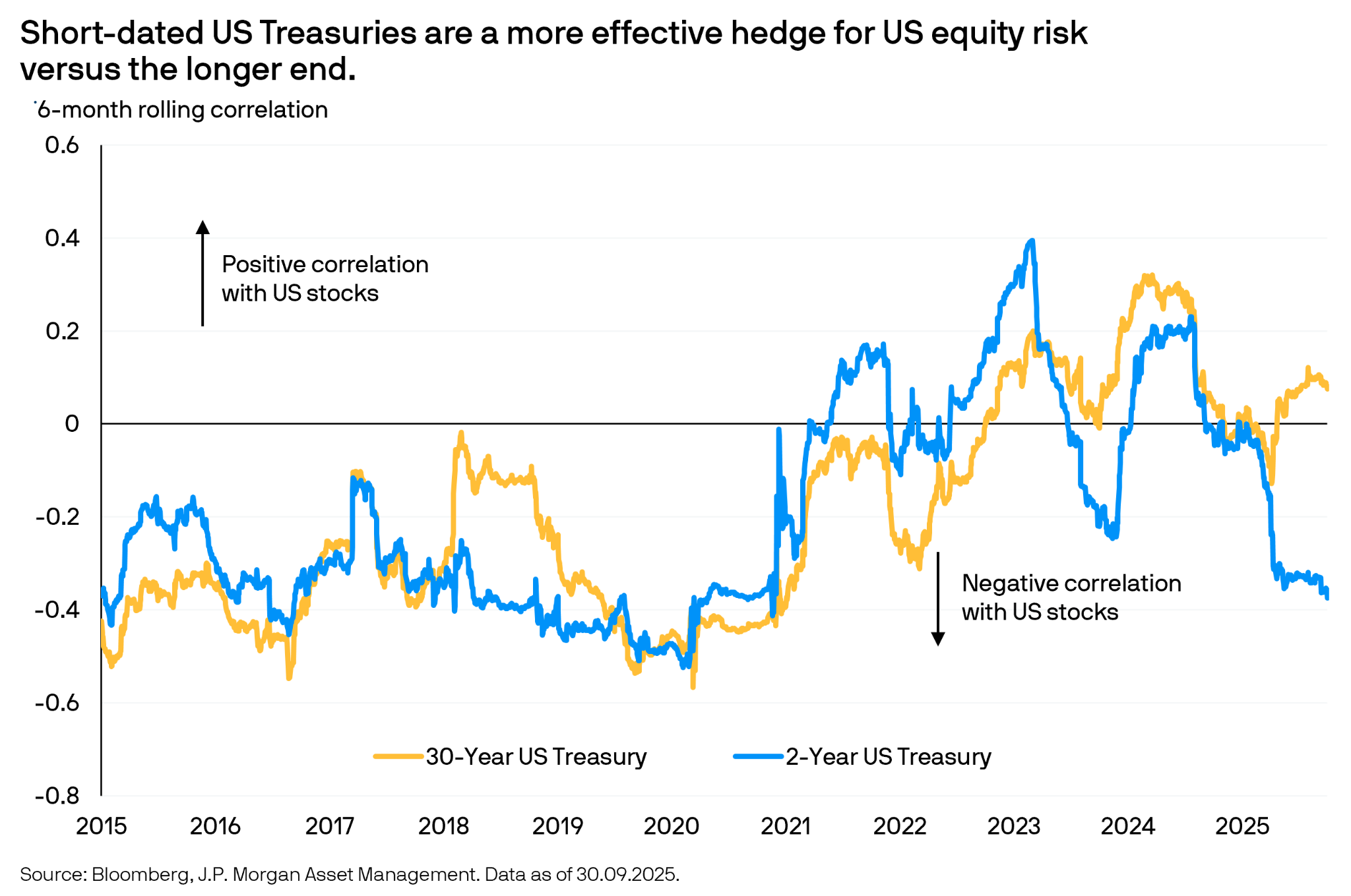
- Greater interest in shorter-duration assets for hedging and volatility management: We have seen that the correlation between stocks and bonds is now in negative territory.
Interestingly, JP Morgan found that the shorter-dated fixed-income universe has even lower correlation to equities, compared to their longer-dated counterparts, as seen below:
Correlation With Equities: Short-dated US Treasuries vs Long-dated US Treasuries
Source: JP Morgan
Also, shorter-dated fixed income can help manage the volatility that results from concerns about supply-side information and policy uncertainty, according to BlackRock.
“Income-producing assets, particularly in the shorter-to-belly of the curve, can help generate carry through volatility, with income a more reliable driver of returns than market timing.”
However, some investors are also managing duration risk by locking in high yields on longer-duration bonds, especially given “renewed Middle East tensions and federal interest rate uncertainty,” according to ETF Db, a database of global listed exchange-traded funds, in July 2026.
- Focus on issuer quality, especially with the AI boom: We mentioned above that Vanguard expects the AI infrastructure buildout to result in more corporate bond issues.
However, as supplies increase, default risk may rise, causing investors to prefer quality issuers (and investment-grade bonds, as a result) and reduce exposure to lower-rated issuers, especially if macroeconomic growth slows down or AI does not fulfil all its promises.
“Strong demand for investment-grade corporate bonds highlights a strategic shift as investors prioritise credit quality ahead of the Q2 earnings season,” according to ETF Db.
In fact, for many institutional investors, credit quality (as a predictor of capital preservation) is a more important consideration than yield.
“Institutional investors are not buying up any security with a yield,” noted Echo Wang, the CEO of EpicBooks, a bookkeeping software. “In fact, they are focusing on sovereign debt, high-grade corporates, and shorter duration credits, where they seek dependable income that would stand them well if the markets move again. While there is no doubt that the higher yields are making headlines, the real story is that of discipline. Institutional investors are becoming more reluctant to reach for yield in the wake of numerous market upheavals.”
- Global diversification: A global restructuring is occurring, and this has made global diversification one of the top investment strategies for institutional investors.
Fixed income allocation is also reflecting this interest in global diversification.
For example, emerging market debt has become more attractive due to the higher yield they provide.
“Emerging markets debt continues to offer attractive income, supported by stronger fundamentals entering this period of volatility,” according to BlackRock. “Improved policy frameworks, healthier external balances and enhanced central bank credibility have helped stabilise markets following recent spread repricing. As dispersion across countries increases, income remains compelling, but outcomes are increasingly driven by country‑level differences.”
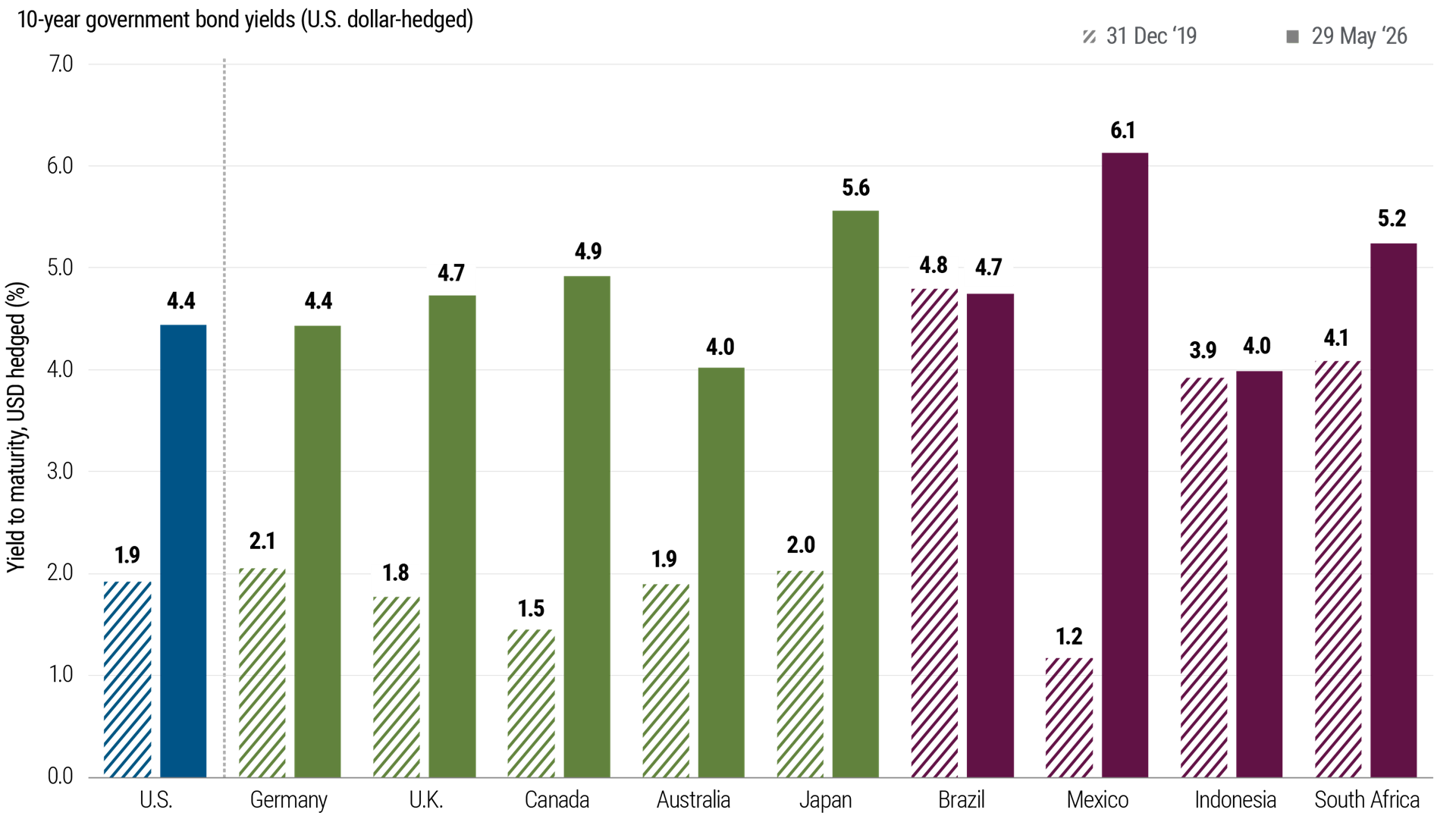
Interestingly, non-US developed markets are also producing yields that compare to or even exceed those of the US.
As the chart below shows, Germany, the UK, Canada, and Japan all have higher yields than the 10-year US Treasury, as of May 29, 2026, according to data from PIMCO, an investment management firm.
US 10-Year Government Bond Yields vs Selected Developed and Emerging Markets Bonds
Source: PIMCO
Similarly, emerging markets like Brazil, Mexico, and South Africa have higher yields than the US 10-year bond.
While global diversification can help increase yield, it can also reduce risk.
“Bonds across DM and EM local markets generally respond to different drivers – distinct rate cycles, divergent fiscal trajectories, differentiated currency dynamics,” they noted. “Owning that breadth itself is a potential source of return, because it has the ability to harvest risk premia that a narrower allocation structurally cannot access, while also helping support risk mitigation.”
3. Fixed income outlook: Top concerns for fixed-income investors
Certain factors are determinants for the future of fixed income as a broad asset class and how institutional investors should approach them.
We consider the most important ones below.
- Economic uncertainty: In 2025, Trump’s tariffs further exacerbated the global economic uncertainty. This was one of the reasons why the interest rate cuts many analysts expected did not materialise.
If economic uncertainty persists, the volatility it introduces will pose a risk to assets in the fixed-income universe, since they are especially sensitive to interest rate decisions.
“With markets increasingly uncertain, the risk of volatility rises, and as that unfolds, portfolios will need to adapt to take advantage of new opportunities and optimise risk exposures,” according to TCW.
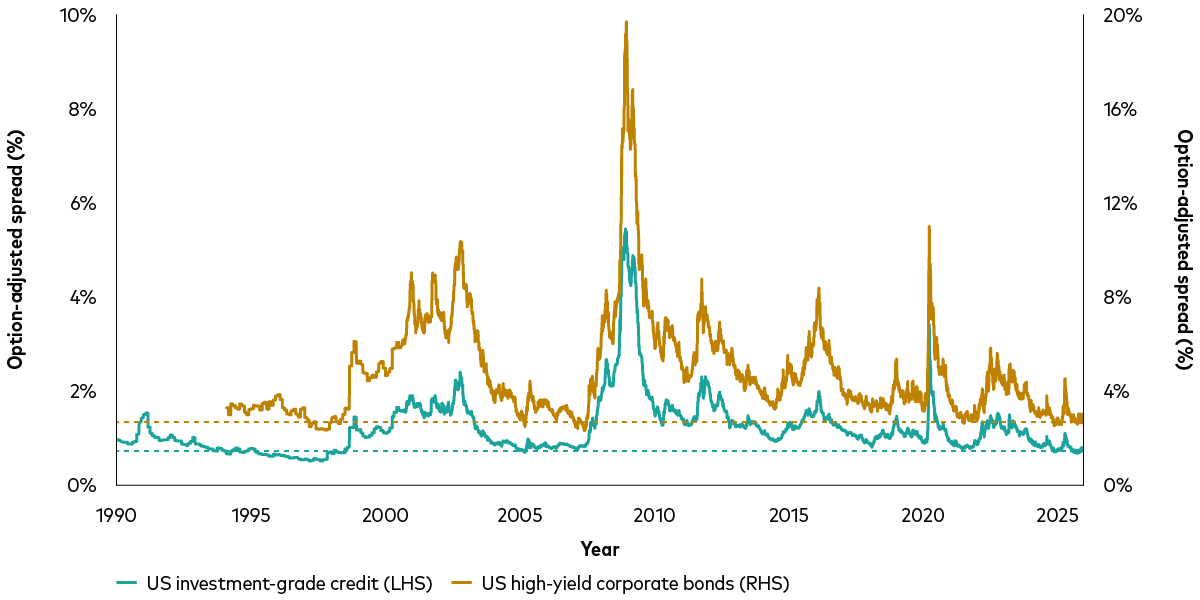
- Lower credit spreads: As we saw above, credit spreads are tightening, which is one reason why many investors are looking beyond corporate bonds.
This can be seen in the chart below:
Credit Spread Narrowing in Fixed-Income Markets
Source: Vanguard
Finding a good risk-return profile will require an active management approach that can adapt fixed income allocation to current economic realities.
“With credit spreads historically narrow, rigorous fundamental research and disciplined security selection are necessary to identify those issuers who are likely to be more resilient through volatility and provide greater downside protection,” according to TCW. “The flexibility to move into undervalued sectors, adjust a portfolio's risk profile and interest rate exposure, and find those issues where yield spreads provide better compensation for risk are likely to be critical factors in investors’ success through 2026.”
- Global divergence: While investors have embraced regional diversification to improve risk-adjusted returns in fixed income, country-level diversification may be necessary, as fundamentals differ even within a region.
“Diverging inflation and policy paths across Asia are creating country‑specific outcomes rather than a single regional trade,” noted BlackRock. “Lower starting inflation in many economies provides greater policy flexibility, while higher energy prices and global volatility are affecting markets unevenly. This divergence is shaping asset performance and expanding opportunities driven by domestic fundamentals.”
- Duration risk: Long-dated bonds are especially sensitive to rate surprises. Though there is currently more likelihood for rate cuts than hikes in most advanced economies, any resurgence of inflation could lead to fresh calls for higher rates.
What BlackRock said about European fixed income applies to other non-European economies:
“Supply‑driven inflation is lifting near‑term inflation risks while weighing on growth expectations, even as demand for new issues and higher yields support the asset class. In this environment, careful duration positioning is essential, as different inflation and growth paths can lead to very different return outcomes.”
- Structural themes: Artificial intelligence remains the most important structural theme in the global economy.
Vanguard has projected that the focus on infrastructure buildout would lead to a greater supply of corporate bonds.
However, there is also a concern about what could happen if it turns out that we have all exaggerated the impact of AI.
“Should the cost/benefit of the AI build-out come into question or even become prohibitive, the air coming out of the AI investment balloon would likely deflate both the markets and the economy,” according to JP Morgan.
If such deflation occurs, it could introduce some structural weakness in the fixed-income space.
4. Fixed income investing strategy: What should institutional investors do?
Given these factors that will determine the future of fixed-income assets, how should institutional investors approach fixed-income investing?
Below are the most important conclusions we can make from the foregoing:
- Active management is crucial: We saw that a fixed income investment strategy that relies on active management exposes investors to a broader range of assets than a passive strategy. More importantly, these extra asset classes can help investors earn higher returns in an environment marked by lower credit spreads.
Also, such active management is essential for managing volatility in an uncertain macro and geopolitical environment.
“Supply-side inflation and policy uncertainty mean outcomes depend less on broad market exposure and more on precision,” noted BlackRock.
For institutional investors, this could mean purchasing mutual funds or active fixed-income ETF portfolios if there is no in-house expertise for the kind of thorough research required for an active approach.
Furthermore, it means paying more attention to manager quality and choosing those that can combine multiple asset classes (from municipal bonds to investment-grade corporate bonds to inflation-linked bonds to infrastructure debt).
Pension funds and insurers may also consider fixed income managers who can execute a smart liability-driven investing (LDI) strategy as a part of risk management.
- Global diversification is important for risk-adjusted objectives: We have noted that there are many opportunities for higher spreads in emerging markets and developed markets ex-US.
Also, we saw that regional diversification is not enough since market fundamentals in each country can cause a divergence in their paths, even though they are in the same region. This reiterates the need for an active approach to fixed-income investing. Institutional investors should focus on managers who can drill down to the individual country level when selecting assets to invest in.
“Global growth is unequal, demanding active management,” according to Goldman Sachs. “The US benefits from AI and fiscal tailwinds, and Japan shows domestic strength. Conversely, Europe struggles with tighter financial conditions, and the UK labour market remains weak.”
- Asset-class level diversification is also crucial: Just as economies seek macroeconomic resilience, institutional investors should create a resilient fixed-income portfolio that can perform across different economic conditions. A core part of such a resilient portfolio is asset-class level diversification.
“A resilient portfolio is diversified across issuers, maturities and sectors rather than concentrated in a single yield opportunity,” according to Firdaus Syazwani, founder of Dollar Bureau, a personal finance website. “It balances government bonds for stability with carefully selected investment-grade corporate credit for additional return, while maintaining enough liquidity to respond to changing market conditions.”
- Lean into duration discipline to manage duration risk: Given the uncertainty about inflation and interest rates in the US and other advanced economies, a combination of short-term and long-term exposure may help to achieve the right risk-return mix.
“Navigating today’s fixed income landscape requires what we call Dynamic Patience: deliberately building income, staying tactical on duration and deploying capital creatively when markets misprice risk,” noted BlackRock.
This means institutional investors should keep an eye on the yield curve and also consider using derivatives to reduce interest rate risk.
In addition, institutional investors should stress test for both rate cuts and hikes while testing how duration matches with their liabilities, according to Joe Braier, the CEO of Lake Country Advisors, an M&A advisory firm.
- Credit fundamentals remain important: Vanguard noted that an increase in issuance in the AI space will lead many investors to prioritise sound issuers that guarantee reliable cash flows and post limited liquidity risk.
This reinforces an important point: while searching for higher yields, institutional investors should not ignore credit fundamentals. As they say, the return of capital can be more important than the return on capital.
“A sound fixed-income portfolio in 2026 prioritises diversification, balancing high-quality bonds and sustainable investments to mitigate risks,” according to Marc Pamatian, founder of Chief Bookkeeping Officer, a fractional bookkeeping company. “It focuses on assets with strong credit fundamentals while adapting to emerging market trends and shifting interest rate environments. This approach ensures resilience, aligning returns with broader economic developments and long-term financial goals.”
Given how responsive fixed-income markets are to economic fundamentals, asset managers must continue to be in the know of macroeconomic developments and how they impact fixed-income assets.
One way to do this is to be in constant conversations with other economic and financial experts interested in fixed-income markets.
At cio investment club, we make this easier by providing a network of asset managers, asset owners, and other finance enthusiasts where you can exchange insights and ideas about the economy and specific financial markets.
We also organise exclusive roundtables and investment breakfasts where you can have face-to-face interactions and one-on-one networking sessions with other investment experts.
Do you want to be part of a community where you can uncover insights that will improve your investment decisions? Register now to become a part of the cio investment club.
Takeaways
- Higher real yields and the prospect of lower policy rates have restored bonds as a meaningful source of income and portfolio diversification.
- Institutional investors are expanding beyond government bonds into private credit, ABS, mortgages, and selective high-yield opportunities while actively managing duration and credit risk.
- Tight credit spreads and AI-related corporate borrowing are pushing investors toward investment-grade issuers and rigorous credit selection.
- Investors are increasingly looking beyond the US to developed and emerging bond markets where higher yields and country-specific opportunities can improve risk-adjusted returns.
This document is produced by Instaconnect Limited, trading as cio investment club, a company registered in England & Wales with registration number 15262951.
Instaconnect Limited is neither authorised nor regulated by the Financial Conduct Authority in the United Kingdom nor the Securities and Exchange Commission in the United States of America.
This document is a marketing documentation and is not intended to constitute an invitation or an inducement to engage in any investment activity. It is not intended to constitute investment advice and should not be relied upon as such. It is not intended and none of Instaconnect Limited, its holding companies or any of its or their associates, or any of the participants in the documentation, shall have any liability whatsoever for (a) investment advice; (b) a recommendation to enter into any transaction or strategy; (c) advice that a transaction or strategy is suitable or appropriate; (d) the primary basis for any investment decision; (e) a representation, warranty, guarantee with respect to the legal, accounting, tax or other implications of any transaction or strategy; or (f) to cause Instaconnect Limited to be an advisor or fiduciary of any recipient of this report or other third party.
The content and graphical illustrations contained in this document are provided for information purposes and should not be relied upon to form any investment decisions or to predict future performance. Instaconnect Limited recommends that recipients seek appropriate professional advice before making any investment decision. Although the information expressed is provided in good faith, Instaconnect Limited does not represent, warrant or guarantee that such information is accurate, complete or appropriate for your purposes and none of them shall be responsible for or have any liability to you for losses or damages (whether consequential, incidental or otherwise) arising in any way for errors or omissions in, or the use of or reliance upon the information contained in this document.
To the greatest extent permitted by law, we exclude all conditions and warranties that might otherwise be implied by law with respect to the document, whether by operation of law, statute or otherwise, including as to their accuracy, completeness, or fitness for purpose.
Instaconnect Limited and its logo are proprietary trademarks of Instaconnect Limited and are registered in the United Kingdom. Unauthorised copying of this document is prohibited.
© Copyright Instaconnect Limited 2026