



When the US Federal Reserve finally cut the interest rate by 25 basis points on September 17, 2025, it was a signal to some that a massive economic recovery had begun.
However, less than a month later, a massive sell-off hit the US stock market in response to Trump issuing fresh tariff threats against China. You would remember that tariffs were the major cause for the stock market sell-off in April and the uncertainty that led the Federal Reserve to pause rate cuts.
Does this then mean that we are back to the same uncertainty as in April? If another round of tariff threats hits the global economy, then economists may resume expressing concerns about trade war, higher inflation, lower long-term growth, and declining global trade flows, among others.
Moreover, the geopolitical situations in the Middle East (Israel and Palestine) and Eastern Europe (Russia and Ukraine) persist even as inflation expectations continue to tick up.
Just as national economies seek macroeconomic resilience (defined as adaptability and resistance to shocks), institutional investors must continuously explore ways to keep their portfolios resilient, irrespective of the broader macroeconomic uncertainty.
In what follows, we consider some strategies that institutional investors can employ to achieve this. We’ll examine:
- Fiscal policy uncertainty: The importance of diversification
- Scenario planning: How to tackle interest rate risk
- Inflation risk: The role of inflation hedges
- Currency and geopolitical risk: The roles of currency hedges and portfolio allocation
Do you want to learn more about how various macroeconomic developments affect your portfolio? Subscribe today for the cio investment club’s newsletter.
1. Fiscal policy uncertainty: The importance of diversification
More than $10 trillion was wiped off the global stock market on April 3, 4, and 7, in response to Trump’s tariff announcements on April 2 (Liberation Day).
Renewed US-China trade tensions would also lead to a 2.7% drop in the S&P 500 Index on October 10 as investors worried about the implications of Trump’s statements.
The stock market hates uncertainty, and this is exactly what the whole tariff business has provided in abundance. No one knows what the Trump administration will do next, leading to some cautiousness among investors.
As we said in April, the effect of this tariff uncertainty extends beyond the US. A trade war between the US and China and retaliatory tariffs between the US and its trading partners (especially the European Union and Canada) will likely slow down global GDP and increase global inflation.
Similarly, on October 1, the US government began a shutdown due to disagreements between Republicans and Democrats regarding the budget. This has resulted in 900,000 federal workers furloughed and 700,000 working without pay. Many government services have been delayed, and economic data from the Bureau of Labour Statistics and the Census Bureau have not been released.
Though government shutdowns usually have small and temporary effects on the economy, a prolonged one can become concerning.
“A shutdown that lasts at least several weeks could cause confusion about the Federal Reserve's monetary policy path as the central bank will be without government data that helps guide its decisions, while also posing a possible drag on economic growth the longer it extends,” according to Reuters.
Also, a combination of a US credit rating downgrade, a prolonged shutdown, and changes to the trade regime will be more concerning and result in questions about how global investors will view the United States, according to Brian Shipley, chief investment officer of Coldstream Wealth Management, interviewed by Reuters.
What then should institutional investors do in response to this?
Reduce portfolio risk through diversification
When the equity market was selling off in April, many investors found refuge in gold. Since then, gold has continued to make new all-time highs (ATH) as many investors embrace it as a safe haven.
Commodities in general have shown to be excellent safe havens that can reduce the risk exposure of a portfolio.
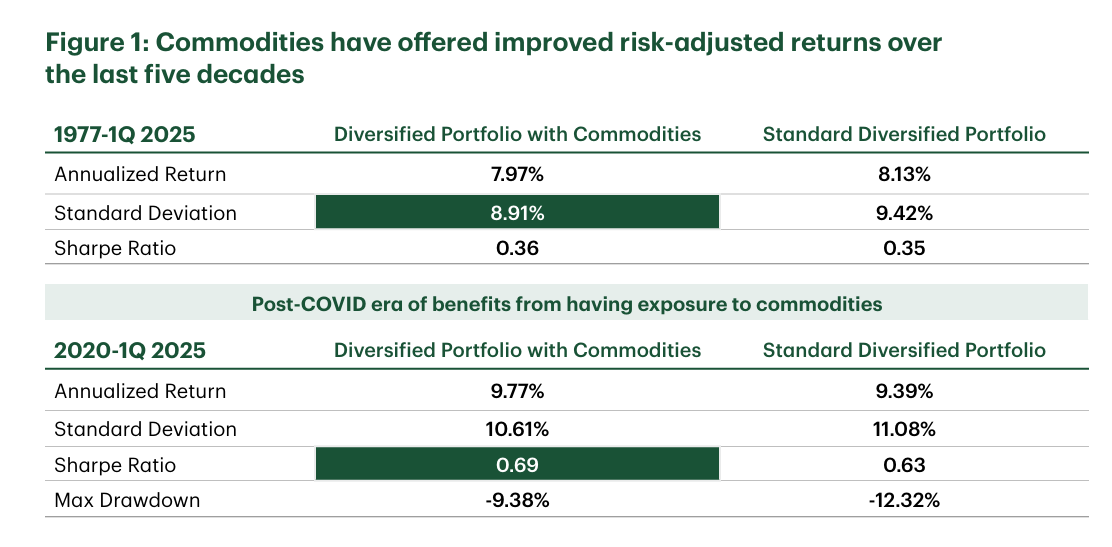
Data from 1977 to Q1, 2025, shows that adding commodities to a 60/40 stock/bond portfolio reduces the portfolio risk and increases its risk-adjusted returns (Sharpe ratio), according to a study by TD Asset Management, an investment management firm.
How Commodities Reduce Risk and Improve Risk-Adjusted Returns
Source: TD Asset Management
It might also be time to diversify away from the United States. Back in July, J.P. Morgan, a global financial firm, noted that valuation shifts, volatility patterns, and long-term return potential were important reasons for investors to add non-US equities to their portfolios.
“Heavy allocations to U.S. stocks, especially in passive index formats, often come with more exposure to a few dominant firms than investors realise,” they noted. “Adding global holdings can help smooth performance across different economic conditions, innovation winners, interest rate paths, and policy environments. That doesn’t mean turning away from U.S. markets; it simply means building in more flexibility in case leadership shifts or volatility continues.”
Given the massive uncertainty that has been introduced into the US economy by the Trump administration, diversification into ex-US developed and developing countries remains a wise strategy.
Also, given the concentration of the S&P 500 in tech stocks, institutional investors should consider diversifying their US exposure into equal-weight ETFs, small-cap stocks, and mid-cap stocks, according to Morgan Stanley experts interviewed by CNBC.
2. Scenario planning: How to tackle interest rate risk
After the interest rate cut in September, J.P. Morgan said it expected two more cuts this year.
However, this was before Trump’s October 10 statements about China.
No one knows how this whole situation will play out. If the trade war intensifies, inflation expectations (which are already rising) can rise significantly again and lead the Fed to pause interest rate cuts. In other words, we can be back to the same spot we were in Q2, 2025.
However, the US and China may find new agreements, and the whole situation may be easily dissipated with the Fed continuing with interest rate cuts.
Yet, there are still concerns about what impact interest rate cuts will have on inflation, irrespective of the tariff situation.
“We continue to forecast that the lagged effects of widespread monetary policy easing will support growth in most major economies and regions into 2026, but sticky inflation is a potential spanner in the works,” according to S&P Global, a financial firm. “While our latest round of inflation forecasts generally shows lower headline rates in 2026 compared to 2025, this partly reflects the expected sharp drop in crude oil prices from later this year.”
In other words, inflation remains a concern as the Fed, the European Central Bank (ECB), and the Bank of England (BoE) continue to struggle to bring it down to the 2% target.
The uncertainty in the US is playing out in the UK as well. After cutting rates by 25 basis points in August (after a long pause), the BoE held rates steady on September 18 as inflation stayed above its target. Similarly, after eight consecutive rate cuts, the ECB has held rates since July.
Given that we can’t be too sure about the interest rate path, institutional investors should be ready for both situations by having strategies in place to explore the opportunities that come from either a pause or a cut.
Strategies for interest rate cuts
If the cuts happen, institutional investors may benefit from shifting to growth stocks in the technology, consumer discretionary, and healthcare sectors.
The cut may also lead to a lower cost of borrowing in the real sector, favouring alternative investments in real estate and infrastructure.
However, it is wise to keep an eye on inflation and increase allocation to inflation hedges.
Strategies for a pause on interest rate cuts
If uncertainty persists, shorter-duration bonds should be prioritised over long-duration bonds since the former are less sensitive to changes in interest rates.
Also, if you are concerned that a rising rate is possible, you should consider floating-rate instruments so you can earn more returns as rates rise.
This can also be a good time to maintain liquidity so you can take advantage of opportunities when the interest rate path becomes clearer.
3. Inflation risk: The role of inflation hedges
Inflation has been a recurring theme in everything we have said thus far.
In August, J.P. Morgan highlighted the factors that could cause inflation to rise and those that could mitigate it.
The former include rising tariffs, weakening dollar, tightening labour supply, income tax refunds, and fiscal stimulus as midterm elections approach, while the latter include lower energy costs, falling rents, and low airline fares.
They believed that economic conditions did not necessitate the September cut, nor the proposed December cut. Instead, they argue that political pressures from policymakers have been a strong factor behind the decision.
Though they expressed concerns about how these cuts could impact consumer price inflation (CPI), they were more concerned about how they could further fuel asset price inflation and lead to a bubble.
Also, we have seen that both the BoE and the ECB have also struggled to keep inflation within the 2% target. If Trump’s tariff policy becomes more inflationary, the impact will end up becoming global.
Embracing inflation hedges
How then should institutional investors navigate this uncertainty regarding the path of inflation?
“Given this risk and the probability of continued, somewhat elevated inflation, it still makes sense for investors to broaden the diversification of their portfolios to include some alternative assets, particularly those that can best offset inflation, as well as international assets denominated in foreign currencies.”
Regarding alternative assets, commodities like crude oil have proved their mettle as inflation hedges over the years.
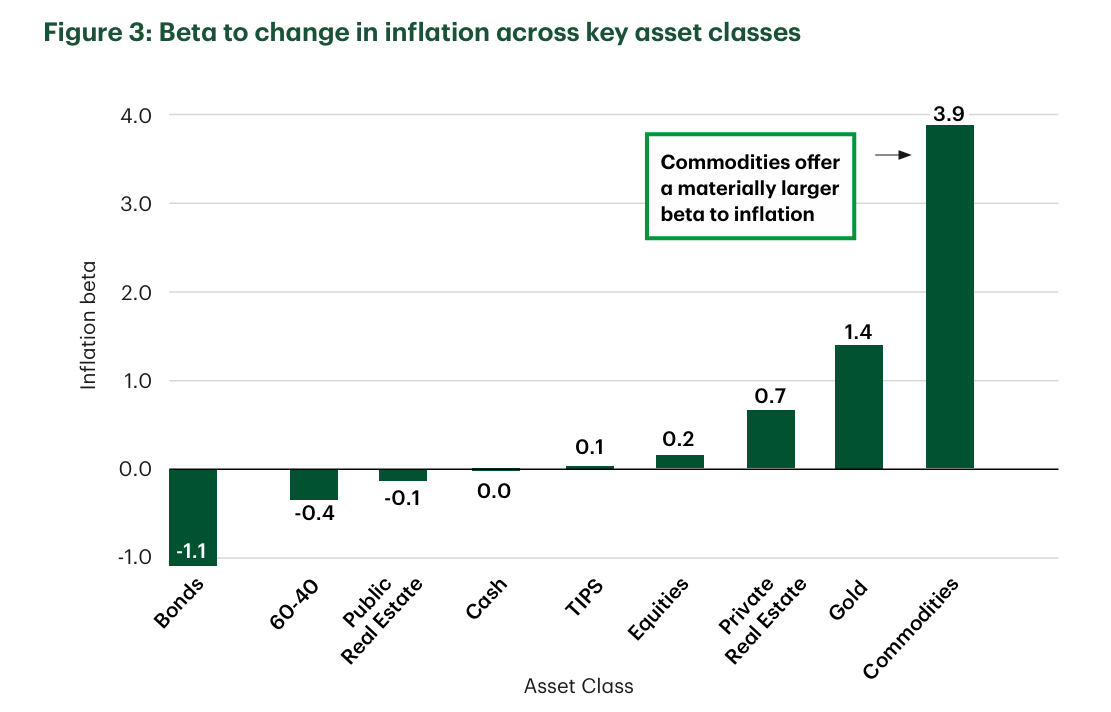
As the chart below shows, commodities offer the highest beta to inflation among all asset classes. Gold and private real estate are far off in the second and third position.
Beta to Inflation of Multiple Asset Classes
Source: TD Asset Management
J.P. Morgan also mentioned the importance of international diversification. Exposure to assets in countries with lower inflation and more stable currencies and economies that are commodity producers can help minimise the impact of inflation on institutional investors’ portfolios.
Since these economies have built economic resilience, investing in them makes it easier for investors to build portfolio resilience.
4. Currency and geopolitical risk: The roles of currency hedges and portfolio allocation
Trump has recently brokered a ceasefire between Israel and Palestine. However, this is far from the end of hostilities.
“The agreement was for a ceasefire and an exchange of hostages for prisoners,” noted the BBC. “It is not a peace agreement, or even the start of a peace process.”
If recent actions from the Middle East are any indication, one cannot be too certain of what will come next.
Similarly, the Russia-Ukraine war continues.
The main concern from an economic point of view is that these wars have the potential to increase energy costs and food prices (by disrupting supply chains).
Given that lower energy cost was the reason S&P Global expected lower inflation going forward, these two wars remain significant for the path of inflation. And economic theory teaches that the path of inflation will affect interest rate policy, which will also affect global growth.
If news from these regions leads to inflationary fears, there might be selloffs in equity sectors sensitive to global demand and energy prices.
Also, if this news leads to currency depreciation, investors with exposure to assets in these countries may lose money selling off their portfolio investments.
Furthermore, given the contagion effect, other countries in the region may suffer similar fates, and investors in these other countries may also have to realise losses on their investments.
What can institutional investors do to navigate these geopolitical risks?
Inflation hedges
Given that higher food and energy prices are the major risks of the current geopolitical tensions in the Middle East and Eastern Europe, institutional investors must continue to prioritise inflation hedges in their portfolios.
Currency hedges
For investors with exposure to regions with high geopolitical risk, hedging against currency risk is essential. Popular currency hedges include forward/futures contracts, currency options, and currency-hedged ETFs.
Diversified international exposure
As said above, it is easier to achieve portfolio resilience by investing in countries with macroeconomic resilience.
These are countries that can reduce aggregate consumption losses for a given level of asset losses in the face of natural disasters (among other resilient indicators), according to a Policy Research Working Paper by Stephane Hallegatte, the Chief Climate Economist of the World Bank Climate Change Group.
Dominique Strauss-Kahn, a former Managing Director of the IMF, also associated macroeconomic resilience with having fiscal space and monetary space to deal with economic shocks and vulnerabilities. The former means the ability to spend safely without compromising fiscal sustainability, while the latter means the monetary credibility to pursue expansionary monetary policy without creating inflationary problems, according to Development Alternatives Incorporated.
Furthermore, institutional investors should prioritise markets with strong governance, a vibrant financial sector, a stable financial system, monetary authority independence, and fiscal discipline, among others.
It’s possible to identify which countries will be resilient before an external shock happens, according to the Centre for Global Development (CGD). “Prior to the COVID-19 pandemic and subsequent global shocks, it was possible to identify emerging markets and developing countries that would encounter serious economic and financial problems if an external shock were to materialise,” they noted.
Interestingly, countries that scored low based on the resilience indicator used (Zambia, Ethiopia, Argentina, Tunisia, Brazil, Egypt, among others) were the same countries that couldn’t cope when the pandemic hit. On the other hand, countries that only faced low risk (Asian countries like Bangladesh and Vietnam and Latin American countries like Honduras and Chile) did better.
By adapting a similar methodology, institutional investors can identify countries that are more likely to remain resilient when economic shocks and financial crises hit.
Even then, there shouldn’t be a concentration in a few countries, especially if they are countries with high geopolitical risk or that exist in a region with high geopolitical risk.
If there was a time when asset managers and other financial and economic experts should come together to share ideas, it is now.
At the cio investment club, we provide a platform where asset managers and owners can make better decisions by listening to one another’s opinions and insights.
We also organise exclusive roundtables and investment breakfasts where you can have face-to-face interactions and one-on-one networking sessions with other investment experts.
As global economic uncertainty persists, such a meeting of minds can help to identify opportunities that others will miss and position you for better outcomes.
Do you want to become a member of a community of financial and economic experts where you can share ideas about various macroeconomic issues? Register today to join the cio investment club.
Takeaways
- As economies seek macroeconomic resilience in the face of economic uncertainty and financial crisis, institutional investors must also build portfolios that are resilient to all sorts of economic shocks.
- Diversification remains the strongest defence. Commodities, gold, and non-US equities can help institutional investors reduce risk amid fiscal uncertainty.
- Interest rate unpredictability demands scenario planning, enabling investors to benefit whether the Fed pauses or continues cutting rates.
- Commodities and equities in markets with strong and stable currencies can help to manage inflation risk.
- Currency and geopolitical risks require proactive management, including the use of currency-hedged ETFs, futures, and diversified exposure to resilient markets.
This document is produced by Instaconnect Limited, trading as cio investment club, a company registered in England & Wales with registration number 15262951.
Instaconnect Limited is neither authorised nor regulated by the Financial Conduct Authority in the United Kingdom nor the Securities and Exchange Commission in the United States of America.
This document is a marketing documentation and is not intended to constitute an invitation or an inducement to engage in any investment activity. It is not intended to constitute investment advice and should not be relied upon as such. It is not intended and none of Instaconnect Limited, its holding companies or any of its or their associates, or any of the participants in the documentation, shall have any liability whatsoever for (a) investment advice; (b) a recommendation to enter into any transaction or strategy; (c) advice that a transaction or strategy is suitable or appropriate; (d) the primary basis for any investment decision; (e) a representation, warranty, guarantee with respect to the legal, accounting, tax or other implications of any transaction or strategy; or (f) to cause Instaconnect Limited to be an advisor or fiduciary of any recipient of this report or other third party.
The content and graphical illustrations contained in this document are provided for information purposes and should not be relied upon to form any investment decisions or to predict future performance. Instaconnect Limited recommends that recipients seek appropriate professional advice before making any investment decision. Although the information expressed is provided in good faith, Instaconnect Limited does not represent, warrant or guarantee that such information is accurate, complete or appropriate for your purposes and none of them shall be responsible for or have any liability to you for losses or damages (whether consequential, incidental or otherwise) arising in any way for errors or omissions in, or the use of or reliance upon the information contained in this document.
To the greatest extent permitted by law, we exclude all conditions and warranties that might otherwise be implied by law with respect to the document, whether by operation of law, statute or otherwise, including as to their accuracy, completeness, or fitness for purpose.
Instaconnect Limited and its logo are proprietary trademarks of Instaconnect Limited and are registered in the United Kingdom. Unauthorised copying of this document is prohibited.
© Copyright Instaconnect Limited 2025