


It was about a year ago when President Donald Trump announced sweeping tariffs on imports to the United States.
The stated goals were to reduce reliance on global supply chains, revive domestic manufacturing, reduce the US trade deficit, and protect strategic industries, among others.
However, economic and financial market analysts expressed concerns about how Trump’s tariffs would impact both the US and the global economy. About $10 trillion was lost in three trading days across global equities, even as a trade war developed between the US and China.
There were also concerns about inflation (both producers and consumers prices), declining trade flows, job losses, lower investment and capital flows, and lower global GDP.
One year later, it is crucial to ask if these tariffs have had the stated effects and if there are still reasons to be concerned about future impacts. More importantly, we need to consider how institutional investors should approach their portfolio construction in light of Trump’s tariff policy.
We’ll cover:
- One year later: The current state of Trump’s tariff policy
- Taking stock: The economic impacts of Trump tariffs
- Projected future economic impacts of Trump’s tariffs
- How should institutional investors respond to Trump’s tariff policy
Do you want to learn more about how various economic policies affect your investment decisions? Subscribe now to the cio investment club’s newsletter for regular updates about the global economy.
1. One year later: The current state of Trump’s tariff policy
The major tariff announcements
President Trump’s tariff policy began with an executive order on February 1, 2025, imposing tariffs on Mexico (25%), Canada (25%), and China (10%). On March 12, 2025, he announced 25% tariff on imported steel and aluminium.
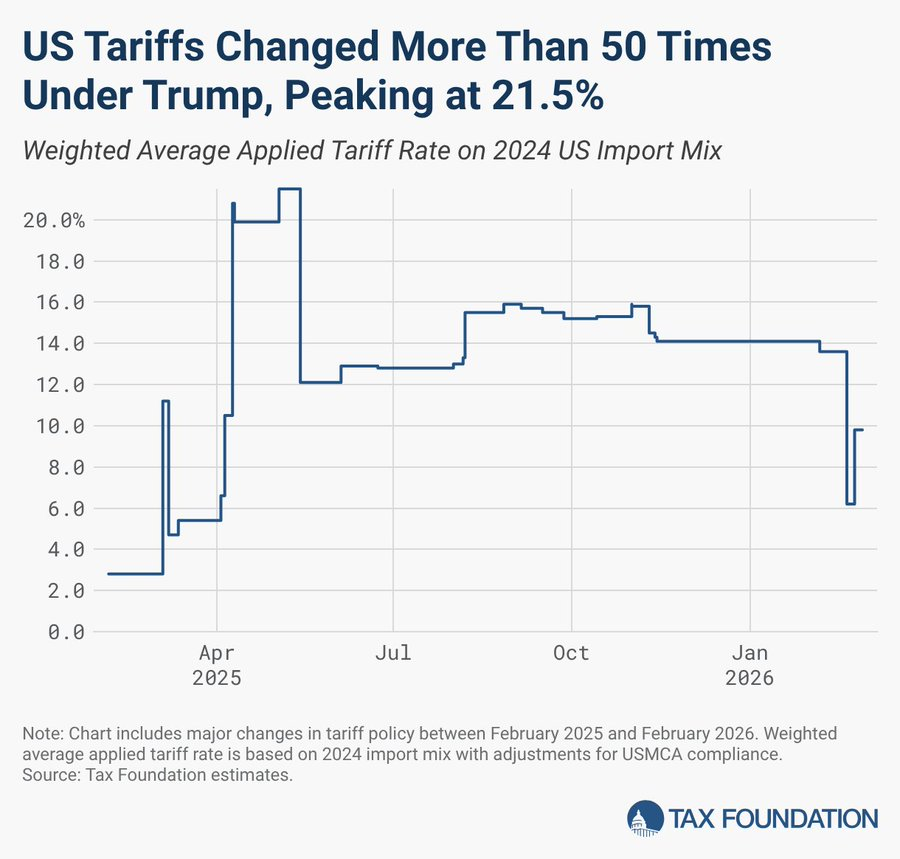
However, the sweeping tariffs would come on April 2, 2025 (Liberation Day), when he announced a 10% baseline tariff on nearly all imports and reciprocal tariffs (beyond the 10% baseline) on 90 nations. The tariff on China was also raised to 125%, even as the effective tariff rate in the US went up to 21.5%.
Post Liberation Day: Ramp up on exemptions
The April 2 tariffs would be paused for 90 days beginning on April 9 as the US opened the negotiation door to willing nations. Escalations in tariffs with China were also paused for 90 days on May 12.
Unfortunately, only two deals (with the UK and Vietnam) were completed at the expiry of the 90-day reprieve, according to the Council on Foreign Relations (CFR).
Interestingly, despite Trump’s insistence that no product would be exempted, many items actually enjoyed import tariff exemptions.
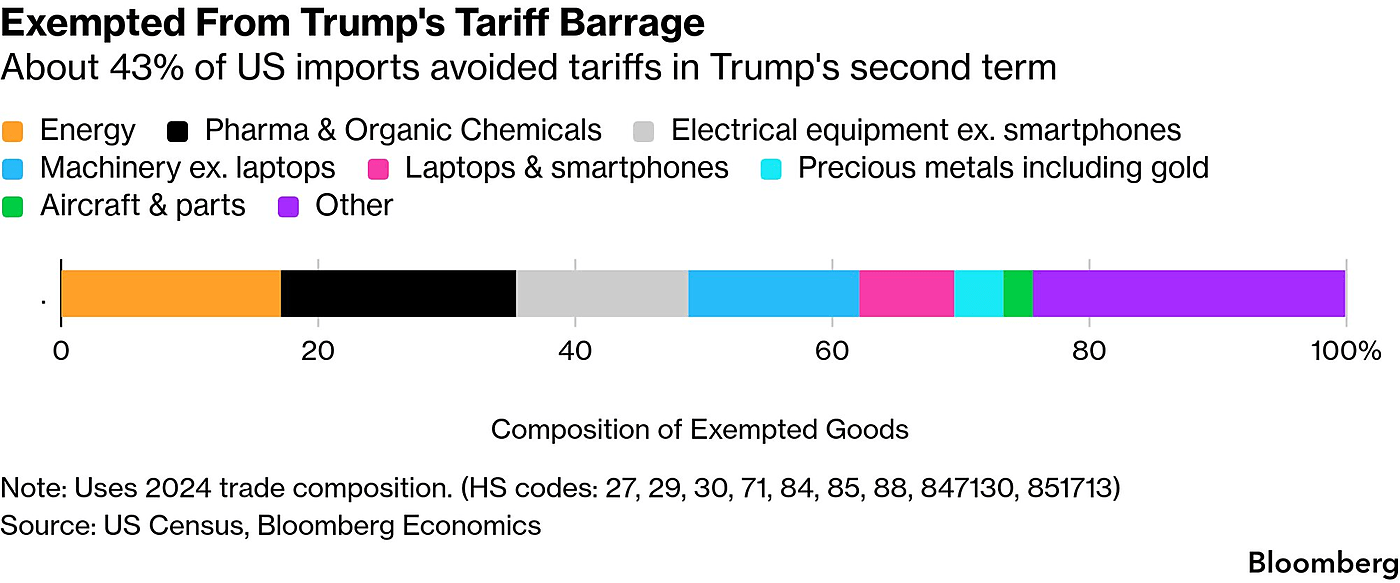
As shown below, more than 43% of US imports enjoyed some form of exemptions from Trump’s tariffs, with many of them coming into the US duty-free.
Items Exempted from Trump’s Tariffs
Source: Cato Journal
By the end of 2025, the effective tax rate had fallen to 14% from the high of 21.5%, due to the various exemptions, as seen below:
Weighted Average US Tariff Rate
Source: Tax Foundation
Trump’s government would go on to complete a total of 14 deals by the end of February, according to the CFR. However, the major deals that were being negotiated – with Brazil, India, and China – remained inconclusive.
Also, Trump has threatened additional tariffs on Mexico, Canada, China, and some European countries and sector-specific tariffs on semiconductors, pharmaceuticals, and critical minerals, among others.
The Supreme Court ruling
On March 4, 2026, the US Supreme Court ruled that the US President has no power to impose tariffs without congressional approval.
Also, the majority argued that the International Emergency Economic Powers Act (IEEPA) did not support Trump’s claim of emergency powers to impose tariffs.
At the time of this ruling, the effective tax rate was 13.6%, according to the Tax Foundation.
More importantly, the Supreme Court ruling affected many countries' willingness to continue negotiating deals, as reported by CFR. They mentioned India and the European Union as examples of this trend.
In response, Trump announced a global tariff rate of 10% under Section 122 of the Trade Act of 1974 for 150 days, according to CNBC. He also expressed the intention to increase the rate to 15% later on.
Also, tariffs imposed under Section 232 of the Trade Expansion Act of 1962 (for national security reasons) remain in place.
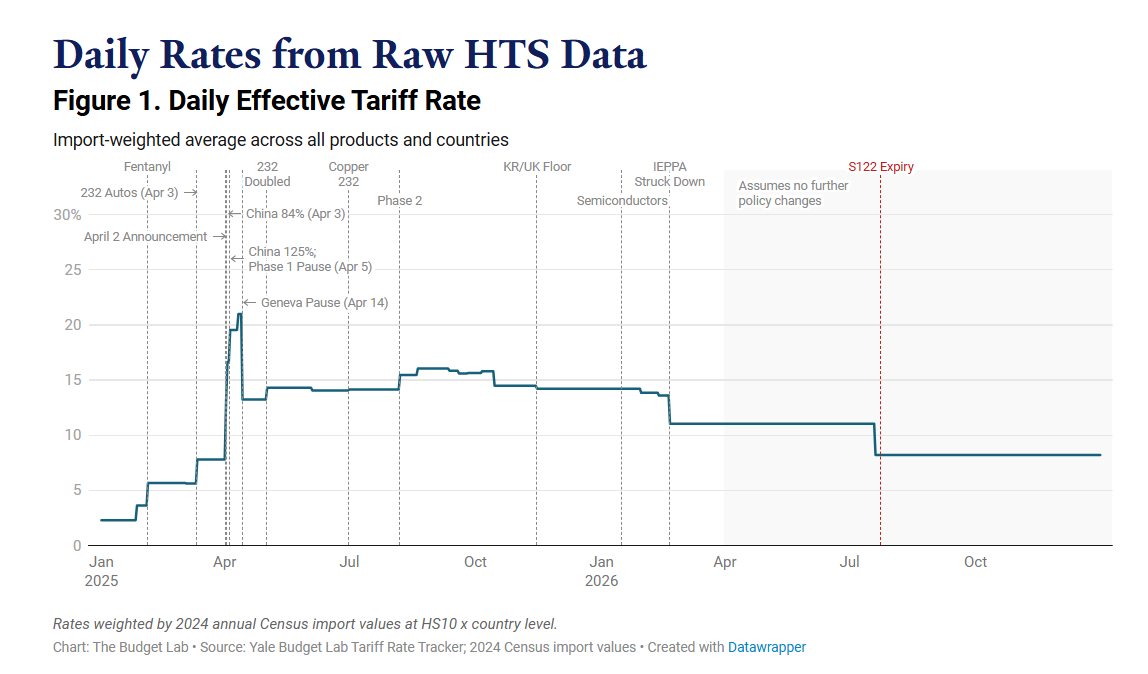
On April 2, 2026, exactly a year after Liberation Day, the average daily effective tariff rate in the US had fallen to 11.05%, according to data from Yale’s Budget Lab, as seen below:
Average Daily Effective Tariff Rate
Source: Yale Budget Lab
They also expect this to remain the same until July if there are no further policy changes. When the tariffs imposed under Section 122 of the Trade Act of 1974 expire after 150 days, the average effective rate would fall to 8.2%, which is only a little higher than it was before Liberation Day (7.79%).
In summary, there are still lots of uncertainties regarding Trump’s tariff policy. As the Tax Foundation noted, there have been more than 50 changes in US tariffs since Trump started his second term.
These tariffs can be considered “rushed and improvisational,” according to CFR. “While early deals were scant on details, they became more complex over time,” they noted. “However, nearly every deal is a replica of a previous version, with small modifications. It is no surprise that trading partners have been confused.”
2. Taking stock: The economic impacts of Trump tariffs
Now that we understand where we are, let’s consider some of the impacts of Trump’s tariffs on the US and global economy, a year on.
Rising prices
US importers and customers have faced higher prices since the announcement of Trump’s tariffs.
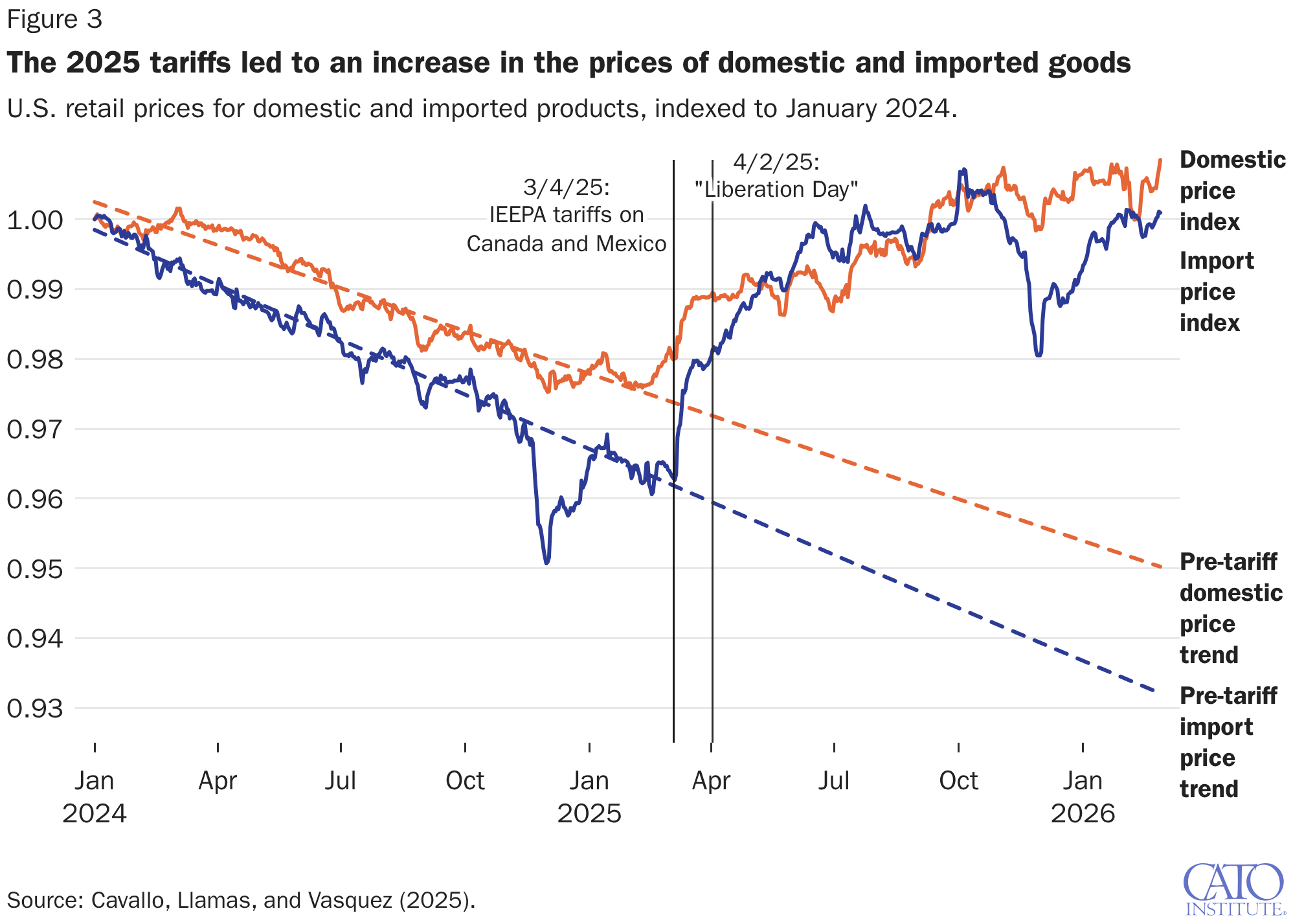
The prices of both domestic and imported goods increased, according to a study conducted in January 2026 by economists from the Harvard Business School. Below is a visual representation of the changes:
Impact of Trump’s Tariffs on the Prices of Domestic and Imported Goods
Source: Cato Institute
As the chart shows, the domestic price Index was trending towards 0.95 before April 2025. With the tariffs, it trended upward to above 1.00 as of January 2026. The import price index was falling and heading towards 0.93 before the tariffs pushed it to almost 1.00.
Weakening employment in tariff-sensitive industries
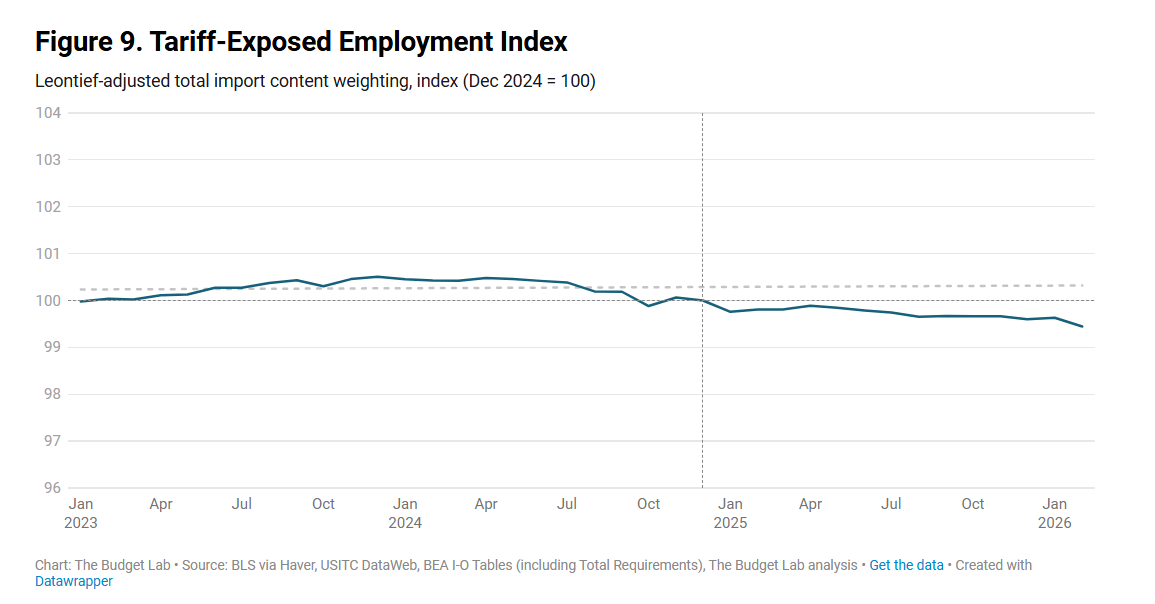
While tariffs have not had any definitive effect on the aggregate job market, the story is different for industries that are more exposed to tariffs, according to The Budget Lab.
They constructed indices of tariff-sensitive employment, which “measure employment weighted by industry-level tariff exposure.” Below is the trend of the overall index:
Tariff-Exposed Employment Index
Source: The Budget Lab
This index fell by 0.6% between January 2025 and February 2026. Also, the index was 0.9% below where it should have been if pre-2025 patterns continued. In other words, there was a weakening of employment in tariff-sensitive industries.
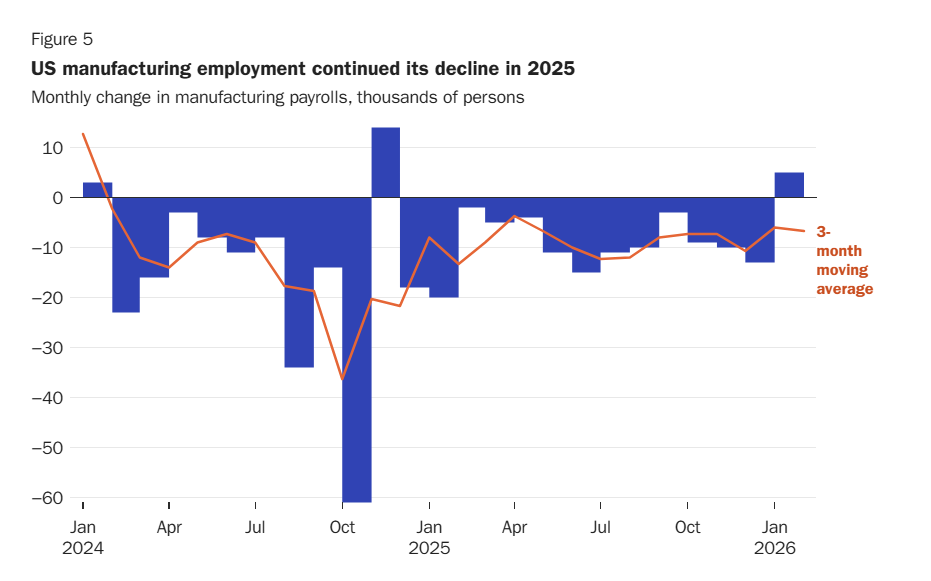
Interestingly, while tariff-exposed employment was falling, the expected increase in US manufacturing jobs did not materialise.
As seen below, the monthly change in manufacturing payrolls was still negative throughout 2025.
Monthly Changes in Manufacturing Payrolls
Source: Cato Journal
“Manufacturers reported throughout 2025 that tariff-induced cost pressures and uncertainty hampered economic activity in the sector, and employment data suggest that this also contributed to a slowdown in hiring,” they noted. “While manufacturing employment indeed struggled throughout 2024, the data confirm that—contrary to White House promises—there was no tariff-related hiring boom in 2025.”
Trade policy uncertainty
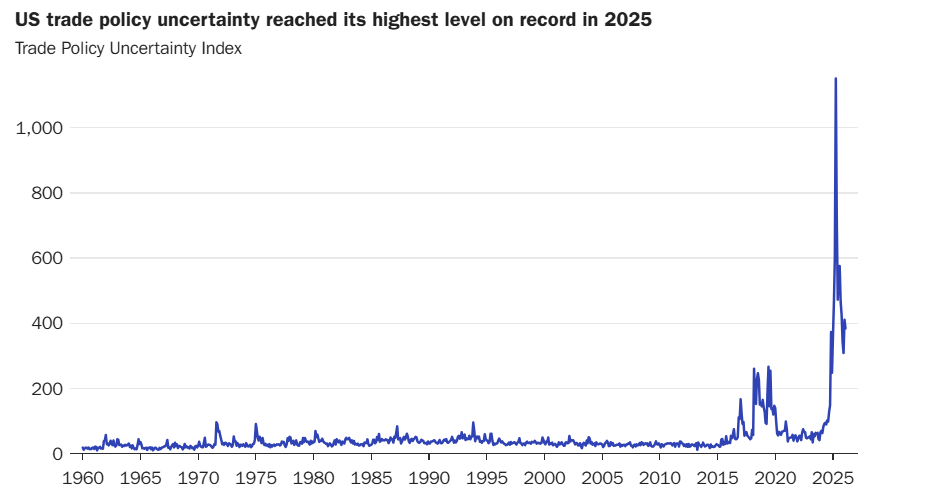
The Trade Policy Uncertainty index reached an all-time high in 2025, as seen below:
US Trade Policy Uncertainty Index
Source: Cato Journal
This should not be surprising, given the data from the Tax Foundation that shows there have been 50 tariff changes in Trump’s second term.
Diversification away from US supply chains
In the first half of 2025 (H1, 2025), US agricultural exports to China fell by 54%, according to RFD TV, an American media company. On the other hand, China is counting on Brazil and Argentina for soybean imports.
“As in other sectors, Liberation Day has accelerated China’s strategic diversification away from U.S. supply chains,” according to Michael Werz, a senior fellow at CFR.
Also, US agricultural exports declined by 3% in 2025, with further drops expected in 2026.
Cato also noted how US trading partners have been negotiating free trade agreements with each other since 2020, while the US has entered into none during the same period.
More recently, the EU is negotiating trade deals with MERCOSUR, India, and Australia; Canada with Thailand, Philippines, and ASEAN; China with ASEAN, Congo, and South Korea; and India with the UK and New Zealand.
This “fracturing of the multilateral trade system” is one of the underrated impacts of Trump’s tariffs, according to George Hawkmont, the founder of Hawkmont Research, an economic research blog. He believes that the structural shift that results from the EU, Canada, and Japan reducing their dependence on the US will not reverse, even in the next administration.
Industry-specific impacts
In addition to looking at macro impacts, we can also consider industry-specific impacts of the tariffs.
CNBC has done a good job of chronicling these impacts in major industries. Below are the key summaries:
- Retail: Mega-retailers have survived while smaller ones have been hit significantly. Many retailers have avoided massive impacts from the tariff by diversifying their supply chain.
- Automotive: Operating costs of foreign and domestic automakers have increased due to the tariffs. Many are redirecting and resourcing supply chains to reduce costs, while industry leaders are lobbying the US government for policies that will lead to a more competitive auto industry.
- Consumer packaged goods: Operators in this industry have also faced rising costs. Some have resorted to cutting down expenses and sourcing from countries with lower tariffs, while others have increased prices.
- Pharmaceuticals: Many pharmaceutical companies have signed agreements with Trump to lower the prices of new and existing medicines in exchange for a three-year relief from tariffs.
This has helped them fare better than other industries.
3. Projected future economic impacts of Trump’s tariffs
Uncertainties remain about the future direction of US international trade policy.
As we saw above, the Supreme Court has ruled that Trump does not have the power to impose tariffs without congressional backing.
However, Trump has explored Section 122 of the Trade Act of 1974 to impose a 10% global tariff rate that will last for 150 days. He also said this could increase to 15% later on.
In other words, no one is certain what will happen after the 150 days are over. Will there be a further increase in the average tariff rate?
Price increases continue
Interestingly, some companies are choosing not to factor the Supreme Court ruling into their decision-making, according to CNBC. Gap, an apparel company, is an example.
Also, many companies have already paid tariffs on their current inventory. If they continue to pass these costs to customers, then prices will continue to rise.
More importantly, given the lag in the transmission mechanism of economic policies, some experts believe that the full-on effects of Trump’s tariffs on US households and businesses are still ahead.
“But the full effect of Trump’s tariffs on consumer prices has yet to be realized,” according to Werz. “Economists estimate a lag of twelve to eighteen months before tariff effects reach consumers, placing peak pressure between April and October 2026.”
Uncertainty about the US continues
The uncertainty that has followed Trump’s trade announcements has led many of the US trading partners to be wary of the next decision he will take.
“The impulsive Liberation Day tariffs alienated allies, angered friendly trading partners, and proved mostly for naught with the court decision and the billions of dollars in tariffs that must now be refunded,” according to Edward Allen, a senior fellow at CFR.
Even with the Supreme Court decision, it does not seem that recovering trust in the US will be an easy road. Many believe such trust may not even be recovered during Trump’s administration.
Diversification away from the US may continue
If uncertainty persists, then US trading partners will keep looking for other economies with more stable and favourable trade policies. In other words, the global restructuring will continue.
“With the administration’s tariffs undermining US commitments under previously negotiated trade agreements, we should expect non-US trade agreements to continue to proliferate in the future,” according to Cato.
Furthermore, US agricultural exports are expected to fall to a five-year low at the end of 2026, according to Farm Progress, an agriculture media platform.
If retaliatory tariffs on US goods follow any perceived harsh tariff from the US, then US exports may suffer across the board in the following years.
Fall in US GDP
Though tariff revenue has increased under Trump, the projected impact of tariffs on economic growth is negative.
The permanent Section 232 tariffs will make the US GDP fall by 0.2%, while the IEEPA tariffs will bring it down by another 0.3%, according to the Tax Foundation. Also, retaliatory tariffs will cause a further 0.2% decline.
4. How should institutional investors respond to Trump’s tariff policy?
Institutional investors have to consider tariff uncertainty as a new reality and adjust their portfolio decisions to reflect it.
Some of the key points to consider include:
- Embracing scenario planning: The average effective tariff rate can increase or decrease after the 150 days are over. And any increase or decrease may be temporary.
In Trump’s economy, scenario analysis will be crucial. Institutional investors must analyse the possible impacts of Trump’s tariffs on world trade and the global economy by considering best-case, base-case, and worst-case scenarios.
Such comprehensive scenario planning will help avoid more ‘shocks’ from the indecisiveness of the Trump administration.
- Creating comprehensive risk management strategies: Gone are the days when trade liberalisation was taken for granted. Openness to trade protectionist policies means that institutional investors must pay more attention to trade policies as part of risk factors.
“Trade policy uncertainty has become a permanent risk premium that institutional investors now price in,” said Daniel Battaglia, an ex-investment banker and founder of Parksy, a peer-to-peer parking marketplace.
Also, institutional investors must pay attention to a company’s supply chain and evaluate how trade policies can affect it.
- Prioritising tariff winners and companies with a diversified supply chain: Some of the expected winners from the whole tariff business include domestic manufacturers in protected industries, industrials tied to reshoring, defense and infrastructure companies, and commodities like steel and aluminum.
Institutional investors should look for some gems among these companies.
Also, higher tariffs accentuate the difference between companies with pricing power and those without. While companies with pricing power can pass on higher costs to customers to maintain or increase net income, those without might have to cope with lower net income or go on a wave of cost efficiency measures.
Finally, supply chain diversification is increasingly becoming a competitive advantage. Institutional investors should consider those companies with multi-country sourcing and nearshoring strategies.
- Embracing strategic international diversification: Global diversification remains one of the best investment strategies of 2026 for institutional investors.
One reason for this is that the trade war between the US and China has opened up opportunities for some countries.
“While manufacturing-dependent emerging markets that relied on US-bound export chains have had to fundamentally rethink their positioning, other regions have benefited: nearshoring to Mexico, Vietnam, and India has accelerated,” said Battaglia. “The impact of the tariffs is deeply asymmetric depending on sector and geography.”
Vietnam, Thailand, South Korea, India, Taiwan, Malaysia, and Mexico are ramping up exports. This export growth is poised to potentially improve these economies and provide more investment opportunities in their equity markets.
Also, institutional investors should recognise that “geopolitical alignment and regional blocs now increasingly drive trade and capital flows as much as fundamentals do,” according to Hawkmont. As a result, standard global or international diversification will not suffice.
Asset managers should consider spreading their assets across the three main trade blocs: US-aligned, China-aligned, and neutral/emerging (India, ASEAN, and parts of Africa).
- Preparing for possible inflationary pressure: If tariffs continue to lead to rising producer and consumer prices, institutional investors must hedge against inflation by investing in companies with pricing power and increasing allocation to commodities like gold, silver, and crude oil.
- Consider allocation to real assets: Tariff-driven fragmentation can increase demand for infrastructure (ports, logistics, energy), industrial real estate, and commodities.
Real assets benefit from supply chain reconfiguration and domestic production capacity buildout. Institutional investors should consider increasing allocation to real assets in both public and private markets.
- Consider hedging against currency volatility: The whole tariff business was one of the factors that contributed to the fall of the dollar last year. Though things have improved since then, the US dollar outlook is still uncertain, especially in the medium-to-long term.
If protectionist policies persist, institutional investors may need to start hedging FX exposure more strategically.
- Always be on the lookout for wonderful companies priced at a discount: The biggest immediate impact of Trump tariffs on the stock market was the loss of $10 trillion in three trading days.
Though tariff as a factor does not have much impact on the stock market at the moment, this experience shows that any manifestation of uncertainty or a doubling down on protectionism may send the stock market on another downward trend.
If this happens, it will provide opportunities for institutional investors to pick up some wonderful companies at a discount.
However, this also means that institutional investors must build resilient portfolios that can survive any geopolitical or economic shock instead of being driven by the fear-and-greed cycle when such shocks occur.
What will this look like?
“From a portfolio perspective, resilience now means geographic diversification, exposure to domestic-demand-driven sectors, and building in inflation and policy risk hedges,” according to Deepak Shukla, the CEO of Pearl Lemon Capital, a business financing company. “In practice, I’ve leaned toward diversified asset exposure and avoided overconcentration in trade-sensitive industries.”
Asset managers who are dealing with the impacts of Trump’s tariffs can share ideas and strategies that will be helpful to one another.
Due dilligence and risk management will become more important, and as every asset manager knows, these are processes that are best done with insights and contributions from others.
At cio investment club, we provide you with a community of asset managers and other finance professionals who can help you improve your risk management processes and make better portfolio decisions.
We also organise exclusive roundtables and investment breakfasts where you can physically interact with other professionals and collaborate on exciting opportunities.
Do you want to be part of an investment community that will help you make better portfolio decisions in view of Trump’s tariffs? Register today to join the cio investment club.
Takeaways
- Despite aggressive policy moves, constant changes and legal challenges have made US trade policy unpredictable.
- US businesses and consumers are already feeling price pressure, with peak effects expected in 2026.
- Tariffs have not delivered the expected job growth, especially in manufacturing.
- Scenario planning, supply chain analysis, comprehensive risk management, and global diversification, among others, are now essential strategies.
This document is produced by Instaconnect Limited, trading as cio investment club, a company registered in England & Wales with registration number 15262951.
Instaconnect Limited is neither authorised nor regulated by the Financial Conduct Authority in the United Kingdom nor the Securities and Exchange Commission in the United States of America.
This document is a marketing documentation and is not intended to constitute an invitation or an inducement to engage in any investment activity. It is not intended to constitute investment advice and should not be relied upon as such. It is not intended and none of Instaconnect Limited, its holding companies or any of its or their associates, or any of the participants in the documentation, shall have any liability whatsoever for (a) investment advice; (b) a recommendation to enter into any transaction or strategy; (c) advice that a transaction or strategy is suitable or appropriate; (d) the primary basis for any investment decision; (e) a representation, warranty, guarantee with respect to the legal, accounting, tax or other implications of any transaction or strategy; or (f) to cause Instaconnect Limited to be an advisor or fiduciary of any recipient of this report or other third party.
The content and graphical illustrations contained in this document are provided for information purposes and should not be relied upon to form any investment decisions or to predict future performance. Instaconnect Limited recommends that recipients seek appropriate professional advice before making any investment decision. Although the information expressed is provided in good faith, Instaconnect Limited does not represent, warrant or guarantee that such information is accurate, complete or appropriate for your purposes and none of them shall be responsible for or have any liability to you for losses or damages (whether consequential, incidental or otherwise) arising in any way for errors or omissions in, or the use of or reliance upon the information contained in this document.
To the greatest extent permitted by law, we exclude all conditions and warranties that might otherwise be implied by law with respect to the document, whether by operation of law, statute or otherwise, including as to their accuracy, completeness, or fitness for purpose.
Instaconnect Limited and its logo are proprietary trademarks of Instaconnect Limited and are registered in the United Kingdom. Unauthorised copying of this document is prohibited.
© Copyright Instaconnect Limited 2026