




Creating a resilient, all-weather portfolio that can smooth out market ups and downs has been the focus of institutional investors since the global financial crisis of 2008.
Institutional thinking shifted from pure return maximisation to a focus on risk-adjusted performance, liquidity management, portfolio diversification, and long-term stability.
The increased interest in multi-asset funds from institutional investors is another step further in this massive reorientation.
As the correlation between stocks and bonds increases, the search for truly diversified portfolios has led asset managers to embrace low-cost multi-asset funds that can provide the resilience and stability they desire.
In this article, we will consider why multi-asset funds are becoming more popular, why they are important to institutional investors, and how they can best use them in a way that minimises their risk factors.
We’ll cover:
- Why are multi-asset funds becoming more popular?
- What are the benefits of multi-asset funds to institutional investors?
- Approaching with care: How institutional investors should navigate multi-asset funds
1. Why are multi-asset funds becoming more popular?
Before considering the benefits of multi-asset investments to institutional investors, let’s take some time to understand why they are becoming popular in the first place.
The weaknesses of traditional stock/bond portfolios
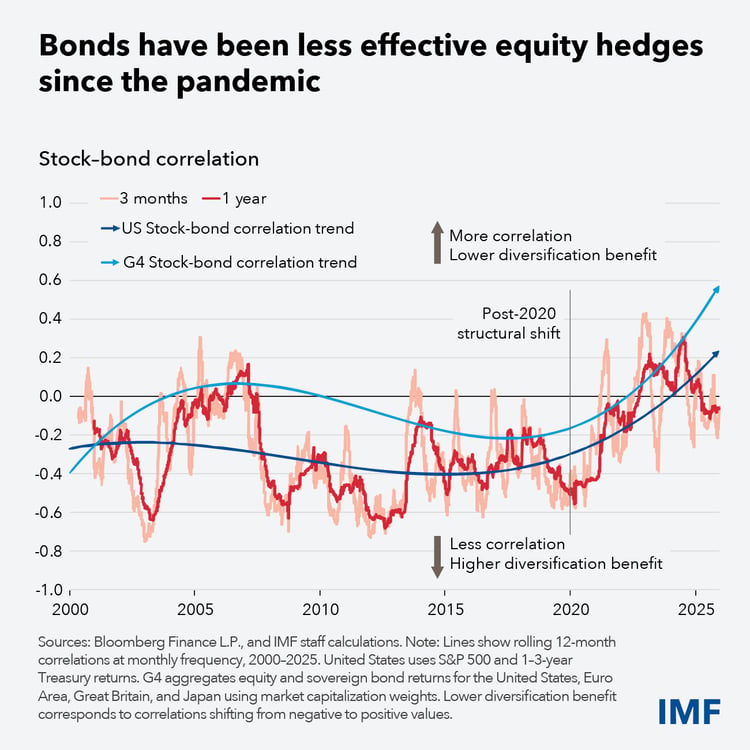
Financial and economic experts have noticed that the correlation between stocks and bonds has increased since the pandemic, making it difficult for investors to achieve genuine diversification.
“Diversification has become harder since 2020 as stocks and bonds tend to move in tandem during sharp selloffs, adding to financial stability concerns,” reported the International Monetary Fund (IMF).
As the chart below shows, the correlation coefficient between stocks and bonds was consistently entering positive territory after 2020, even touching the 0.4 mark twice in 2024.
Stock-Bond Correlation, 2000-2025
Source: IMF
The main point here is that the increased correlation occurs more during market downturns, which means bonds can hardly function as the investment risk diversifier they have been known to be.
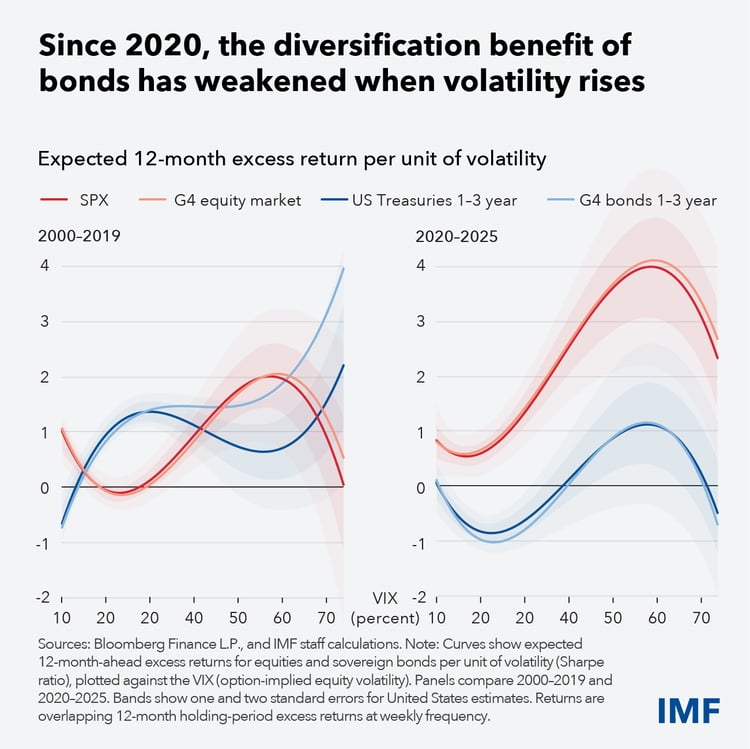
For example, the chart below shows that the excess returns for each unit of volatility that bonds provide have reduced since 2020:
Bonds’ Excess Returns Per Unit of Volatility, 2000-2019 and 2020-2025
Source: IMF
Notice that when volatility was at 70% between 2000 and 2019, bonds were providing positive and upward-trending returns while stocks were declining. In contrast, between 2020 and 2025, both bonds and stocks were trending downward at 70% volatility.
How should investors react to this?
“With diminished diversification, investors must build portfolios that account for the shift in correlations,” according to the IMF. “Alternative strategies—such as incorporating commodities or private assets—may offer partial solutions, but they come with their own complexities and risks.”
This is exactly what investors have been doing. The portfolio benefits of commodities like crude oil, gold, and silver have come to the fore as investors seek true safe havens and inflation hedges.
Some investors are going one step forward by embracing dynamic multi-asset funds that include stocks, bonds, commodities, real estate, and private assets. By purchasing these off-the-shelf solutions, they can enjoy true diversification without any complexity.
“The increasing instability of the bond-equity correlation may necessitate a move away from pure strategic asset allocations, also known as benchmarked portfolios, to more dynamic multi-asset portfolios,” said Sven Helsen, Senior Portfolio Manager in the Multi-Asset/Target Allocation team at BNP Paribas, a global investment firm. “The latter can not only shift their allocations between asset classes (beta rotation), but also access idiosyncratic opportunities within each asset class (alpha generation).”
The search for improved risk-adjusted returns
As said above, institutional investors are increasingly focused on outcomes like stable long-term growth, lower drawdowns, predictable income, and liability matching rather than just pure return numbers.
Thus, they are more likely to maximise risk-adjusted returns than pure returns.
“At Pearl Lemon Invest, we have seen growing interest in strategies that combine equities, fixed income, commodities, and alternatives because institutions want smoother risk-adjusted returns rather than pure market exposure,” said Deepak Shukla, CEO of Pearl Lemon Invest, a business and property financing solution.
A multi-asset allocation that includes assets like commodities and cryptocurrencies can help achieve this goal.
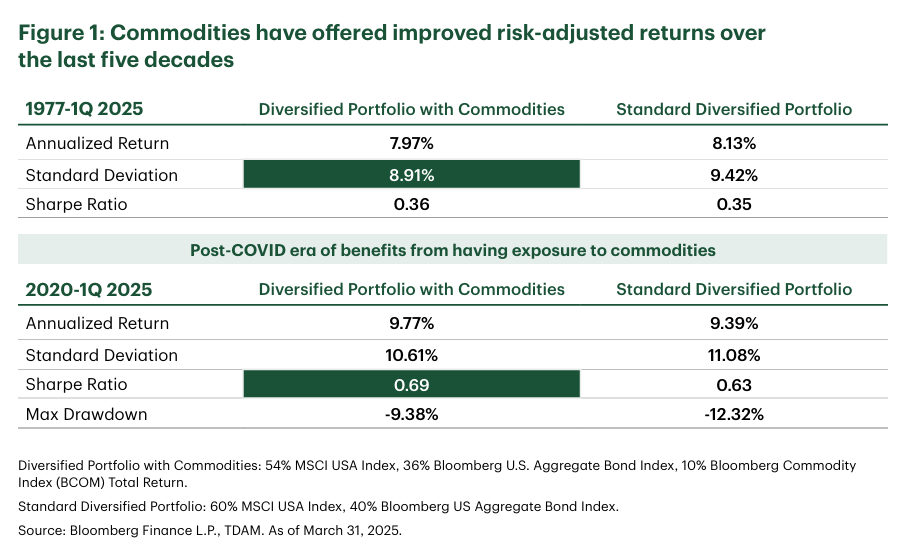
For example, adding commodities to a traditional diversified portfolio (stocks and bonds) can improve its risk-adjusted returns, according to research by TD Global Investment Solutions.
As the chart below shows, the risk-adjusted return differential between a portfolio with commodities and one with only stocks and bonds has increased since 2020, which reiterates what we have said about the rising correlation between stocks and bonds.
How Commodities Increase Risk-Adjusted Returns of Traditional Portfolios
Source: TD Global Investment Solutions
Furthermore, notice that the portfolio with commodities has a lower maximum drawdown than the traditional portfolio.
Though there have been debates about whether bitcoin is a good investment, there is no doubt that it is one of the assets with the highest risk-adjusted returns.
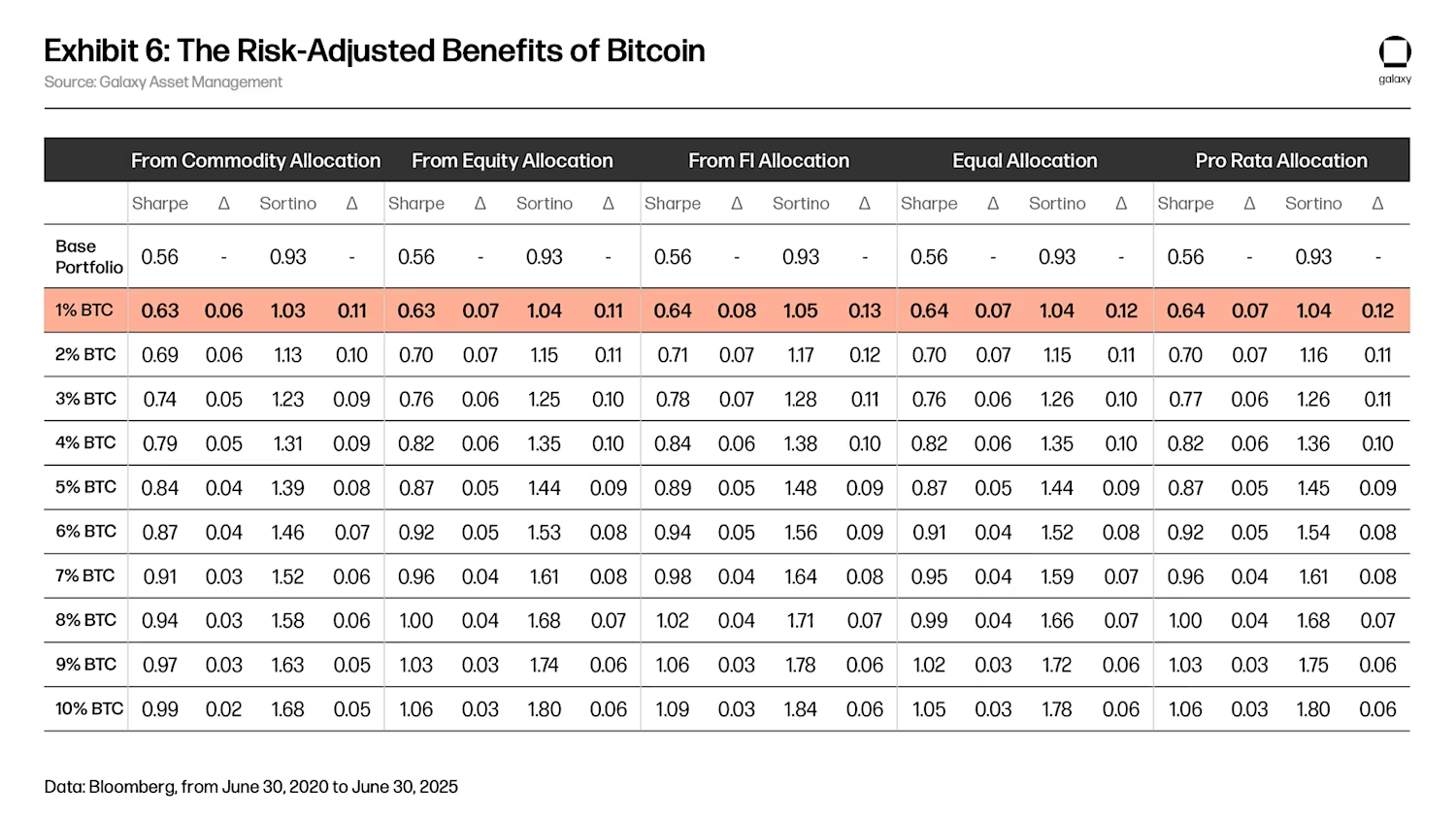
Adding just 1% of bitcoin to an existing portfolio increases its risk-adjusted returns, according to a study by Galaxy, a fintech company providing institutional-grade access to digital assets, data centres, and blockchain infrastructure.
As the chart below shows, the more the bitcoin allocation (from 1% through to 10%), the higher the risk-adjusted returns.
Also, this result holds whether you are allocating to bitcoin from the commodity, equity, or fixed-income portion of the portfolio. Even with an equal or pro-rata allocation from these different asset classes, the presence of bitcoin increased risk-adjusted returns.
How Bitcoin Increases the Risk-Adjusted Returns of Portfolios
Source: Galaxy
Instead of creating portfolios with different assets that increase risk-adjusted returns, institutional investors are embracing pre-packaged multi-asset funds with high risk-adjusted returns.
The need for resilience amidst market volatility
Global economies are talking about macroeconomic resilience just as asset owners and managers are talking about portfolio resilience.
Even if we consider the pandemic a black swan event, since then, we have had persistent geopolitical tensions, inflation shocks, higher interest rates, and economic uncertainty that have all led to increased market volatility.
In response, multi-asset managers are tactically shifting multi-asset allocations to defensive assets during downturns, commodities during inflationary periods, equities during equity exposure, and cash when risks increase.
Such flexibility appeals to institutions that want all-weather portfolios that can thrive across market cycles.
The search for easier access to alternatives
The search for higher returns and diversification has led institutional investors to embrace private and productive finance assets. These can be in the form of private equity, private capital, infrastructure, real estate, and growth equity, etc.
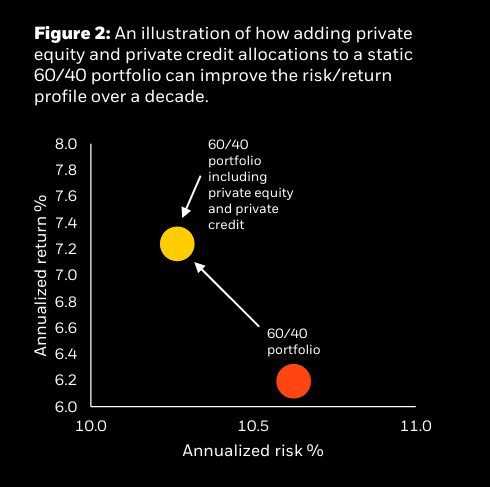
Adding private equity and credit to a traditional 60/40 portfolio can improve its risk/return profile over a decade, according to a study by BlackRock, a global financial services firm.
As seen below, the annualised return is higher, and the annualised risk is lower when you add private assets to a portfolio.
The Role of Private Assets in Traditional Portfolios
Source: BlackRock
Instead of building these allocations internally, which is often expensive and operationally complex, institutional investors are embracing multi-asset funds that include private assets.
The pursuit of higher yield
Many institutions need dependable income streams to meet obligations like pension payments, insurance liabilities, and University spending needs.
Unfortunately, high inflation has meant that traditional fixed-income assets no longer provide sufficient real yields to meet these obligations.
As a result, institutions are embracing fixed-income alternatives like dividend-paying equities, corporate credit, infrastructure income, REITs, emerging-market debt, and covered call strategies.
Many multi-asset income funds include these different types of assets in pursuit of higher yields.
The desire to outsource the asset allocation work
Institutional investors could have responded to all the trends we have noticed by constructing their own portfolios to achieve these stated objectives.
However, many of them, especially smaller pension funds, family offices, foundations, and regional insurers, are recognising that tactical asset allocation requires macro expertise, quantitative models, risk management systems, and continuous monitoring.
Instead of handling all these in-house, they prefer to outsource the investment choices to specialised multi-asset managers and purchase the multi-asset funds they offer instead.
The growth of outcome-oriented investing
Finally, the move from benchmark-related performance evaluation to outcome-oriented investing has increased the popularity of multi-asset funds.
Institutional investors increasingly define objectives in practical terms like “Generate 6% annualized returns,” “Maintain inflation + 4%,” “Limit drawdowns below 10%,” and “Preserve capital while generating income.”
Since many multi-asset portfolio managers design their portfolios with real-world targets like this, it has been easier for institutional investors to embrace them.
2. What are the benefits of multi-asset funds to institutional investors?
The multi-asset fund ship is sailing, but is it wise for you to join it?
Asked differently, are multi-asset funds a good investment?
Below are some of the benefits that may make them attractive to you, depending on your objectives and governance structure.
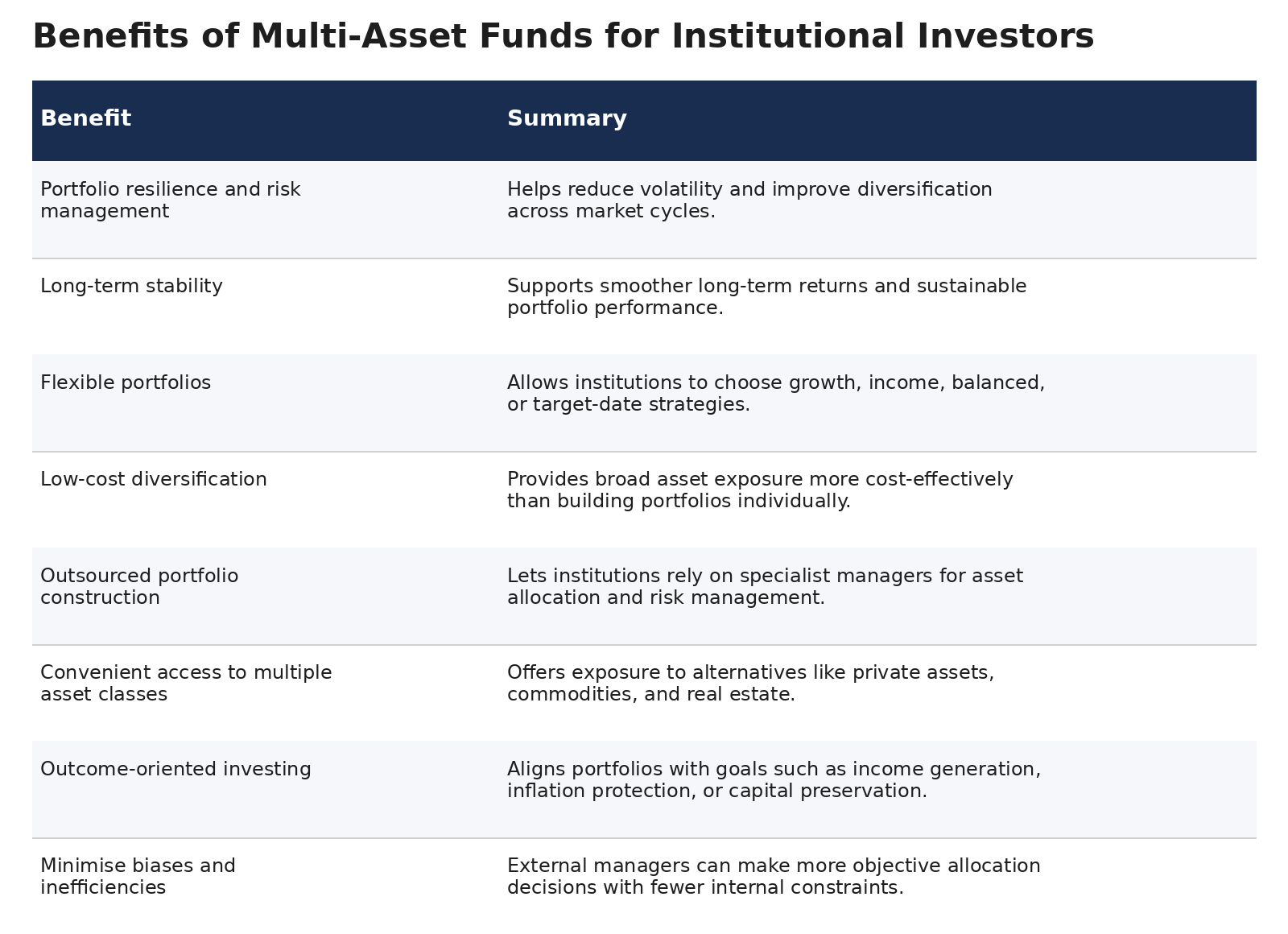
- Portfolio resilience and risk management: Given that multi-asset funds can attain true diversification, they can help investors manage the risk that comes from market ups and downs.
Also, they tend to have an active management approach that is responsive to the realities of every market condition. This also includes the selective use of derivatives to manage risk and volatility.
“Actively managed multi-asset funds possess the advantage of adaptability,” according to Reshma Moloo, the head of Multi Asset at HSBC Global Private Banking and Wealth. “Skilled investment managers can dynamically adjust exposure to asset classes, capitalising on short-term opportunities and managing downside risks. For example, a manager may increase equity exposure while reducing bond holdings if they perceive stocks to be more attractive.”
- Long-term stability: A resilient portfolio provides stable capital growth that smooths out different market conditions and helps investors achieve their long-term goals.
“Multi-asset funds are especially good for managing volatility and drawdown,” according to Moloo. “By spreading risk across market segments, these funds seek to capitalise on the positive performance of certain asset classes when others are losing value. This helps shield portfolios from significant losses and smooth out overall investment performance. In an ever-changing market landscape, the ability to manage risk effectively is valuable for investors seeking stability and long-term growth.”
Similarly, income-oriented investors can use multi-asset investments to create sustainable income across market cycles.
- Flexible portfolios: Different types of multi-asset funds appeal to different investors: multi-asset growth funds for capital growth-oriented investors, multi-asset income funds for income-oriented investors, target-date and target-return funds for specific investment objectives, and multi-asset balanced funds for moderate risk investors.
Instead of revising their portfolio allocation strategies when their goals change, institutions can easily sell one multi-asset fund to buy another to match different levels of risk.
- Low-cost diversification: It is no news that buying an index fund or an ETF is more cost-effective than buying individual assets. Similarly, purchasing a multi-asset fund that invests in different investment funds can be less expensive than purchasing individual funds or individual assets.
- Outsourced portfolio construction: Creating a diversified portfolio can be so time-consuming that outsourcing it to multi-asset funds can be an efficient choice.
“Diversification may sound good in theory, but it requires constant attention and rebalancing, and most institutional committees only do this quarterly at best,” according to Joe Braier, the president of Lake Country Advisors, a team of financial advisers with M&A expertise. “Multi-asset funds eliminate that time lag since the portfolio manager can reallocate funds whenever the situation changes, sometimes in days. One set of due diligence documents, one reporting stream and one relationship to manage is needed for a $50 million allocation to one multi-asset vehicle. That simplicity of operation allows internal staff to focus on liability management and long-term strategic planning.”
By outsourcing portfolio construction, asset managers can focus on other important aspects of their work, like setting strategic frameworks (objectives, risk management principles, liquidity parameters, ESG and sustainability priorities, target outcomes), multi-asset managers selection, due diligence, performance monitoring, governance, client relationship and value creation, and product innovation and integration, amongst others.
- Convenient access to different types of investments: Institutions can avoid the regulatory and administrative complexities of investing in private assets by purchasing multi-asset funds that include them.
By outsourcing these complexities, they can focus on more important aspects of their work.
- Outcome-oriented investing: With multi-asset funds, institutional investors can better attain their desire for outcome-oriented investing as an alternative strategy to mere benchmarking.
- Minimise biases and inefficiencies: Sometimes, asset managers working for asset owners can have biases that affect their portfolio allocation decisions. Internal politics can come into play in a way that introduces inefficiencies.
On the other hand, since multi-asset portfolio managers are far removed from the intricacies of particular investors, they can be more objective when making multi-asset allocation decisions.
Below is a chart summarising these benefits:
4. Approaching with care: How institutional investors should navigate multi-asset funds
Though the benefits are undeniable, institutional investors interested in multi-asset strategies must still approach them with care and due diligence.
We consider what care and due diligence will look like when it comes to investing in multi-asset funds.
Embracing a core and satellite portfolio approach
While institutional investors can allocate portfolio allocation to specialist managers with multi-asset funds, they should also have a satellite portfolio where they can also explore other priorities (thematic exposures, ESG investing, and regional tilts, etc.).
“These (multi-asset) funds can serve as a core allocation in portfolios, complemented by satellite allocations tailored to an investor’s preferences and objectives,” according to Moloo.
An active management approach is a must
Only an active management approach can help investors achieve long-term stability with multi-asset funds.
“The very fluid market environment calls for a flexible approach: to be able to capture returns as they become available in a favourable market environment, but to balance the portfolio using more risk-reducing assets to minimise losses during adverse conditions like market drawdowns,” said Ugo Montrucchio, a multi-asset portfolio manager at Schroders Capital, a wealth management firm.
Manager’s skills matter
If active management is the way to go, then the skills of the multi-asset fund manager matter greatly.
Institutions must select managers with excellent skills at macro analysis, risk modelling, asset allocation, rebalancing, security selection (if it’s not a fund of funds), and tactical positioning.
Also, institutional investors should evaluate if fund managers have proven experience across market cycles, robust risk controls, strong governance structures, clear accountability frameworks, and a transparent decision-making process.
“Multi-asset funds are not an automatic allocation magic pot; they are a valid structural approach for institutions that can do the work at the front end,” according to Braier. “Choose the appropriate manager, read all the fund documents and treat them as you would any other partner with tens of millions invested in him.”
Fees should be a consideration
Multi-asset funds can sometimes carry layered or opaque fee structures, especially when they invest through multiple underlying vehicles.
“Fee structures can often be complex, sometimes diluting returns when layering active management costs alongside underlying asset expenses,” according to Marc Pamatian, the CEO of Chief Bookkeeping Officer, a fractional bookkeeping company.
Institutions should evaluate management fees, performance fees, underlying fund expenses, transaction costs, and custody and operational costs.
Higher fees may be justified if the strategy delivers strong risk-adjusted performance or access to specialised expertise. However, excessive complexity (and fees) can erode long-term returns.
The aim is to select funds that provide the best value for money.
Pay attention to possible liquidity mismatches
Many modern multi-asset funds include private or less liquid investments to enhance returns or income generation.
While these assets can improve yield and diversification, they may also introduce liquidity risks. Liquidity mismatches can especially become a major concern during market dislocations when some funds struggle to meet redemption demands while holding illiquid assets.
Another area to evaluate carefully is liquidity,” according to Pamatian. “Some strategies may allocate to less liquid assets, impacting the ability to adapt to market conditions quickly. Institutional portfolios demand alignment with risk tolerance, performance expectations, and long-term investment goals, so a deep, diligent evaluation of any multi-asset strategy is non-negotiable.”
Institutional investors must ensure the liquidity structure of the fund they choose aligns with their redemption policies, liability schedules, cash flow requirements, and regulatory obligations.
Choose strategies that match your institution’s financial goals
Not every institution should pursue the same type of multi-asset strategy.
Pension funds may prioritise liability matching and downside protection, while insurers should focus on capital preservation and regulatory efficiency. Also, endowments may seek inflation protection and long-duration growth, while family offices may emphasise flexibility and wealth preservation.
This diversity in goals implies that institutional investors can select different multi-asset funds. A strategy designed for aggressive growth may not suit an institution focused on stable income and low volatility.
In other words, the success of a multi-asset strategy depends on whether it aligns with your institution’s liquidity needs, return objectives, time horizon, regulatory constraints, risk profile, and desired financial future.
Transparency is non-negotiable
One of the challenges with actively-managed funds (compared to their passively managed counterparts) is that there is no strict requirement to disclose their holdings.
Consequently, it is up to institutional investors to select funds that provide detailed reporting (through prospectuses and mandates) on asset exposures, risk concentrations, stress tests, scenario analysis, liquidity metrics, leverage usage, and performance attribution, amongst others.
“Complexity is one of the dangers with multi-asset funds,” according to Shukla. “Some multi-asset funds become so layered that investors lose visibility into underlying exposures.”
The solution?
“My biggest advice is to understand what actually drives the fund’s performance instead of assuming 'diversified' automatically means safer.”
In other words, due diligence into the fund itself is non-negotiable.
Multi-asset funds have become an important topic among financial market experts and investors.
Asset managers who have them on their radar can benefit from joining these discussions. They can gain and share insights about particular multi-asset funds and the best ways to approach them as an investment strategy.
At cio investment club, we provide you with a network of asset managers and other financial market experts who share opinions and insights about important trends in the investment landscape.
We also organise exclusive roundtables and investment breakfasts where you can have face-to-face interactions and one-on-one networking sessions with other investment professionals.
Our Multi Asset Roundtable will be held in London on 14th October 2026. This is an opportunity for asset owners and managers to reflect on the benefits of multi-asset funds and the best strategies to take advantage of them.
You can contact us if you would like to be a part of this discussion, or book your place on the cio investment club’s website. It promises to be an enjoyable experience.
Do you want to join a community of financial and economic experts where you can share ideas on relevant investment trends? Register today to join the cio investment club.
Takeaways
- Rising stock-bond correlations are pushing institutional investors toward multi-asset funds that offer broader diversification and greater resilience.
- Multi-asset funds help institutions pursue stronger risk-adjusted returns, stable income, and long-term portfolio stability across market cycles.
- Access to alternatives like commodities, private assets, and bitcoin is becoming a major driver of institutional multi-asset adoption.
- Institutional investors must approach multi-asset funds carefully by focusing on manager quality, liquidity risks, transparency, fees, and strategic alignment.
This document is produced by Instaconnect Limited, trading as cio investment club, a company registered in England & Wales with registration number 15262951.
Instaconnect Limited is neither authorised nor regulated by the Financial Conduct Authority in the United Kingdom nor the Securities and Exchange Commission in the United States of America.
This document is a marketing documentation and is not intended to constitute an invitation or an inducement to engage in any investment activity. It is not intended to constitute investment advice and should not be relied upon as such. It is not intended and none of Instaconnect Limited, its holding companies or any of its or their associates, or any of the participants in the documentation, shall have any liability whatsoever for (a) investment advice; (b) a recommendation to enter into any transaction or strategy; (c) advice that a transaction or strategy is suitable or appropriate; (d) the primary basis for any investment decision; (e) a representation, warranty, guarantee with respect to the legal, accounting, tax or other implications of any transaction or strategy; or (f) to cause Instaconnect Limited to be an advisor or fiduciary of any recipient of this report or other third party.
The content and graphical illustrations contained in this document are provided for information purposes and should not be relied upon to form any investment decisions or to predict future performance. Instaconnect Limited recommends that recipients seek appropriate professional advice before making any investment decision. Although the information expressed is provided in good faith, Instaconnect Limited does not represent, warrant or guarantee that such information is accurate, complete or appropriate for your purposes and none of them shall be responsible for or have any liability to you for losses or damages (whether consequential, incidental or otherwise) arising in any way for errors or omissions in, or the use of or reliance upon the information contained in this document.
To the greatest extent permitted by law, we exclude all conditions and warranties that might otherwise be implied by law with respect to the document, whether by operation of law, statute or otherwise, including as to their accuracy, completeness, or fitness for purpose.
Instaconnect Limited and its logo are proprietary trademarks of Instaconnect Limited and are registered in the United Kingdom. Unauthorised copying of this document is prohibited.
© Copyright Instaconnect Limited 2026