




Uncertainty in the global economy, combined with changing interest rate expectations, has led to a renewed interest in convertible bonds.
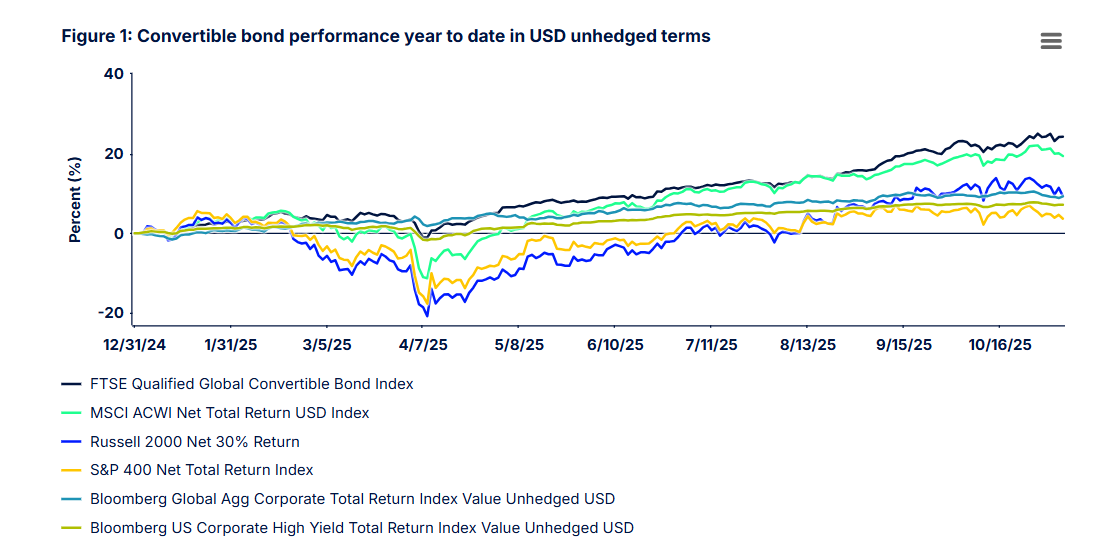
This interest was further enhanced when convertible bonds, which usually provide about 70% of equity returns, outperformed various equity and bond indices in 2025.
As macroeconomic uncertainty continues to dominate US and global markets, many retail and institutional investors are reconsidering the role of convertible bonds in their portfolios.
This has led to fresh inquiries about the benefits of convertible bonds and the risks of investing in them.
In this article, we will help you understand the appeal of convertible bonds and how institutional investors can best approach them. We’ll cover:
- Why is there a renewed interest in convertible bonds?
- The case for convertible bonds
- The risks of investing in convertible bonds
- How institutional investors can manage the risks of investing in convertible bonds
Do you want to learn more about how macroeconomic trends affect financial markets and asset classes, such as convertibles? Subscribe now to cio investment club’s newsletter for expert insights on the global economy.
1. Why is there a renewed interest in convertible bonds?
Certain features of the global economy and financial markets have led many asset owners and managers to consider adding convertible bonds to their portfolios.
We review some of them below:
Uncertain macro environment and strategic positioning
The uncertainty in the global economy started with Trump’s tariffs in 2025.
Frequent changes in policy direction led to uncertainty in fiscal and monetary policy.
Monetary policy uncertainty was especially significant because the Federal Reserve was unsure whether to raise or lower rates, as Trump’s tariff policy could lead to stagflation.
After a 25 basis point cut in December, 2025, the Fed has held rates steady even though prior expectations were for multiple interest rate cuts.
There has also been uncertainty about the path of inflation and economic growth, and this has been worsened by geopolitical tensions in the Middle East and Eastern Europe.
Periods of economic uncertainty, inflation concerns, and geopolitical instability have made investors look for instruments that balance growth and capital preservation.
Convertibles can perform well in such volatile environments because they combine features of both stocks and bonds. They can benefit from the upside of strong equity markets when macroeconomic conditions are positive, while also offering downside protection when conditions worsen.
“Convertibles are structurally positioned to benefit from volatility,” according to Lomard Odier Investment Managers, an investment management company. “Rising equity volatility increases the value of the embedded option, making the asset class particularly attractive in uncertain or choppy markets. Historically, volatility has acted as a buffer against corrections in both equity and fixed income markets. It also creates tactical opportunities for profit-taking and re-entry.”
Portfolio resilience and the need for flexibility
When there was a global equities sell-off after Liberation Day, precious metals like gold and silver became safe havens for investors. Both assets ended up outperforming equities by the end of 2025.
Similarly, as said above, convertible bonds outperformed equities and bonds in 2025 as they rebounded after an initial downturn caused by Liberation Day. As the chart below shows, the FTSE Qualified Global Convertible Bond Index outperformed various bond and equity indices.
Convertible Bond Performance Versus Equity and Bond, 2024-2025
Source: State Street Global Advisors
“Over the last 30 years, convertibles delivered 70% of equity returns but with only 35% of the volatility (6.7% p.a.),” according to Allianz Trade, an international insurance company. “2025 has topped this performance, with convertibles outperforming both equities and bonds (Sharpe ratio 2.0 vs. 1.0 and 0.1), helped by falling interest rates, the rise of technology, balanced technicals, and resilience during volatility.”
What is of most interest to investors here is the convertible bond’s ability to match a significant portion of equity returns while eliminating a great portion of its volatility.
In an environment where financial market volatility is increasing and macroeconomic resilience has become a struggle, portfolio managers are aiming for resilient portfolios that can hold their own and protect investors’ funds.
Convertible bonds have played this role well, and their outperformance of equities in 2025 is a great reminder of the value they can offer to investors seeking to build resilient portfolios.
Stability vs yield maximisation in volatile markets
Since the 2008 financial crisis, asset managers have learned to incorporate risk as an important factor in portfolio allocation decisions.
Instead of maximising yield and returns, they are learning to focus on stable returns across different market cycles. For example, many asset managers are prioritising risk-adjusted returns as a measure of performance rather than absolute returns.
This has also played in favour of convertible bonds. In 2025, they posted a Sharpe Ratio that is 2X of equities (2 to 1) and 10X of bonds (2 to 0.1).
As uncertainty and volatility persist, institutional investors looking for return stability will continue to appreciate the convexity (equity upside participation and bond-like downside protection) of convertible bonds.
Diversification and interest in multi-asset funds
As the equity-bond correlation continues to rise, institutional investors are looking beyond traditional equity-bond portfolios for true diversification.
This search has led them to multi-asset funds that combine different asset classes in a way that offers true diversification and higher risk-adjusted returns.
Multi-asset managers have been showing interest in convertible bonds as portfolio diversifiers, given that they behave differently from bonds and equities.
“Convertible bonds have historically exhibited low correlations to equities and traditional fixed income,” according to UBP, an investment management company. “This makes them a valuable diversification tool, particularly in market stress when correlations between asset classes increase.”
New issuances and supply-side interest
Global issuance of convertible bonds reached a five-year peak of about $81 billion in 2025, according to Allianz Trade.
This was driven by growth sectors like tech and biotech, and companies seeking flexible funding solutions given higher-than-expected interest rates.
Also, Lombard Odier estimated the total issuance between early 2023 and October 2025 at $300 billion, which took the total universe of convertible bonds to $500 billion.
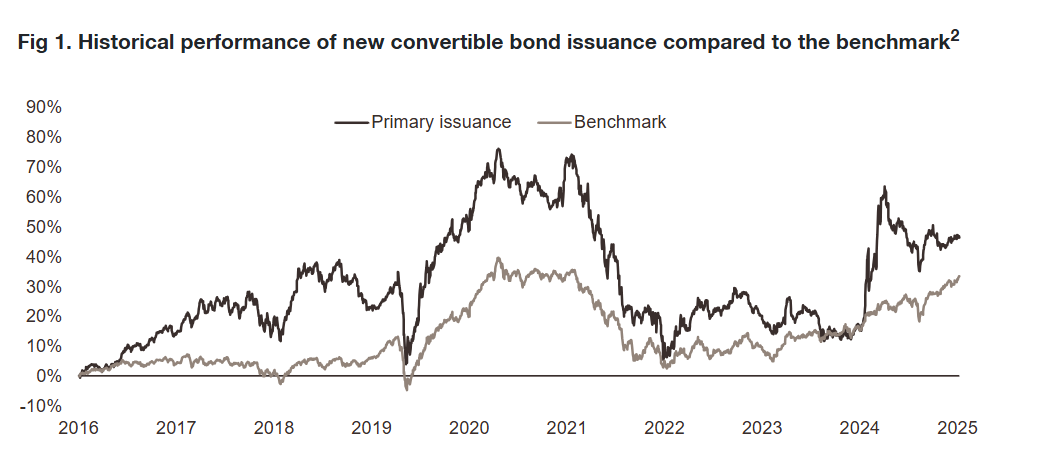
Interestingly, all of these new issuances were oversubscribed due to strong investor appetite. This is understandable since new issues often come at a discount and can increase potential returns.
Performance of New Convertible Bond Issuance Compared to the Benchmark
Source: Lombard Odier
2. The case for convertible bonds in institutional portfolios
One way to appreciate the renewed interest in convertibles is to evaluate the typical benefits they provide to asset managers.
Portfolio flexibility
Convertible bonds allow holders to either stick to the fixed-income component or convert to equities in pursuit of better returns. This flexibility provides an advantage to asset managers, especially in uncertain and volatile markets.
“Convertible bonds allow institutions to remain invested while preserving the ability to emotionally and strategically adjust if market conditions reverse unexpectedly,” according to Tapos Kumar, the CEO of Finance Ideas, a financial education platform. “I think that adaptability is more important today than traditional portfolio labels.”
Kumar calls this flexibility adaptive positioning.
It means asset managers do not have to always guess correctly the direction the market is taking. They can reposition towards downside protection or upside participation as market conditions change.
“Under the present circumstances, many institutional investors look for flexibility rather than placing aggressive directional bets,” said Deepak Shukla, the CEO of Pearl Lemon Invest, a business financing company. “Convertibles provide an opportunity to be exposed to the upside of equities while retaining bond like qualities in case of market weakness.”
Diversification
We have also seen that convertibles behave differently from bonds and equities, which makes them a good portfolio diversifier.
“Convertibles enhance diversification within a multi-asset portfolio, thereby reducing risk in pursuit of an intended return,” according to Allianz Trade. “These instruments straddle the line between equities and fixed income, thereby facilitating a smoother transition between these asset classes. Their capacity to adapt to market fluctuations through convex behaviour means that convertibles can modify their return profiles, introducing an innovative dimension to the portfolio's return mix.”
Lower downside risk
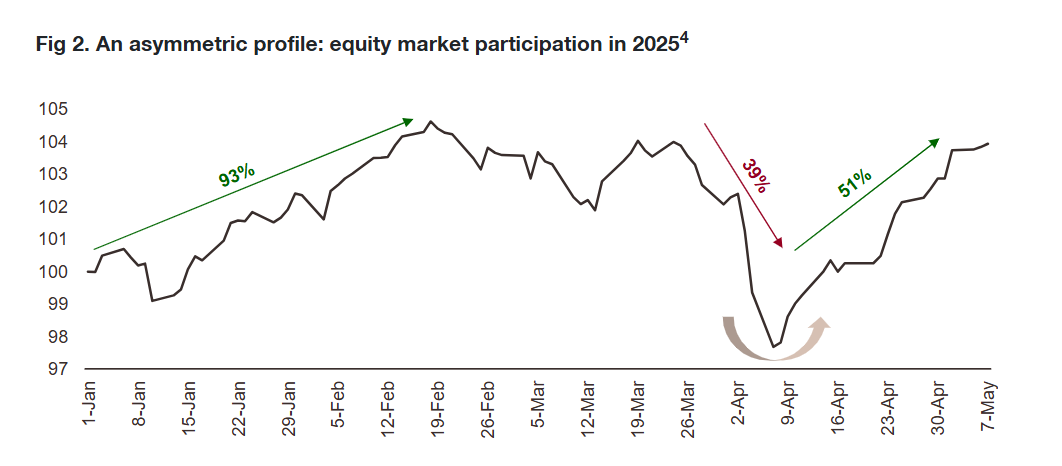
Convertible bonds have an asymmetric return profile that experts refer to as convexity. This means that they provide downside protection (from the bond component) and upside participation (from the equity element).
Below is an example of this convexity:
The Convexity of Convertible Bonds Return
Source: Lombard Odier
In this example, convertible bonds captured 93% of the upside between January 1 and February 19 and 51% of the upside between April 9 and May 7. On the other hand, it exposed the investor to only 39% of the downside between March 26 and April 9.
Unlike ordinary stocks, convertible bonds still function as bonds. If the stock underperforms, investors continue receiving coupon payments and may recover principal at maturity, offering a level of capital protection.
Equity upside in a high-growth environment
On the other hand, convertible bonds can be converted into shares of the issuing company, allowing investors to benefit if the company’s stock price rises significantly.
This is especially useful in high-growth environments when the equity market is in a bullish momentum.
Volatility control
Because they combine debt and equity characteristics, convertible bonds tend to experience less price volatility than common shares.
As Allianz Trade noted above, they captured 70% of equity returns with only 35% of its volatility over the past 30 years.
“Convertible securities provide an opportunity for one to control volatility yet still gain from any market success,” according to Shukla.
Lower sensitivity to rising interest rates
While bonds are highly sensitive to rising rates (which leads to lower prices), convertibles tend to be more resilient since they are more short-term dated.
“Convertibles also tend to have a lower sensitivity to rising interest rates than traditional bonds,” according to Schroders Capital, a global financial firm. “This is largely attributed to their typically shorter durations (usually between three to five years) and the built-in equity option, which tends to respond positively to rising interest rates, serving as a compensatory mechanism.”
This lower sensitivity also adds to their stability, which makes them appealing to asset managers seeking stable returns over market cycles.
3. The risks of investing in convertible bonds
Convertibles may look like the perfect solution that every investor should immediately embrace. However, there is no free lunch in the finance world, and convertibles have certain risks that institutions should know:
Credit quality risk
Convertible bonds are still corporate debt instruments, which means investors are exposed to the financial health of the issuing company. If the issuer experiences financial difficulties, its ability to make interest payments or repay principal could weaken.
This risk can be particularly relevant because many convertible bonds are issued by growth-oriented or younger companies in sectors like technology and biotech, which may have weaker credit profiles than established blue-chip firms.
However, the credit risk of convertibles is currently low.
“The default risk for convertible bond issuers remains low,” according to State Street Global Advisors. “From a ratings standpoint, convertibles are more typically concentrated in the crossover segment, unlike high yield issuers, which are all sub-investment-grade.”
Interest rate risk
Like traditional bonds, convertible bonds can lose value when interest rates rise. Higher rates generally make existing bonds with lower coupons less attractive.
However, as said above, convertible bonds are often somewhat less sensitive to interest rate movements than conventional bonds because their equity conversion feature can support prices if the issuer’s stock performs well.
Liquidity thinness
Some convertible bond markets can be relatively illiquid, meaning there may be fewer buyers and sellers compared to larger stock or government bond markets.
This can make it harder for investors to buy or sell positions quickly without affecting prices, especially during periods of market stress. Thin liquidity may also lead to wider bid-ask spreads and higher transaction costs.
However, liquidity thinness is an issue mainly with smaller, niche convertible bonds. For the mainstream market, liquidity in convertibles is comparable to that of investment-grade bonds (rather than high-yield bonds).
Thus, by focusing on benchmark-sized issues and pooled vehicles like ETFs, asset managers can mitigate liquidity risk.
Lower yield
Convertible bonds typically offer lower interest payments than standard corporate bonds from the same issuer.
This happens because investors are receiving an additional benefit: the option to convert the bond into shares if the stock price rises. In exchange for this upside potential, investors usually accept lower coupon income.
The flexibility of adaptive positioning that convertibles offer may make this lower yield less of a disadvantage to institutional investors. “The strongest institutional approaches treat convertible bonds less as yield products and more as strategic tools for managing uncertainty,” according to Kumar.
Equity sensitivity
Convertible bonds are partly influenced by movements in the issuer’s stock price. If the underlying shares decline sharply, the value of the convertible bond may also fall.
As the stock price moves closer to or above the conversion price, the convertible bond tends to behave more like an equity investment than a traditional bond. This means investors can become increasingly exposed to stock market volatility.
“Some convertible bonds perform well only if markets maintain a very specific balance between optimism and stability,” according to Kumar. “If volatility rises too aggressively or growth expectations weaken too quickly, the structure can become less efficient than investors initially expected.”
Valuation complexities
Convertible bonds can be difficult to value because they combine features of both fixed income and equity securities. Their pricing depends on several factors simultaneously, including: interest rates, issuer credit quality, stock price performance, stock volatility, time remaining until maturity, conversion ratio, and conversion price
Because of these multiple moving parts, assessing whether a convertible bond is fairly priced often requires more sophisticated analysis than evaluating a standard bond or stock.
4. How institutional investors can manage the risks of convertible bonds
While these risks exist, the advantages of convertible bonds, especially in a world of uncertainty and high volatility, make them a no-brainer for institutional investors.
Yet, managing the risks is essential for a successful convertible bond strategy. “One mistake investors make is assuming 'hybrid' automatically means 'safer,’ according to Shukla. “Investing in convertible bonds still requires disciplined risk management.”
Below, we look at what this risk management will involve:
Due diligence on issuer quality
Credit risk is usually a function of issuer quality. Since it is one of the fundamental risks, you should prefer convertibles from quality issuers with sound balance sheets and strong business models.
Some of the things to look out for include revenue growth and profitability, cash flow stability, debt levels and leverage ratios, competitive positioning, industry outlook, and management quality.
The goal is to assess whether the issuer can comfortably meet its interest and principal obligations while also maintaining enough growth potential to support the stock price.
Also, you should evaluate the holdings of pooled vehicles to ensure they are not overly allocated to companies with very high credit risk.
Due diligence on secondary market liquidity
Because some convertible bonds trade in relatively thin markets, you should carefully evaluate liquidity conditions before building positions.
You should assess:
- Average daily trading volume
- Bid-ask spreads
- Number of active market participants
- Historical liquidity during volatile periods
- Size of the issuance
This helps you avoid securities that may become difficult or expensive to exit during market stress. By prioritising more actively traded convertible issues, you can improve portfolio flexibility and risk management.
Embrace diversification
We have seen that convertible markets are often tilted towards growth sectors like technology and biotech.
However, it is a fact that these sectors are also very volatile. As we said above, equity sensitivity can worsen if growth expectations decline or volatility increases aggressively.
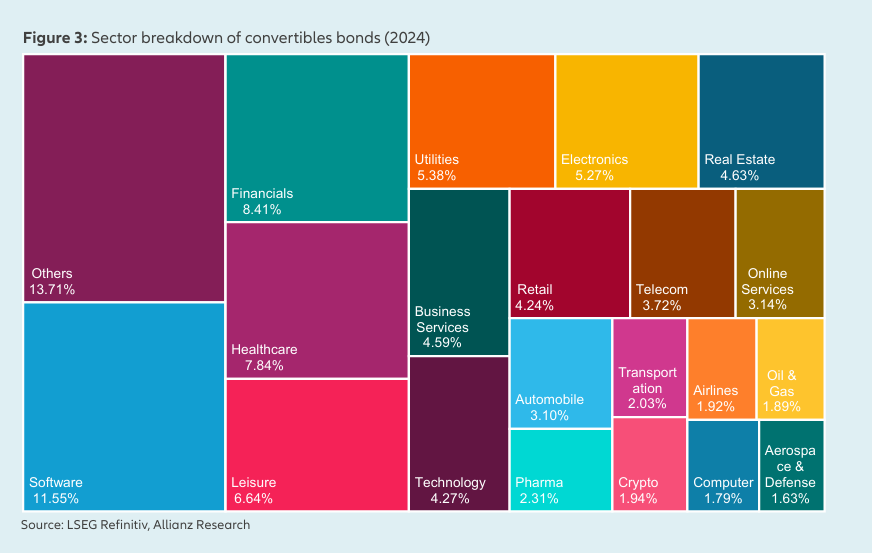
Therefore, a better approach is to diversify across multiple sectors, industries, and issuers. As this chart shows, there are convertible bonds in all equity sectors:
Sector Breakdown of Convertible Bonds
Source: Allianz Trade
Similarly, there is a regional mix in the issuance of convertible bonds.
Since international diversification is one of the best investment strategies for institutional investors in 2026, having a globally diversified convertible bond portfolio or fund might be a better strategy than concentrating in only one economy (usually the US).
There are still quality options in Greater China, Mainland China, Hong Kong, and Europe.
Stress testing
You should use stress testing and scenario analysis to understand how convertible bond portfolios may perform under adverse market conditions.
Scenarios you can model include sharp equity market declines, rising interest rates, credit spread widening, economic recessions, sector-specific shocks, and liquidity freezes.
By doing this, you can identify vulnerabilities within the portfolio and adjust positioning, hedging strategies, or risk exposure before major market disruptions occur.
And this is why Allianz Trade promote an active approach to convertible bonds:
“Active management is recommended to navigate the market's hybrid nature: Active managers can adjust their exposure, capitalise on new issuance discounts and navigate call provisions, while passive strategies may lack flexibility and miss opportunities.”
Opting for favourable conversion terms
You should also closely analyse the conversion features embedded in convertible bonds to ensure the terms provide attractive risk-reward potential.
Consider selecting convertible bonds with:
- Reasonable conversion premiums
- Attractive conversion prices
- Sufficient time to maturity
- Flexible conversion windows
- Strong upside participation potential
Favourable conversion terms improve the likelihood that you can benefit from future stock appreciation while still retaining downside protection from the bond component.
On the other hand, poorly structured conversion terms may limit upside participation or reduce the overall attractiveness of the investment.
As convertibles become more popular, institutional investors must continue to have discussions about their risks and benefits. This will allow them to sharpen their strategy to take advantage of the benefits while managing the risks.
At cio investment club, we provide a platform where such conversations can happen. We connect asset owners, asset managers, and other financial experts from across the globe to discuss new and renewed investment trends and chart a path towards better performance.
We also organise exclusive roundtables and investment breakfasts where experts can network physically and explore business partnerships while discussing timely topics like convertible bonds.
Do you want to join an investment club dedicated to the success of asset managers and owners? Register today to become a member of cio investment club.
Takeaways
- Convertible bonds are regaining popularity because they offer equity upside with lower volatility during uncertain macroeconomic conditions.
- In 2025, convertible bonds outperformed many equity and bond indices while delivering stronger risk-adjusted returns.
- Institutional investors are increasingly using convertibles for portfolio resilience, diversification, and adaptive positioning.
- Despite their advantages, convertible bonds still require disciplined risk management around credit quality, liquidity, and valuation complexity.
This document is produced by Instaconnect Limited, trading as cio investment club, a company registered in England & Wales with registration number 15262951.
Instaconnect Limited is neither authorised nor regulated by the Financial Conduct Authority in the United Kingdom nor the Securities and Exchange Commission in the United States of America.
This document is a marketing documentation and is not intended to constitute an invitation or an inducement to engage in any investment activity. It is not intended to constitute investment advice and should not be relied upon as such. It is not intended and none of Instaconnect Limited, its holding companies or any of its or their associates, or any of the participants in the documentation, shall have any liability whatsoever for (a) investment advice; (b) a recommendation to enter into any transaction or strategy; (c) advice that a transaction or strategy is suitable or appropriate; (d) the primary basis for any investment decision; (e) a representation, warranty, guarantee with respect to the legal, accounting, tax or other implications of any transaction or strategy; or (f) to cause Instaconnect Limited to be an advisor or fiduciary of any recipient of this report or other third party.
The content and graphical illustrations contained in this document are provided for information purposes and should not be relied upon to form any investment decisions or to predict future performance. Instaconnect Limited recommends that recipients seek appropriate professional advice before making any investment decision. Although the information expressed is provided in good faith, Instaconnect Limited does not represent, warrant or guarantee that such information is accurate, complete or appropriate for your purposes and none of them shall be responsible for or have any liability to you for losses or damages (whether consequential, incidental or otherwise) arising in any way for errors or omissions in, or the use of or reliance upon the information contained in this document.
To the greatest extent permitted by law, we exclude all conditions and warranties that might otherwise be implied by law with respect to the document, whether by operation of law, statute or otherwise, including as to their accuracy, completeness, or fitness for purpose.
Instaconnect Limited and its logo are proprietary trademarks of Instaconnect Limited and are registered in the United Kingdom. Unauthorised copying of this document is prohibited.
© Copyright Instaconnect Limited 2026