




For much of the past decade, global investors could be forgiven for believing that the best investment strategy was simple: keep allocating more capital to the United States.
US stocks consistently outperformed most international markets, the dollar remained dominant, and the world's largest technology companies generated extraordinary returns. But 2025 and 2026 have prompted many investors to question whether portfolios have become too concentrated in a single market.
We have seen a decline in foreign ownership of US Treasuries, a fall in the USD’s share of central bank reserves, and the growing use of other currencies in commodity markets, even as concerns about dedollarisation persist.
The same trend exists in the equities market. Concentration of US indices in a few mega tech stocks, overvaluation of the US equity market, incredible performance by the non-US equities market, and growing concerns about US macroeconomic uncertainty have made global diversification one of the best investment strategies for 2026.
European equities have especially been in the limelight, buoyed up by attractive valuations, expansionary fiscal policies, and the AI revolution.
In what follows, we take a deep dive into the current interest in European stocks and then provide a European stock market outlook to uncover what prospects the market offers. We’ll cover:
- Global diversification and concerns about US equities
- Why are investors interested in European equities?
- European stock market outlook: What does the future hold?
- Implementing global diversification: What should institutional investors do
Do you want to know more about investment opportunities in the global equity market? Subscribe now to the cio investment club’s newsletter.
1. Global diversification and concerns about US equities
Various concerns about the US economy and stock market have led to fresh calls for diversification away from the US.
Though many experts still hold on to US exceptionalism, these concerns question the logic of continued US overconcentration.
Some of these concerns include:
The concentration of US equity indices in a few mega-cap stocks
“US tech stocks' market dominance reaches new heights and presents new risks.” That was the headline of a recent report by Reuters about the concentration risk in the US equities market.
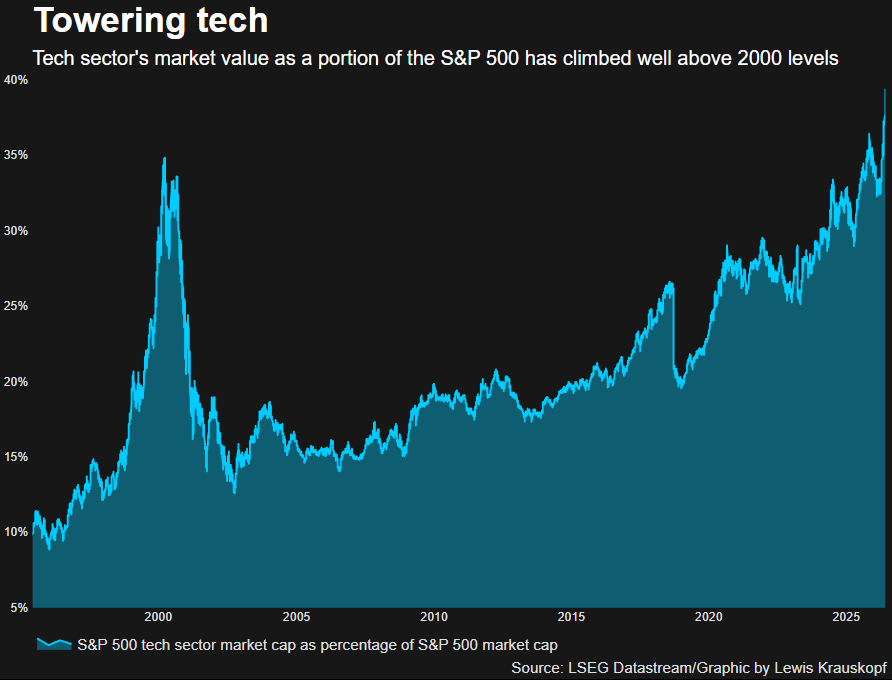
The S&P 500 technology sector accounted for 39% of the market capitalisation of the overall S&P 500 Index as of June 3, 2026, as seen below:
S&P 500 Technology Sector as a % of the S&P 500 Index
Source: Reuters
More important than the actual figure is the fact that this is the highest it has ever been, even eclipsing the internet bubble of the year 2000.
Such a situation creates fragility, according to Robeco, an asset management company. “If ‘US exceptionalism’ increasingly means ‘narrow exceptionalism,’ portfolios built around that concentration can be more vulnerable than they appear,” they said.
It’s even more interesting that the technology sector itself is further concentrated in a few companies.
For example, a look at the MSCI USA Index, which measures the performance of the large-cap and mid-cap segments of the US market, shows that the top 10 stocks (all in the technology sector) account for 38.35% of the index.
In other words, it is not just that the technology sector dominates; rather, the US stock market depends on a handful of technology stocks.
While some will say that there is no need for concern since these companies dominate the AI revolution, optimism around AI itself needs to be measured. “Investor optimism regarding AI and growth may already be priced into the current market,” according to Deepak Shukla, CEO of Pearl Lemon Capital, a business financing company.
Overvaluation of US equities compared to alternatives
Rapid earnings growth has led to rising valuations of many US stocks, raising concerns about overvaluation.
At the end of Q3, 2025, all 11 US sectors traded at a more expensive P/E ratio than counterparts in Europe, Australasia, and Far East (EAFE), according to Dan McKellar, CFA, a Senior Vice President at Bailard Inc., a wealth management firm.
He also noted that the dividend yields of the MSCI EAFE index (2.9%) exceeded those of the MSCI US Index (1.2%).
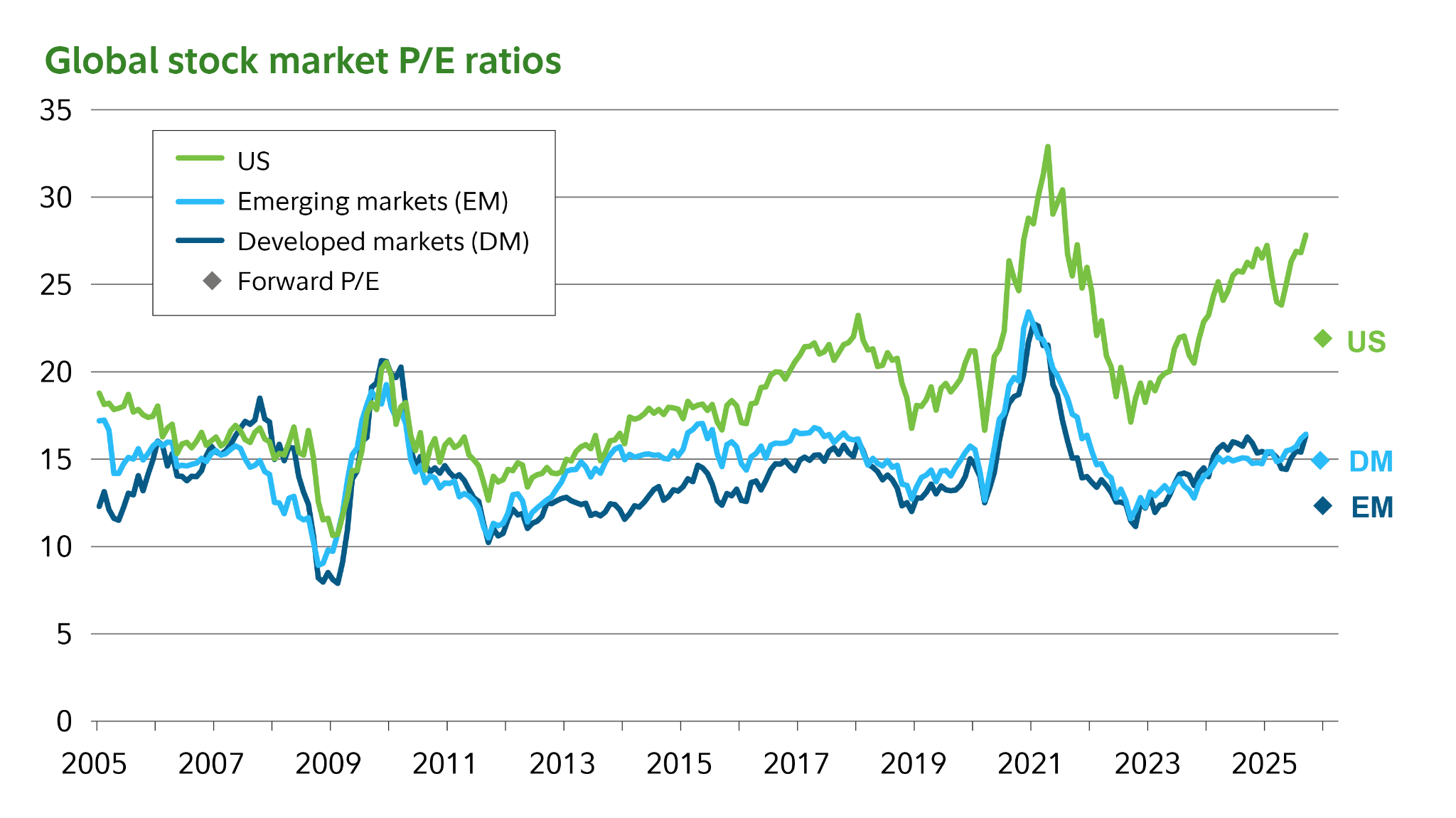
The chart below also shows that the valuation gap (as measured by the forward P/E ratio) between US and non-US stocks (whether developed or emerging) has been widening in recent years:
Valuation Gap Between US, Developed Markets, and Emerging Markets Indices
Source: Fidelity Investments
“For globally minded investors, this is more than a warning sign,” said McKellar. “It's an opening. Developed markets outside the U.S. offer lower valuations, more balanced sector leadership, and less reliance on a few dominant names.”
Concerns about the US economy
Many concerns about the US economy have either emerged or reemerged since the beginning of Trump’s administration.
For example, Trump’s tariffs led to uncertainty about the US trade policy and supply chain resilience.
“The biggest concern with US equities today is the severe supply chain uncertainty and volatile tariff deadlines that threaten to compress corporate profit margins,” according to Mike Erickson, the CEO of AFMS, a supply chain and logistics consulting company.
Beyond trade policy, questions about fiscal sustainability, geopolitical posture, macroeconomic policy uncertainty, and macroeconomic instability have become persistent, according to Robeco.
While they don’t believe these factors make the US structurally weak, they notice that it may warrant adjustments in US risk premiums.
Outperformance by non-US equities indices
The year 2025 was one of incredible performance by equity markets outside of the US.
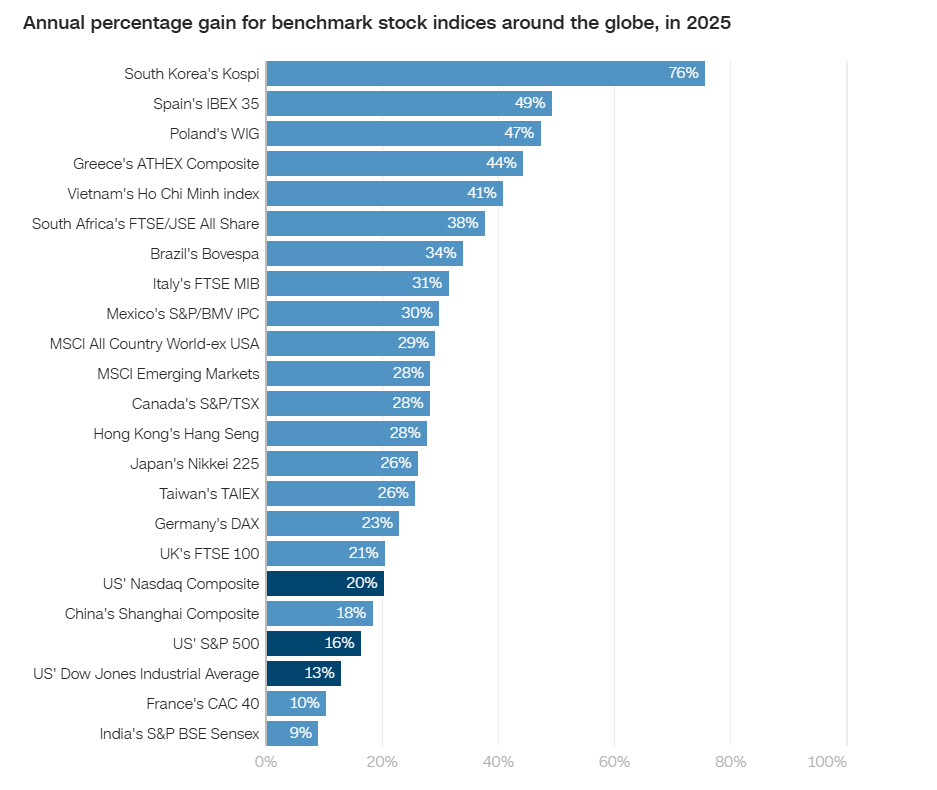
The Morningstar Global Markets ex-US Index, which measures the performance of non-US stocks across the globe, delivered 32% return in 2025, which is higher than the 18% return of the Morningstar US Market Index, according to data from Morningstar.
Also, the chart below shows that 19 stock indices across the globe outperformed the S&P 500 in 2025:
Annual Percentage Gain for Benchmark Stock Indices Around the Globe, in 2025
Source: CNN
2. Why are investors interested in European equities?
The global restructuring that picked up pace in 2025 has favoured European equities.
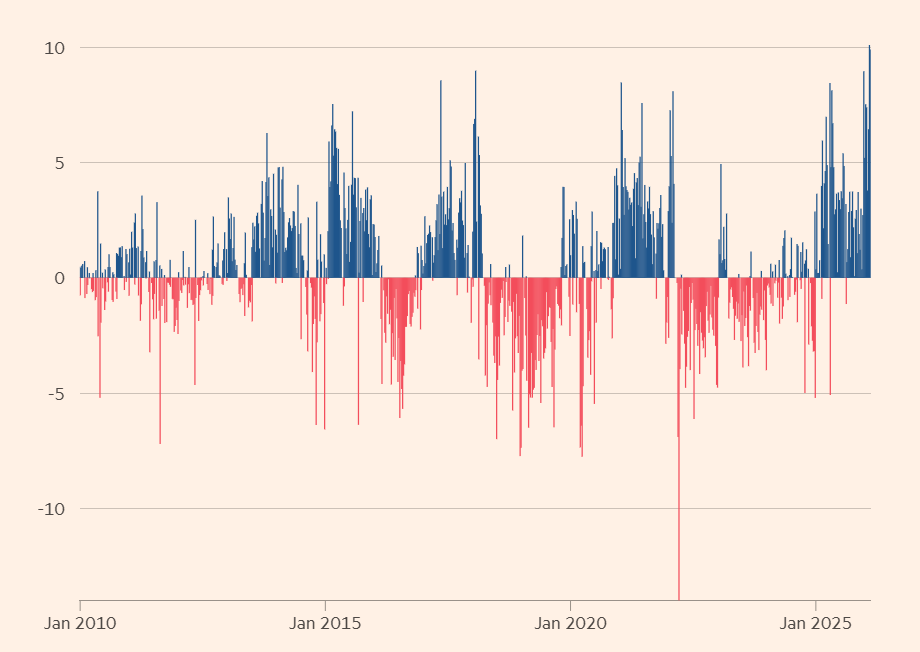
“Global investors are pouring record sums into European equities, as a desire to reduce exposure to the US meets growing optimism over the state of the region’s economy,” reported the Financial Times in February, 2026.
As the chart below shows, European equities recorded their largest weekly inflows in January:
Net weekly purchases of European Equities ($bn)
Source: Financial Times
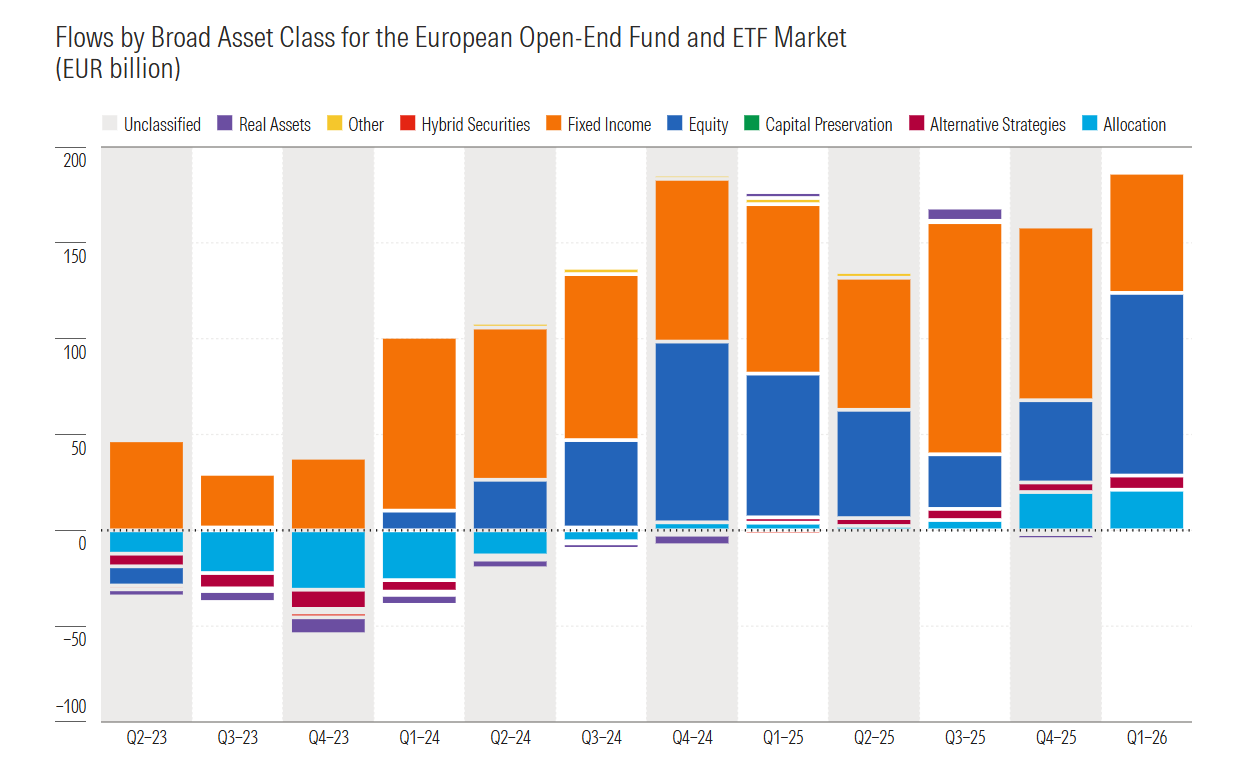
Similarly, funds flow into European equity funds (open-end) and ETFs more than doubled quarter-on-quarter, going from €42.9 billion in Q4, 2025, to €95.3 billion in Q1, 2026, according to Morningstar.
Flows by Broad Asset Class for the European Open-End Fund and ETF Market
Source: Morningstar
But why are global investors in search of diversified equity portfolios looking towards European stocks?
There are a few reasons:
- Cheaper valuation: The Financial Times referred to data from LESG that shows that the Stoxx Europe 600 trades at a P/E ratio of 18.3, which is far cheaper than that of the S&P 500 Index (27.7).
Data as of May 29, 2026, also shows that the MSCI Europe Index trades at a P/E ratio of 17.49 while the MSCI US Index trades at a P/E ratio of 28.27.
- Diversification away from AI: Also, concerns about the bursting of the AI bubble and overconcentration of tech stocks in stock indices have led many investors to look outside the tech sector.
“A rotation in stock market leadership away from the AI giants has boosted European markets with their heavy weighting to ‘old economy’ sectors such as banks and natural resources,” according to the Financial Times. “The booming demand for physical assets has propelled the UK’s FTSE 100 almost 7 per cent higher this year, with stocks such as Weir Group and Antofagasta up more than 20 per cent.”
- Favourable macroeconomic policies: Germany’s €500 billion infrastructure program and expansionary fiscal policies across Europe have also propelled European stocks via the industrials, utilities, and construction sectors.
“A more recent jump in German factory orders has buoyed markets as investors seize on signs that the historic defence spending spree announced last March is feeding through to industry, prompting Bank of America analysts to upgrade German equities to overweight,” reported the Financial Times.
They also point to a statement by Beata Manthey, head of European and global equity strategy at Citibank, that interest in European stocks has been driven by domestic stimulus delivery and rotation into non-tech sectors.
- Growing earnings: Earnings estimates of European companies have been increased by an average of 6-7% this year, according to Sharon Bell, European portfolio strategist at Goldman Sachs Research.
She noted that there have been strong earnings performances in the energy, utilities, industrials, defense, and financial sectors, which have buoyed stocks in these sectors.
- More diversification, less concentration: The European stock market is more diversified than its US counterpart. This is obvious in two ways, according to Bell.
First, while the ten largest (by market cap) companies in the US make up like 40% of the index, those in Europe make up only about 15% of the index.
Second, while few companies have driven the returns of US equities, there is more diversification in Europe, even if both markets are supported by similar themes (energy, tech, AI, industrials, utilities, etc.).
3. European stock market outlook: What does the future hold?
Many experts expect that the trends that have favoured European stocks should continue to drive them forward in the coming years.
In addition to increasing its earnings estimates for European companies, the team at Goldman Sachs Research upgraded its forecast for STOXX600 (a popular European index) to 660, over the next 12 months (as of June 5, 2026).
Also, Bell is confident that while the European market is diversified, it is also poised to benefit from the AI trade. Technology companies in European countries will benefit from exposure to AI, while the utilities companies will profit from higher energy demand. Similarly, demand for AI data centres will result in higher revenue for companies in the industrial sector.
Beyond AI, the recent focus on plugging the lack of infrastructure and defense spending in Europe (especially Germany) over the past few years will result in European companies winning a lot of business.
Interest in European stocks from Asia (especially Japan) also projects a favourable outlook for the stock market, according to Tomochika Kitaoka, chief equity strategist at Nomura, in an interview with the Financial Times.
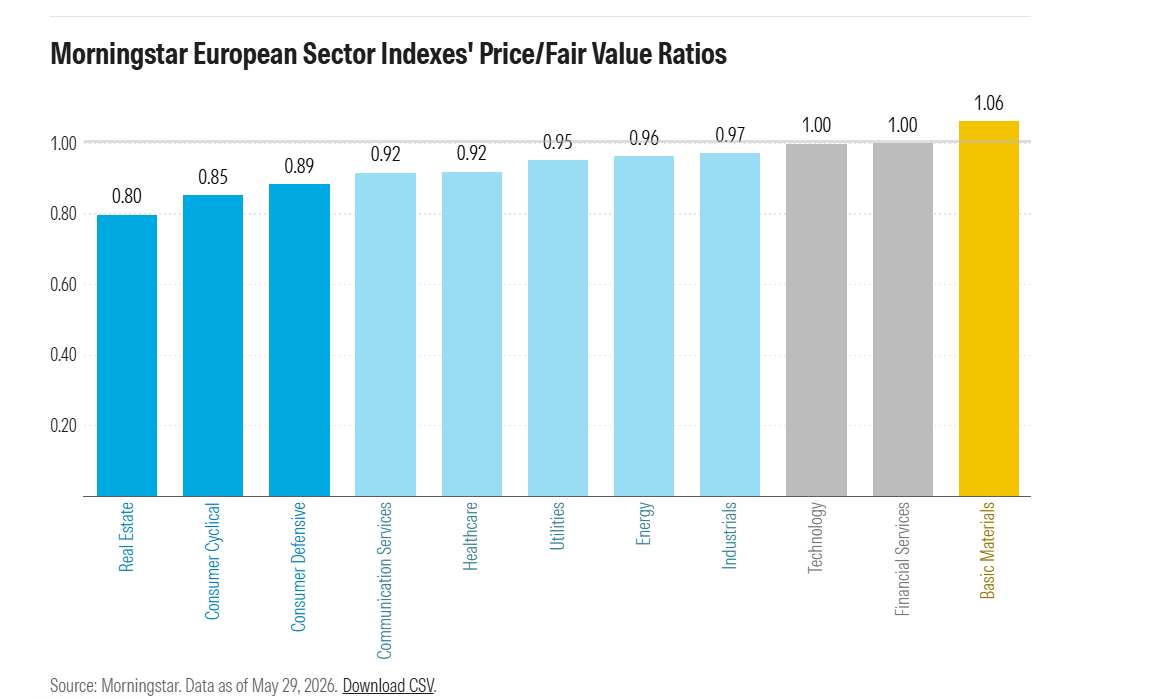
Also, a survey by Morningstar shows that 10 of the 11 European stock sectors are currently undervalued (as seen below), based on its proprietary price/fair value multiples.
Morningstar European Sector Indexes’ Price/Fair Value Ratios
Source: Morningstar
Since value is a huge reason for the interest in European stocks from US and Asian investors, we can expect funds to keep flowing into this market, ceteris paribus.
These trends should also be supported by broader macroeconomic ones, according to UBS, an investment management firm.
“Real incomes should rise as inflation moderates and high levels of household savings offer a potential boost to spending,” they noted. “Fiscal policy in Germany, in particular, should also translate into stronger growth in the country and the broader Eurozone this year and next. The European Central Bank's (ECB) judgment that monetary policy is ‘in a good place’ means clarity on interest rates, which can help some more rate-sensitive sectors.”
Such macroeconomic policy-induced growth should especially favour European small caps, according to DWS, an asset management company.
“If the new German government succeeds in addressing structural challenges and reigniting economic growth, the positive impact could be particularly strong for small and mid-sized companies – more so than for the large DAX-listed firms, which tend to operate globally,” they noted. “This is because small caps generate on average 30 per cent of their profits domestically, compared to only 20 per cent for Dax companies.”
Furthermore, the earnings growth that Bell mentioned should continue in the near future. UBS predicted the current trend in February, projecting a 7% earnings growth in 2026. Interestingly, they expected this to increase to 18% in 2027.
Also, just as Bell expects AI to bode well for companies in the information technology, energy, utilities, and industrials sectors, UBS expects the favourable fiscal policy environment to benefit banks (earnings re-acceleration, prospective loan growth, and healthier fee income), real estate companies (lower rates, higher property prices), and German equities as a whole.
4. Implementing global diversification: What should institutional investors do
Institutional investors with a global equity strategy still need to approach diversification away from the US and into European equities with careful consideration of all relevant information.
Below are some key points to consider:
- The US is still a global powerhouse: Warren Buffett once said that he cannot bet against the ingenuity of US companies.
This is an important point to note at this point. A diversification away from the US should not be seen as a complete abandonment of the US. Rather, it is an attempt to correct previous overconcentration in the US, given current realities about the global economy and equities market.
“The US can remain an important allocation while investors broaden exposures to a wider, attractively valued global opportunity set,” according to Robeco.
Also, investors need to embrace geographical diversification as a tactical tool to gain exposure to the main drivers of the global economy, rather than a fad they need to follow.
“Instead of just investing in different places, investors are investing in big ideas about the future of the economy, such as technological growth, renewable energy, or aging populations,” according to Tapos Kumar, the founder of Finance Ideas, a financial education website.
Thus, he suggests that investors should explore the growth expectations and technology leadership that make the US market attractive while also embracing the greater access to industrial exporters, healthcare leaders, infrastructure-related businesses, and globally diversified manufacturers that European markets offer.
- Earnings in Europe still fall short of the US: Not many investors believe that European stocks can deliver the profit growth that we find in S&P 500 companies, according to the Financial Times.
US earnings have grown faster than European earnings by 8% (annualised) between 2008 and 2025, according to J.P Morgan, a financial services firm.
Though they expect this gap to narrow between 2025 and 2027, they don’t forecast Europe overtaking the US.
This is another reason why an interest in European stocks should be combined with a solid base in US stocks.
- The US should outperform in the short term: While expecting European equities to post strong single-digit returns in the next 12 months, Bell still predicts that Asian and US stock markets should outperform over the same period.
“Our base case is that you get positive returns from Europe,” she said. “And we have upgraded our index forecast. But we would still have the U.S. and Asia outperforming. Why is that? So we would have the US outperforming because it's got big hyperscalers where we're expecting pretty good returns. And we're looking for an economy which actually is growing quite nicely in the next couple of years in the US.”
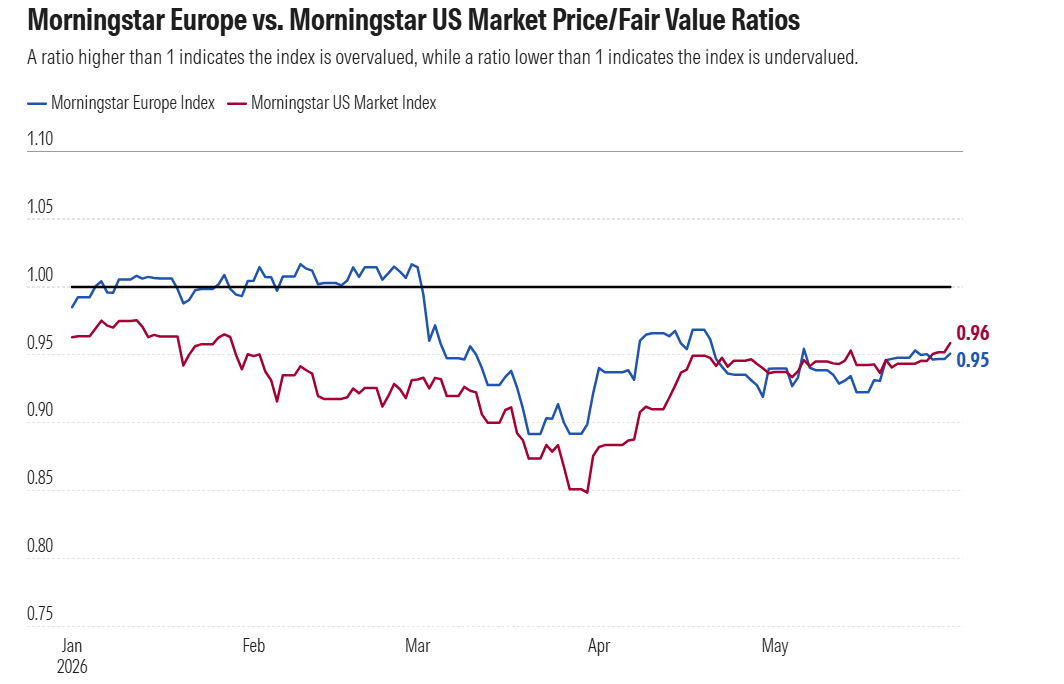
- US higher valuation may be justified: Though there is a wide valuation gap between the US and Europe when we consider the P/E ratios, it narrows when we compare fair values.
Take the Morningstar Price/Fair Value multiple as an example.
As the chart below shows, the gap between the P/FV ratios for both indices has narrowed over the past two months.
Morningstar Europe vs Morningstar US Market Price/Fair Value Ratios
Source: Morningstar
One implication of these four points, which we have referred to briefly before, is that European stocks should be seen as a channel to diversify a portfolio overly concentrated in the US rather than a replacement for a core US allocation.
“This shouldn’t be seen as an either/or scenario pitting the United States against Europe,” according to Shukla. “As far as many people are concerned, the essence of diversification lies in minimizing concentration risk, not replacing one asset base with another. A more prudent approach may be a gradual shift towards increasing European exposure amid existing investments in the US, rather than a drastic change to allocations driven by momentary market sentiment.”
A second point, which is related to the concerns raised about earnings growth and structural changes, is that institutional investors should consider whether they are better served investing in individual equities rather than indices.
“We don’t buy European equities, we don’t buy the Dax,” said Hani Redha, a multi-asset portfolio manager at PineBridge Investments, an investment management firm, in an interview with the Financial Times. “We have very targeted [ways] to get exposure to that theme.”
Such an approach can help institutions gain exposure to European companies operating in sectors with the strongest potential: information technology, energy, utilities, health care, financials, industrials, and real estate.
Alternatively, institutions can consider a combination of both strategies.
“For many institutional investors, broad European indices can provide efficient exposure while reducing single-company risk,” according to Shukla. “However, Europe's globally recognised leaders in luxury goods, healthcare, industrials, and consumer products are also worth consideration due to their international revenue streams and strong competitive positions. In general, I favour combining broad index exposure with select high-quality European businesses rather than relying entirely on individual stock selection.”
An active approach to European equities, whether pursued independently or in combination with an index investing strategy, requires that asset managers conduct a thorough analysis of the overall European economy and the particulars of selected companies that are favoured by structural and macroeconomic trends.
Asset managers with little experience in the European market can benefit from conversations with those who possess such experience.
At the cio investment club, we provide an avenue where such interactions can take place regularly. We bring together financial experts with diverse experiences and knowledge bases so that institutional investors can make better portfolio management decisions.
We also organise regular exclusive roundtables and investment breakfasts where asset managers and owners can network with like-minded professionals from across the globe.
Do you want to be part of an investment community that will help you create and execute a sound global equity strategy? Register today to be a part of the cio investment club.
Takeaways
- Global diversification is back in focus as investors seek to reduce overconcentration in US assets amid valuation, concentration, and macroeconomic concerns.
- European equities are attracting strong inflows thanks to cheaper valuations, fiscal stimulus, improving earnings, and broader market diversification.
- Europe offers exposure to AI and infrastructure themes without the extreme concentration seen in US mega-cap technology stocks.
- European stocks should complement, not replace, US allocations, as the US remains a global earnings and innovation leader despite current concerns.
This document is produced by Instaconnect Limited, trading as cio investment club, a company registered in England & Wales with registration number 15262951.
Instaconnect Limited is neither authorised nor regulated by the Financial Conduct Authority in the United Kingdom nor the Securities and Exchange Commission in the United States of America.
This document is a marketing documentation and is not intended to constitute an invitation or an inducement to engage in any investment activity. It is not intended to constitute investment advice and should not be relied upon as such. It is not intended and none of Instaconnect Limited, its holding companies or any of its or their associates, or any of the participants in the documentation, shall have any liability whatsoever for (a) investment advice; (b) a recommendation to enter into any transaction or strategy; (c) advice that a transaction or strategy is suitable or appropriate; (d) the primary basis for any investment decision; (e) a representation, warranty, guarantee with respect to the legal, accounting, tax or other implications of any transaction or strategy; or (f) to cause Instaconnect Limited to be an advisor or fiduciary of any recipient of this report or other third party.
The content and graphical illustrations contained in this document are provided for information purposes and should not be relied upon to form any investment decisions or to predict future performance. Instaconnect Limited recommends that recipients seek appropriate professional advice before making any investment decision. Although the information expressed is provided in good faith, Instaconnect Limited does not represent, warrant or guarantee that such information is accurate, complete or appropriate for your purposes and none of them shall be responsible for or have any liability to you for losses or damages (whether consequential, incidental or otherwise) arising in any way for errors or omissions in, or the use of or reliance upon the information contained in this document.
To the greatest extent permitted by law, we exclude all conditions and warranties that might otherwise be implied by law with respect to the document, whether by operation of law, statute or otherwise, including as to their accuracy, completeness, or fitness for purpose.
Instaconnect Limited and its logo are proprietary trademarks of Instaconnect Limited and are registered in the United Kingdom. Unauthorised copying of this document is prohibited.
© Copyright Instaconnect Limited 2026